
UNEMPLOYMENT IN INDIAN STATES
- Goa's unemployment rate stands at nearly 10%, surpassing the national average of 3.17% by more than threefold. It's notable that four of the top five states with high unemployment rates—Goa, Kerala, Haryana, and Punjab—are relatively affluent. In contrast, Maharashtra and Gujarat in western India, both prosperous states, report unemployment rates considerably below the national average.
- Across northern states like Jammu and Kashmir, Punjab, Haryana, Uttarakhand, and Himachal Pradesh, unemployment rates exceed the national average. Similarly, most southern states, except Karnataka, also have higher than average unemployment rates.
- Among the 27 states examined, 12 have unemployment rates lower than the national average. Notably, the low rates in significant states such as Maharashtra, Uttar Pradesh, and Madhya Pradesh contribute to this national average decline.
- However, it's puzzling that except for Maharashtra and Gujarat, states with below-average unemployment rates generally exhibit lower per capita incomes compared to the national average
- The data reveals a downward-sloping trend line, suggesting a negative correlation between the two factors: in states where a significant portion of the workforce is involved in self-employment, the unemployment rate tends to be lower.
- Given that much of self-employment in India is informal, states with a higher prevalence of informal work may find it easier to accommodate job seekers.
- However, it remains uncertain whether this relationship is causal. Does a lack of opportunities in self-employment lead to higher unemployment, or do individuals in states with high unemployment rates simply prefer not to pursue self-employment?
- A considerable portion of informal self-employment stems from agriculture and rural economies.
- Hence, a relevant measure is to analyze the proportion of the workforce engaged in urban sectors.
- A clear positive correlation emerges, indicating that unemployment rates rise in states with higher urbanization levels.
- This elucidates the elevated unemployment levels in highly urbanized states like Goa and Kerala, juxtaposed with lower rates in states such as Uttar Pradesh, Jharkhand, and Madhya Pradesh. Urbanized states typically possess smaller agrarian sectors, leading to fewer informal job opportunities compared to rural areas.
- Although informal sectors persist in urban settings, their capacity to absorb job seekers is relatively limited compared to rural agriculture, which often serves as a reserve by absorbing surplus labour
- However, there are exceptions to this pattern. Gujarat and Maharashtra, despite being highly urbanized—where the urban workforce comprises 37% in both states, significantly higher than in states like Uttar Pradesh (17%) and Madhya Pradesh (20%)—exhibit lower unemployment rates.
- Following the release of the ILO-IHD report, much discourse has revolved around the correlation between education levels and unemployment.
- A previous article in this publication dated December 26, 2023, titled 'Are graduates facing unemployment?', also delved into the prevalent issue of unemployment among graduates.
- For instance, Kerala boasts a highly educated workforce, with graduates constituting 30% of the labor force, yet it contends with high unemployment.
- Conversely, Gujarat and Maharashtra have a relatively smaller proportion of graduates in their workforce—approximately 14% and 20% respectively—and consequently experience lower unemployment rates despite their affluence and urbanization.
- Numerous factors may account for this phenomenon.
- It's plausible that graduates lack the necessary skills demanded by the burgeoning modern sector, underscoring the need to enhance educational infrastructure and standards.
- However, this doesn't fully elucidate why graduates have historically grappled with unemployment, even during the nascent stages of the modern sector.
- Another potential explanation lies in aspirational factors. Graduates aspire to secure high-paying jobs commensurate with their skills, rather than settling for informal employment.
- If the modern sector fails to expand adequately to absorb new graduates, it could precipitate unemployment.
- Nonetheless, these aren't the sole drivers of unemployment; state policies also wield significant influence. Nevertheless, this analysis underscores the interconnectedness between structural shifts and unemployment.
- As burgeoning economies evolve, there's a diminishing reliance on agriculture, accompanied by heightened urbanization and educational attainment.
- As India progresses, these factors are anticipated to exert upward pressure on the unemployment rate. Thus, it's imperative for policy initiatives to prioritize employment generation to counteract these trends
|
For Prelims: Labor Force Participation Rate (LFPR), Employment Rate (ER), Centre for Monitoring Indian Economy (CMIE), and Labour Force.
For Mains: 1. Discuss the significance of the Labor Force Participation Rate (LFPR) as a critical labor market indicator in the context of economic development and policy formulation. (250 words).
|
Previous year Question1. In India, which one of the following compiles information on industrial disputes, closures, retrenchments, and lay-offs in factories employing workers? (UPSC 2022)
A. Central Statistics Office
B. Department for Promotion of Industry and Internal Trade
C. Labour Bureau
D. National Technical Manpower Information System
Answer: C
2. Which of the following brings out the 'Consumer Price Index Number for Industrial Workers'? (UPSC 2015)
A. The Reserve Bank of India
B. The Department of Economic Affairs
C. The Labour Bureau
D. The Department of Personnel and Training
Answer: C
3. International Labour Organization's Conventions 138 and 182 are related to (UPSC 2018)
A. Child labour
B. Adaptation of agricultural practices to global climate change
C. Regulation of food prices and food
D. Security
Answer: A
4. Which of the following statements about the employment situation in India according to the periodic Labour Force Survey 2017-18 is/are correct? (UPSC CAPF 2020)
1. Construction sector gave employment to nearly one-tenth of the urban male workforce in India.
2. Nearly one-fourth of urban female workers in India were working in the manufacturing sector.
3. One-fourth of rural female workers in India were engaged in the agriculture sector.
Select the correct answer using the code given below:
A. 2 only
B. 1 and 2 only
C. 1 and 3 only
D. 1, 2 and 3
Answer: B
|
BIOSECURITY
- Biosecurity encompasses the policies, measures, and systems put in place to prevent the deliberate misuse of biological agents, toxins, or related technologies.
- It includes actions ranging from securing laboratories that work with high-risk pathogens to identifying, managing, and controlling deliberately caused disease outbreaks.
- The scope of biosecurity goes beyond safeguarding human health and also covers the protection of agriculture and animal populations.
- Biosecurity is closely related to, but distinct from, biosafety, which focuses on minimizing the risk of accidental release or exposure to harmful biological agents. Strong biosafety practices form a critical foundation for effective biosecurity.
- In response to historical efforts to develop biological weapons, the Biological Weapons Convention (BWC) was adopted in 1975.
- It marked the first global treaty to ban not only the use but also the production of biological weapons, while obligating member states to eliminate any existing reserves.
- India’s physical geography and ecological diversity expose it to biological risks originating beyond its borders. Given the country’s heavy reliance on agriculture and its large population base, the potential impact of such threats is particularly severe.
- Although India has not experienced any confirmed biosecurity attack, there have been reported cases involving the suspected preparation of ricin, a toxin extracted from castor beans, for possible terrorist use.
- This episode highlights the growing interest of non-state actors in exploiting biological agents and underscores the need for strong biosecurity mechanisms.
- Moreover, rapid advancements in biotechnology have expanded human capacity to manipulate biological systems, thereby increasing the risk of misuse by malicious actors, including in the development of biological weapons
- In India, institutional responsibilities for biosecurity are distributed across multiple agencies. The Department of Biotechnology is responsible for overseeing research governance and laboratory safety norms.
- The National Centre for Disease Control plays a key role in disease surveillance and outbreak management. Biosecurity related to livestock and cross-border animal diseases is handled by the Department of Animal Husbandry and Dairying, while the Plant Quarantine Organisation of India regulates agricultural trade to prevent the entry and spread of harmful pests and diseases.
- India’s legal and regulatory framework on biosafety and biosecurity includes the Environment (Protection) Act, 1986, which regulates hazardous microorganisms and genetically modified organisms, and the Weapons of Mass Destruction and their Delivery Systems (Prohibition of Unlawful Activities) Act, 2005, which outlaws biological weapons.
- Supporting this framework are the Biosafety Rules of 1989 and the 2017 guidelines on recombinant DNA research and biocontainment. In addition, the National Disaster Management Authority has issued comprehensive guidelines for handling biological emergencies.
- At the international level, India participates in key biosecurity-related arrangements, including the Biological Weapons Convention and the Australia Group.
- Despite the involvement of multiple institutions in managing biological risks, regulating laboratories, monitoring public health, and protecting agriculture, India is still in the process of developing a cohesive national biosecurity architecture.
- As reflected in its 66th position on the Global Health Security Index, while India has improved its capacity to detect biological threats, its preparedness to respond effectively to such risks has shown a decline.
The concept of biosecurity has evolved in response to advances in science, experiences of warfare, and emerging global health threats.
- Early Period (Pre-20th Century)
Concerns over biological harm were largely implicit, with limited regulation. Although the use of disease as a weapon was known historically, there were no formal international rules governing biological threats. - Inter-War Developments
The 1925 Geneva Protocol marked the first international effort to prohibit the use of biological and chemical weapons in warfare. However, it did not ban their development, production, or stockpiling, leaving significant regulatory gaps. - Cold War Era and the BWC (1970s)
Growing awareness of the catastrophic potential of biological weapons led to the adoption of the Biological Weapons Convention (1972, in force from 1975). It became the first multilateral treaty to comprehensively ban the development, production, acquisition, and stockpiling of biological weapons and mandate the destruction of existing arsenals. - Post-Cold War Focus on Compliance and Non-State Actors
With the rise of non-state actors and biotechnology diffusion, biosecurity norms expanded beyond state behaviour. Emphasis shifted to export controls, laboratory security, and prevention of misuse of dual-use research. Initiatives such as the Australia Group strengthened coordination on controlling sensitive biological materials. - Public Health and Biosecurity Integration (2000s)
Global disease outbreaks and bioterrorism concerns, especially after the 2001 anthrax attacks, linked biosecurity with public health preparedness. The International Health Regulations (2005) reinforced obligations for surveillance, early detection, and response to biological threats, whether natural or deliberate. - Contemporary Phase: Technology and Global Governance
Rapid advances in genetic engineering, synthetic biology, and artificial intelligence have reshaped biosecurity thinking. Current norms emphasize responsible research, ethical governance, global information sharing, and resilience against both natural pandemics and intentional biological misuse.
Institutional Framework
-
Department of Biotechnology (DBT):
Regulates biotechnology research and oversees biosafety standards, laboratory governance, and compliance with guidelines related to genetically engineered organisms and recombinant DNA research. -
National Centre for Disease Control (NCDC):
Responsible for disease surveillance, early warning systems, and coordination of responses to infectious disease outbreaks. -
Ministry of Health and Family Welfare (MoHFW):
Plays a central role in public health preparedness, epidemic management, and implementation of international health obligations. -
Department of Animal Husbandry and Dairying:
Monitors animal health, livestock biosecurity, and transboundary animal diseases that can threaten food security and public health. -
Plant Quarantine Organisation of India (PQOI):
Regulates the import and export of plants and agricultural products to prevent the introduction and spread of pests and plant diseases. -
National Disaster Management Authority (NDMA):
Issues guidelines and coordinates preparedness and response strategies for biological disasters, including pandemics and bioterror events.
An insufficient biosecurity system poses extremely serious risks, with the potential to endanger the lives of billions of people in India. This makes it imperative to establish a comprehensive national biosecurity framework that enables effective coordination among multiple government agencies. Such a framework would also help in systematically identifying gaps in infrastructure and institutional capacity that require urgent attention.
|
For Prelims: Biological Weapons Convention (BWC), Environment (Protection) Act, 1986, SCOMET List
For Mains: Strengths and weaknesses of the Biological Weapons Convention (BWC), India’s national biosecurity architecture, regulation of biotechnology.
|
|
Previous Year Questions
1.Consider the following pairs: (2020) International agreement/set-up Subject
Which of the pairs given above is/are correctly matched? (a) 1 and 2 only (b) 4 only (c) 1 and 3 only (d) 2, 3 and 4 only Answer (c) Mains 1.The scourge of terrorism is a grave challenge to national security. What solutions do you suggest to curb this growing menace? What are the major sources of terrorist funding? (2017) |
WORLD INEQUALITY REPORT (WIR)
- Severe Concentration of Wealth: Nearly 75% of the world’s wealth is held by the richest 10%, while the poorest 50% possess just about 2%. An ultra-elite group comprising roughly 60,000 individuals (the top 0.001%) owns wealth that is three times greater than that of half the global population combined. Their share of global wealth rose from around 4% in 1995 to more than 6% by 2025.
- Inequality in Human Capital Investment: Public and private spending on education shows stark disparities. Average expenditure per child in Sub-Saharan Africa is approximately €220 (PPP), compared with €7,430 in Europe and €9,020 in North America and Oceania—over forty times higher.
- Climate-Related Inequality: The richest 10% are responsible for about 77% of emissions linked to private capital ownership, whereas the bottom half contributes only 3%. Paradoxically, populations in low-income countries—who emit the least—face the greatest climate risks, while high emitters are better equipped with financial and technological means to adapt.
- Gender-Based Disparities: On average, women work around 53 hours per week compared to 43 hours for men when unpaid domestic and care work is included. In terms of earnings, women receive about 61% of men’s hourly wages when only paid work is considered; once unpaid labor is accounted for, their effective income drops to just 32%.
- Regional Income Gaps: Average daily income stands at roughly €125 in North America and Oceania, but only about €10 in Sub-Saharan Africa—reflecting a thirteen-fold difference. The income ratio between the top 10% and the bottom 50% further highlights deep inequalities within countries.
- Global Financial System Imbalances: Each year, poorer countries experience a net outflow of financial resources amounting to around 1% of global GDP—three times the volume of total development assistance—largely due to capital flows toward US and European government bonds
- Income Disparities: A significant share of national income—about 58%—is accrued by the top 10% of earners, whereas the bottom half of the population accounts for only around 15%.
- Concentration of Wealth: Nearly two-thirds of the country’s total wealth is owned by the richest 10%. Within this group, the top 1% alone controls roughly 40% of overall wealth.
- Low Female Workforce Participation: Women’s participation in the labor market stands at just 15.7%, placing it among the lowest rates globally.
- Overall Economic Well-being: The average per capita income is close to €6,200 annually (PPP-adjusted), while mean household wealth is estimated at about €28,000 (PPP)
The World Inequality Report (WIR) is a flagship global publication that provides a comprehensive assessment of income and wealth inequality across countries and regions over time.
Key points about the World Inequality Report (WIR):
-
Produced by: The World Inequality Lab, led by renowned economists such as Thomas Piketty, Lucas Chancel, Emmanuel Saez, and Gabriel Zucman.
-
Frequency: Published periodically (major editions in 2018, 2022, 2024, etc.).
-
Data Source: Based on the World Inequality Database (WID), which compiles tax records, national accounts, household surveys, and wealth data.
-
Coverage: Tracks inequality trends within countries and between countries, covering income, wealth, gender gaps, carbon inequality, and regional disparities.
.png)
-
Mahatma Gandhi National Rural Employment Guarantee Act (MGNREGA): Provides wage employment and income security to rural households.
-
Prime Minister’s Employment Generation Programme (PMEGP): Encourages self-employment and entrepreneurship, particularly among youth and marginalized groups.
-
Deendayal Antyodaya Yojana – National Urban Livelihoods Mission (DAY-NULM): Focuses on enhancing livelihoods and skill development for the urban poor.
-
Samagra Shiksha 2.0: Aims to strengthen access, equity, and quality across all levels of school education.
-
Pradhan Mantri Jan Dhan Yojana (PMJDY): Promotes financial inclusion by ensuring universal access to banking services.
-
Lakhpati Didi Initiative: Seeks to empower women economically by supporting sustainable income generation at the household level
|
For Prelims: MGNREGA, Pradhan Mantri Jan Dhan Yojana (PMJDY), World Inequality Report (WIR)
For Mains: General Studies-II: Welfare schemes for vulnerable sections of the population by the Centre and States and the performance of these schemes
|
|
Previous Year Questions
1.Inclusive growth as enunciated in the Eleventh Five Year Plan does not include one of the following: (UPSC CSE 2010) (a) Reduction of poverty (b) Extension of employment opportunities (c) Strengthening of capital market (d) Reduction of gender inequality Answer (c) Mains 1. COVID-19 pandemic accelerated class inequalities and poverty in India. Comment. (2020) |
SPECIAL INTENSIVE REVISION (SIR)
- The Special Intensive Revision (SIR) of the Electoral Rolls is an important exercise undertaken by the Election Commission of India (ECI) to ensure that the voter lists (electoral rolls) are accurate, updated, and inclusive before any major election or as part of the annual revision cycle.
- In simpler terms, the SIR is a comprehensive verification and correction process of the electoral rolls — aimed at including eligible voters, removing ineligible ones, and rectifying errors in the existing list.
- It is called “special” because it involves an intensified, house-to-house verification and greater public participation compared to the routine annual summary revision
- The purpose of the Special Intensive Revision is to maintain the purity, accuracy, and inclusiveness of India’s democratic process. Clean and updated voter rolls are essential for free, fair, and credible elections, as they prevent issues like bogus voting, disenfranchisement, and duplication.
- In summary, the Special Intensive Revision (SIR) is a focused, large-scale voter verification campaign conducted by the Election Commission to ensure that the electoral rolls are error-free, inclusive, and reflective of the current eligible voting population. It plays a crucial role in strengthening the integrity and transparency of India’s electoral system
|
During the Special Intensive Revision, Booth Level Officers (BLOs) visit households to verify voter details such as name, address, age, and photo identity. This exercise helps identify:
|
- Article 324(1) of the Indian Constitution empowers the Election Commission of India (ECI) with the authority to oversee, guide, and manage the preparation of electoral rolls as well as the conduct of elections for both Parliament and the State Legislatures.
- As per Section 21(3) of the Representation of the People Act, 1950, the ECI holds the right to order a special revision of the electoral roll for any constituency, or part of it, at any time and in a manner it considers appropriate.
- According to the Registration of Electors’ Rules, 1960, the revision of electoral rolls may be carried out intensively, summarily, or through a combination of both methods, as directed by the ECI.
- An intensive revision involves preparing an entirely new roll, while a summary revision deals with updating or modifying the existing one
| Aspect | Special Intensive Revision (SIR) | National Register of Citizens (NRC) |
| Purpose | To verify, update, and correct the electoral rolls so that all eligible voters are included and ineligible names are removed | To identify legal citizens of India and detect illegal immigrants |
| Authority / Governing Body | Conducted by the Election Commission of India (ECI) | Conducted under the Ministry of Home Affairs (MHA) |
| Legal Basis | Based on Article 324(1) of the Constitution, Section 21(3) of the Representation of the People Act, 1950, and the Registration of Electors' Rules, 1960. | Governed by the Citizenship Act, 1955 and the Citizenship (Registration of Citizens and Issue of National Identity Cards) Rules, 2003 |
| Scope | Focuses only on Indian citizens aged 18 years and above who are eligible to vote | Covers all residents of India (or a particular state) to determine their citizenship status |
| Nature of the Exercise | A regular, recurring administrative exercise carried out to maintain accurate voter lists | A special, large-scale verification exercise conducted under specific legal or political mandates. |
| Relation to Citizenship | Does not determine citizenship — only eligibility to vote | Directly determines citizenship status |
One of the major concerns is the erroneous deletion of eligible voters from the rolls.
-
Mistakes during house-to-house verification or data entry may lead to legitimate voters—especially migrants, daily-wage workers, and marginalized communities—being left out.
-
Such exclusions can directly affect voter participation and undermine the democratic process.
Despite the intensive verification, fake or duplicate names often remain due to poor coordination or outdated records.
-
Deaths, migrations, or multiple registrations in different constituencies are not always updated accurately.
-
This raises questions about the accuracy and credibility of the electoral rolls.
The SIR is a large-scale field operation requiring trained personnel, coordination among departments, and robust data systems.
-
Booth Level Officers (BLOs) are often overburdened with multiple duties and may not have sufficient time or training for thorough verification.
-
Limited digital infrastructure in rural areas can also hamper real-time data updates.
Electoral roll revisions, especially when conducted close to elections, can spark political allegations of bias or manipulation.
-
Parties may accuse each other or the Election Commission of targeting specific communities or constituencies.
-
Even unintentional errors can lead to trust deficits in the electoral process.
Addressing these concerns is vital to maintain trust in the Election Commission and uphold the credibility of India’s democratic system
|
For Prelims: Special Intensive Revision (SIR), National Register of Citizens (NRC), Election Commission of India (ECI)
For Mains: GS II - Indian Polity
|
Previous year Question1. Consider the following statements: (UPSC 2017)
1. The Election Commission of India is a five-member body.
2. Union Ministry of Home Affairs decides the election schedule for the conduct of both general elections and bye-elections.
3. Election Commission resolves the disputes relating to splits/mergers of recognized political parties.
Which of the statements given above is/are correct?
A. 1 and 2 only
B. 2 only
C. 2 and 3 only
D. 3 only
Answer: D
2. Consider the following statements : (UPSC 2021)
1. In India, there is no law restricting the candidates from contesting in one Lok Sabha election from three constituencies.
2. In the 1991 Lok Sabha Election, Shri Devi Lal contested from three Lok Sabha constituencies.
3. As per the- existing rules, if a candidate contests in one Lok Sabha election from many constituencies, his/her party should bear the cost of bye-elections to the constituencies vacated by him/her in the event of him/her winning in all the constituencies.
Which of the statements given above is/are correct?
A. 1 only
B. 2 only
C. 1 and 3
D. 2 and 3
Answer: B
Mains
1.To enhance the quality of democracy in India the Election Commission of India has proposed electoral reforms in 2016. What are the suggested reforms and how far are they significant to make democracy successful? (UPSC CSE 2017)
|
COLLEGIUM VS NJAC
1. Context
2. Collegium System
- The Collegium system is not rooted in the Constitution. Instead, it has evolved through judgments of the Supreme Court.
- Under the system, the Chief Justice of India along with four senior-most Supreme Court judges recommend appointments and transfers of judges.
- A High Court Collegium, meanwhile, is led by the incumbent Chief Justice and the two senior-most judges of that court.
- In this system, the government’s role is limited to getting an inquiry conducted by the Intelligence Bureau (IB) if a lawyer is to be elevated as a judge in a High Court or the Supreme Court.
- The government can also raise objections and seek clarifications regarding the Collegium’s choices, but, if the Collegium reiterates the same names, the government is bound, under Constitution Bench judgments, to appoint them to the post.
3. Evolution of Collegium System
- In the First Judges case, the court held that the consultation with the CJI should be "full and effective".
- The Second Judges Case introduced the collegium system in 1993, as they ordered the CJI to consult a collegium of his two senior judges in the apex court on judicial appointments, such a "collective opinion" of the collegium would have primacy over the government.
- The Third Judges case in 1998, expanded the judicial collegium to its present composition of the CJI and four of its senior-most judges.
4. Constitutional Provisions for Appointment of Judges
5. Procedure for replacement of Collegium System
- Replacing the Collegium system calls for a Constitutional Amendment Bill.
- It requires a majority of not less than two-thirds of MPs (Members of Parliament) present and voting in Lok Sabha as well as Rajya Sabha.
- It also needs the ratification of legislatures of not less than one-half of the states.
6. What are the concerns associated with the Collegium system?
- Constitutional Status: The Collegium is not prescribed in the Constitution. Article 124 mentions consultation, which the SC interpreted as ‘concurrence’ in Second Judges Case (1993). During the hearing against the NJAC, the then SC Bar President had argued that the Constituent Assembly had considered a proposal for making Judges’ appointment ‘in concurrence’ with the CJI but had eventually rejected it.
- Transparency: There is no official procedure for selection or any written manual for the functioning of the Collegium. The parameters considered for selection (or rejection) are not available in the public domain.
- Accountability: The selection of Judges by the Judges is considered undemocratic. Judges are not accountable to the people or any other organ of the State (Legislature or Executive). It can add an element of arbitrariness in functioning.
- Criticism by Judges: Many retired Judges have criticized the working of the Collegium, especially the lack of transparency. Several controversial appointments have been made despite objections by the member-Judges of the Collegium.
- No Checks: There are no checks on the process. Nor has there been any review regarding the effectiveness of the process. Critics of the system argue the phenomena of ‘Uncle Judges’ wherein near relatives, kith, and kin of sitting Judges are appointed to the higher judiciary leading to nepotism. Law Commission in its 230th Report (2012) recommended that that the Judges, whose kith and kin are practicing in a High Court, should not be appointed in the same High Court. The absence of transparency, accountability, and external checks creates space for subjectivity and individual bias in appointments. In some cases, the principle of seniority has been ignored.
- No Reforms: The Supreme Court did not amend the contentious provisions of the NJAC Act or added safeguards to the Act. Instead, it struck down the whole Act. The Supreme Court reverted to the old Collegium System. However, the Court did not take any steps to address the concerns associated with the Collegium System.
7. What is National Judicial Appointments Commission (NJAC)
- The Constitution (99th Amendment) Act, which established the NJAC and the NJAC Act, was passed by Parliament in 2014 to set up a commission for appointing judges,
replacing the Collegium system. - This would essentially increase the government’s role in the appointment of judges.
- The laws were repealed in October 2015 after the Supreme Court struck them down.
7.1 Composition of NJAC
- The Chief Justice of India as the ex officio Chairperson.
- Two senior-most Supreme Court Judges as ex officio members.
- The Union Minister of Law and Justice as ex officio members.
- Two eminent persons from civil society (one of whom would be nominated by a committee consisting of the CJI, Prime Minster, and the Leader of Opposition in the Lok Sabha, and the other would be nominated from the SC/ST/OBC/minority communities or women.
|
For Prelims: Collegium system, National Judicial Appointments Commission (NJAC), Supreme court, High court, Intelligence Bureau (IB), First Judges case, Second Judges Case, Third Judges Case, Article 124(2), Article 217, Law Commission, and 99th Constitutional Amendment Act.
For Mains: 1. What are the two systems of the appointment of Judges that has triggered the fresh debate on the Judicial system in India? (250 Words).
|
|
Previous year Question
1. With reference to the Indian judiciary, consider the following statements: (UPSC 2021)
1. Any retired judge of the Supreme Court of India can be called back to sit and act as a Supreme Court judge by the Chief Justice of India with the prior permission of the President of India.
2. A High Court in India has the power to review its own judgment as the Supreme Court does.
Which of the statements given above is/are correct?
A. 1 only
B. 2 only
C. Both 1 and 2
D. Neither 1 nor 2
Answer: A
2. In India, Judicial Review implies (UPSC 2017)
A. the power of the Judiciary to pronounce upon the constitutionality of laws and executive orders
B. the power of the Judiciary to question the wisdom of the laws enacted by the Legislatures
C. the power of the Judiciary to review all the legislative enactments before they are assented to by the President
D. the power of the Judiciary to review its own judgments given earlier in similar or different cases
Answer: A
3. Consider the following statements:
1. The motion to impeach a Judge of the Supreme Court of India cannot be rejected by the Speaker of the Lok Sabha as per the Judges (Inquiry) Act, 1968.
2. The Constitution of India defines and gives details of what constitutes 'incapacity and proved misbehavior' of the Judges of the Supreme Court of India
3. The details of the process of impeachment of the Judges of the Supreme Court of India are given in the Judges (Inquiry) Act, of 1968.
4. If the motion for the impeachment of a Judge is taken up for voting, the law requires the motion to be backed by each House of the Parliament and supported by a majority of the total membership of that House and by not less than two-thirds of total members of that House present and voting.
Which of the statements given above is/are correct?
A. 1 and 2
B. 3 only
C. 3 and 4 only
D. 1, 3 and 4
Answer: C
|
NUCLEAR ENERGY
Nuclear energy is a form of energy that is generated from the nucleus of an atom. It is released through two main processes: nuclear fission and nuclear fusion.
-
Nuclear Fission: Nuclear fission is the process by which the nucleus of a heavy atom, such as uranium-235 or plutonium-239, is split into two or more smaller nuclei, along with the release of a significant amount of energy. This process can be controlled and sustained in a nuclear reactor. In a nuclear power plant, the heat produced by nuclear fission is used to generate steam, which, in turn, drives turbines connected to generators. These generators produce electricity, which is then distributed for various purposes.
-
Nuclear Fusion: Nuclear fusion is the process of combining the nuclei of light atoms, such as isotopes of hydrogen (e.g., deuterium and tritium), to form a heavier nucleus, along with the release of energy. Fusion is the process that powers the sun and other stars. It has the potential to provide a nearly limitless and cleaner source of energy compared to fission. However, achieving controlled nuclear fusion on Earth has proven to be technologically challenging and has not yet been realized for widespread energy production.
Nuclear energy serves several important purposes and is considered valuable for various reasons, which include:
-
Low Greenhouse Gas Emissions: Nuclear power plants produce electricity with very low greenhouse gas emissions. This makes nuclear energy an attractive option for countries aiming to reduce their carbon footprint and combat climate change. It provides a source of electricity that is relatively clean and doesn't release significant amounts of carbon dioxide or other greenhouse gases into the atmosphere.
-
Reliable Baseload Power: Nuclear energy provides a consistent and reliable source of electricity, known as baseload power. Unlike some renewable energy sources, such as wind and solar, which are intermittent and weather-dependent, nuclear power can operate continuously and meet the minimum electricity demand, ensuring grid stability.
-
Energy Security: Nuclear energy can contribute to energy security by diversifying a nation's energy sources. This reduces the reliance on fossil fuels, which can be subject to price volatility and supply disruptions due to geopolitical conflicts.
-
High Energy Density: Nuclear fission, the process used in nuclear power plants, has a high energy density, meaning that a small amount of nuclear fuel can produce a large amount of energy. This is particularly important in scenarios where space and resource constraints are factors.
-
Long Fuel Supply: Uranium, the primary fuel used in nuclear reactors, is relatively abundant and can provide a stable and long-term source of energy. Additionally, there is ongoing research into advanced nuclear technologies, such as breeder reactors, which can extend the use of nuclear fuel resources.
- Reduced Air Pollution: In addition to lower greenhouse gas emissions, nuclear power plants do not produce the air pollutants associated with fossil fuel combustion, such as sulfur dioxide, nitrogen oxides, and particulate matter, which can have adverse health effects and contribute to air pollution.
- High Energy Independence: Nations with nuclear power capabilities can reduce their dependence on imported fossil fuels. This enhances energy independence and can have economic and geopolitical benefits.
Water reactors are a common type of nuclear reactor that use water as a coolant and/or moderator. There are several types of water reactors, including pressurized water reactors (PWRs) and boiling water reactors (BWRs). Here's an overview of these two main types:
-
Pressurized Water Reactors (PWRs):
- Pressurized Water Reactors (PWRs) are the most prevalent type of commercial nuclear reactors in the world.
- PWRs use ordinary water (light water) as both a coolant and a moderator. The water is kept at high pressure to prevent it from boiling.
- The reactor core contains fuel rods, typically enriched uranium, and control rods to regulate the nuclear reaction.
- The heat generated in the reactor core is transferred to a secondary loop of water (usually at lower pressure) through a heat exchanger. This secondary loop is used to produce steam to drive turbines and generate electricity.
- PWRs are known for their safety features, as the high pressure in the primary coolant loop helps prevent the release of radioactive materials.
-
Boiling Water Reactors (BWRs):
- Boiling Water Reactors (BWRs) also use water as a coolant and moderator, but they allow the water in the reactor core to boil.
- The fuel rods are located in the reactor core, and as the nuclear fission reactions occur, they generate heat, causing the water in direct contact with the fuel rods to boil and produce steam.
- The steam from the reactor core is directly used to drive turbines and generate electricity without the need for a separate heat exchanger.
- BWRs are simpler in design but have different safety features compared to PWRs.
| Pressurized Heavy Water Reactor (PHWR) | Light Water Reactor (LWR) | Prototype Fast Breeder Reactor (FBR) | |
| Coolant and Moderator | Uses heavy water (deuterium oxide, D2O) as both the coolant and moderator. Heavy water moderates the neutrons and helps sustain the nuclear chain reaction | Uses ordinary light water (H2O) as both the coolant and moderator. The light water absorbs some neutrons, which affects the reactivity of the reactor | Uses a liquid metal coolant (sodium or lead) and typically does not use a separate moderator. The fast neutrons produced in the reactor core drive the breeding of fissile material. |
| Fuel | Typically uses natural uranium or slightly enriched uranium as fuel. It relies on heavy water to sustain the chain reaction | Uses enriched uranium (typically U-235) or mixed oxide (MOX) fuel, which contains both uranium and plutonium. Light water reactors require enriched fuel to compensate for neutron absorption by the coolant | Uses plutonium or enriched uranium as fuel. The reactor is designed to create more fissile material (usually plutonium-239) than it consumes |
| Neutron Spectrum | Has a thermal neutron spectrum, where neutrons have lower energy and are moderated by heavy water | Also has a thermal neutron spectrum, where neutrons are moderated by light water | Operates with a fast neutron spectrum, meaning that neutrons have higher energy and are not significantly moderated. This allows for efficient breeding of fissile material |
| Efficiency | Relatively low thermal efficiency due to the neutron-absorbing properties of heavy water | Moderate thermal efficiency. Most commercial nuclear power plants worldwide are LWRs | High potential for efficiency as it can produce more fissile material than it consumes, making it a potential source of sustainable nuclear fuel. |
| Development and Use | Used in some countries like Canada and India for power generation | The most common reactor type for commercial power generation worldwide | Developed as a prototype for future breeder reactor technology. Few operational FBRs exist |
The following are nuclear power plants in India:
-
Tarapur Atomic Power Station (TAPS):
- Located in Tarapur, Maharashtra.
- Features two boiling water reactors (BWRs) and two pressurized heavy water reactors (PHWRs).
-
Kakrapar Atomic Power Station (KAPS):
- Located in Kakrapar, Gujarat.
- Consists of two pressurized heavy water reactors (PHWRs).
-
Rajasthan Atomic Power Station (RAPS):
- Located in Rawatbhata, Rajasthan.
- Comprises several units, including both pressurized heavy water reactors (PHWRs) and pressurized heavy water reactors with enriched uranium (PHWRs-PU).
-
Madras Atomic Power Station (MAPS):
- Located in Kalpakkam, Tamil Nadu.
- Features two pressurized heavy water reactors (PHWRs) and a Prototype Fast Breeder Reactor (PFBR).
-
Narora Atomic Power Station (NAPS):
- Located in Narora, Uttar Pradesh.
- Houses two pressurized heavy water reactors (PHWRs).
-
Kaiga Generating Station (KGS):
- Located in Kaiga, Karnataka.
- Operates with pressurized heavy water reactors (PHWRs).
-
Kudankulam Nuclear Power Plant:
- Located in Kudankulam, Tamil Nadu.
- Currently, it has two VVER-1000 pressurized water reactors (PWRs) in operation, and additional units were under construction.
-
Gorakhpur Haryana Anu Vidyut Pariyojana (GHAVP):
- Located in Fatehabad, Haryana.
- Houses two pressurized heavy water reactors (PHWRs).
|
For Prelims: Current events of national and international importance and General Science
For Mains: General Studies III: Science and Technology- developments and their applications and effects in everyday life
|
GLOBAL POSITIONING SYSTEM (GPS)
- The Global Positioning System (GPS) is a network of satellites that orbit the Earth and provide precise location and time information to GPS receivers anywhere on or near the Earth. Originally developed by the United States Department of Defense for military applications, GPS has become widely used in various civilian applications like navigation, mapping, surveying, and outdoor activities.
- GPS works by triangulating signals from multiple satellites to determine the receiver's exact location, typically using signals from at least four satellites to pinpoint a specific position. Each satellite broadcasts signals containing its own location and the precise time the signal was transmitted.
- By measuring the time it takes for the signals to reach the receiver, the GPS device can calculate how far away each satellite is and use this information to determine its own location through a process called trilateration.
- Apart from navigation in vehicles and smartphones, GPS technology has found applications in agriculture, aviation, disaster management, tracking systems, and more due to its accuracy and reliability in determining precise geographic coordinates
3. History of GPS
The history of GPS dates back to the 1960s when the United States began developing the technology for military purposes. Here's a brief timeline of the significant milestones in GPS development:
1960s: The U.S. Department of Defense starts experimenting with satellite-based navigation systems. The system was initially called NAVSTAR (Navigation System with Timing and Ranging).
1973: Physicist and engineer Ivan Getting proposed the concept of a global positioning system using satellites in geostationary orbits. This idea later evolved into the GPS we know today.
1978: The first experimental Block-I GPS satellite was launched, initiating the development of the operational system.
1983: Korean Air Lines Flight 007, a passenger jet, was shot down after straying into Soviet airspace due to navigational errors. This incident accelerated the development and deployment of GPS for civilian use to prevent similar tragedies.
1993: GPS achieved full operational capability with a complete constellation of 24 satellites in orbit.
Late 1990s: Selective Availability (SA), intentional degradation of GPS signals for civilian users, was turned off, significantly improving the accuracy of civilian GPS receivers.
2000s: With advancements in technology, the use of GPS became widespread in various civilian applications, including navigation devices, smartphones, agriculture, surveying, and more.
Modern Developments: Over time, the system has seen upgrades, including the launch of new satellites (modernized Block IIR, IIR-M, IIF, and GPS III satellites), improved accuracy, and the integration of other satellite systems like GLONASS (Russia), Galileo (Europe), and BeiDou (China) for enhanced global coverage and accuracy.
GPS has evolved from a purely military technology into an integral part of everyday life, powering various industries and navigation systems worldwide. Its accuracy and reliability continue to improve with ongoing technological advancements
4. How does the Global Positioning System Work?
The Global Positioning System (GPS) works through a network of satellites orbiting the Earth. Here's a simplified breakdown of how GPS functions:
Satellite Constellation: The GPS system consists of at least 24 satellites orbiting the Earth. These satellites are placed in such a way that at any given time and place on Earth, there are usually multiple satellites visible in the sky.
Triangulation: A GPS receiver on the ground or in a device, such as a smartphone or a GPS unit, communicates with these satellites by receiving signals from them. To determine its location, the receiver needs signals from at least four satellites. This is because each satellite sends out signals containing information about its location and the exact time the signal was transmitted.
Calculating Distance: The GPS receiver calculates its distance from each satellite by measuring the time it takes for the signals to travel from the satellites to the receiver. Since the speed of the signal is known (the speed of light), the receiver can calculate how far away each satellite is based on the time it took for the signal to arrive.
Trilateration: Once the receiver has gathered distance measurements from at least four satellites, it uses a process called trilateration. Trilateration involves intersecting spheres (or in this case, spheres in three dimensions) to determine the precise location where the spheres intersect. In GPS, these spheres are representations of the distances from each satellite. By finding the intersection point of these spheres, the receiver can calculate its exact position on Earth in terms of latitude, longitude, and altitude.
Data Processing: Once the receiver has calculated its position based on signals from multiple satellites, it uses this information along with maps or other geographical data to display the location or provide navigational instructions to the user.
The accuracy of GPS depends on various factors like the number of satellites visible, the quality of the receiver, atmospheric conditions, and any obstructions (such as tall buildings or mountains) that might interfere with signal reception. However, modern GPS receivers can typically provide very accurate location information, often within a few meters
Satellites, especially those involved in navigation systems like GPS, rely on incredibly precise timekeeping. They achieve this accuracy through a combination of factors:
Atomic clocks: Each satellite carries multiple atomic clocks, considered the most accurate timekeeping devices ever created. These clocks tick based on the natural vibrations of atoms, resulting in minimal drift over time. Compared to regular quartz clocks, atomic clocks are millions of times more precise, losing only a few nanoseconds per day.
Ground control and synchronization: Despite their exceptional accuracy, even atomic clocks experience slight variations. Ground stations continuously monitor the satellite clocks, detecting any deviations from International Atomic Time (TAI), the global standard. Based on these measurements, the ground stations send correction signals to the satellites, keeping their clocks precisely aligned.
Relativity factor: Time itself runs slightly differently depending on factors like gravity and velocity. Satellites orbiting Earth experience weaker gravity and travel faster than stationary objects on the ground. This tiny difference, though minuscule, is accounted for in calculations to ensure accurate timekeeping. Regular adjustments are made to compensate for this relativistic effect.
Redundancy and backup systems: To ensure uninterrupted timekeeping, satellites have multiple atomic clocks. If one clock malfunctions, the others take over, minimizing disruptions. Additionally, regular maintenance and updates are performed on both ground stations and satellites to maintain optimal performance.
Through this intricate interplay of cutting-edge technology, meticulous monitoring, and clever calculations, satellites hold onto time with mind-boggling precision. This unwavering accuracy is vital not only for GPS navigation but also for scientific research, telecommunications, and financial transactions that rely on split-second timing
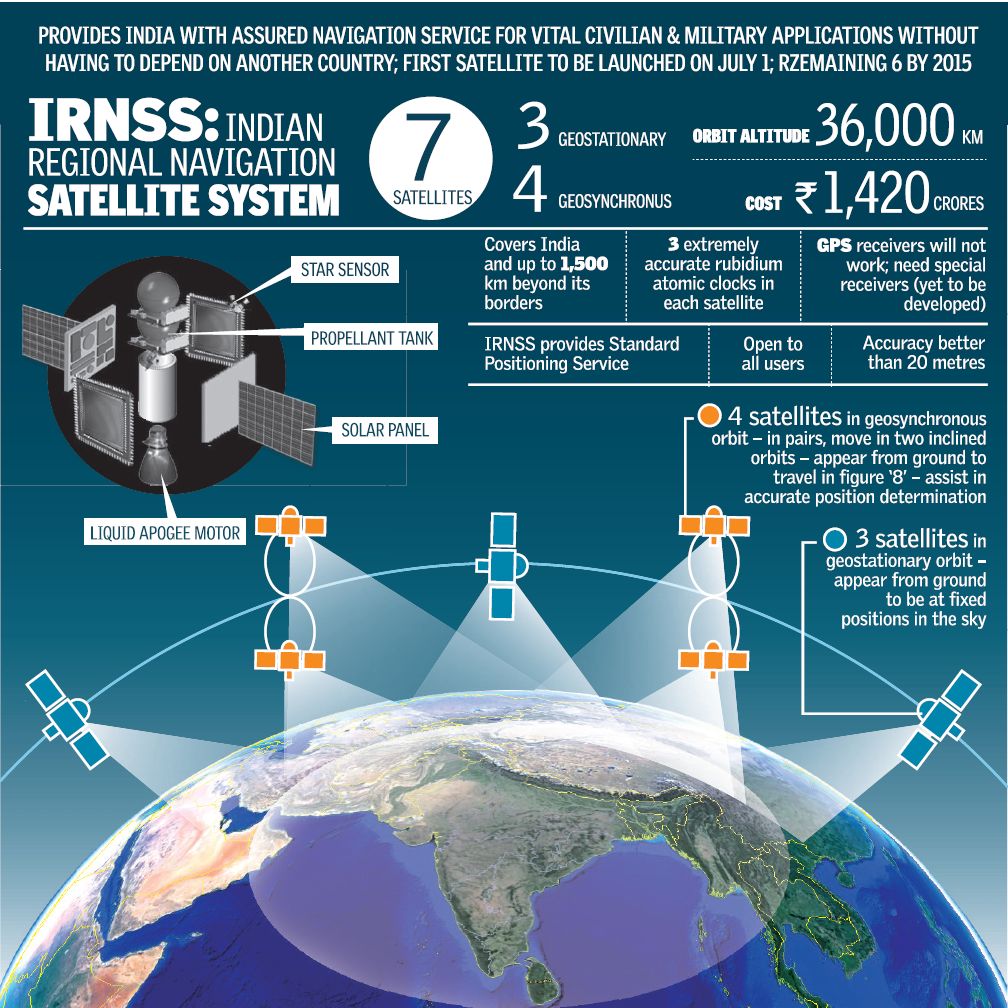
6. India's NaVIC?
- NavIC, or Navigation with Indian Constellation, is an independent stand-alone navigation satellite system developed by the Indian Space Research Organisation (ISRO).
- NavIC was originally approved in 2006 at a cost of $174 million. It was expected to be completed by late 2011 but only became operational in 2018.
- NavIC consists of eight satellites and covers the whole of India’s landmass and up to 1,500 km (930 miles) from its boundaries.
- Currently, NavIC’s use is limited. It is being used in public vehicle tracking in India, for providing emergency warning alerts to fishermen venturing into the deep sea where there is no terrestrial network connectivity, and for tracking and providing information related to natural disasters.
- Enabling it in smartphones is the next step India is pushing for
7. Others Countries Satellites
Several countries operate or have operated satellite navigation systems similar to GPS. Some of these systems include:
-
GLONASS (Global Navigation Satellite System): Developed by Russia, GLONASS is a satellite navigation system that provides global coverage. It's similar to GPS and operates with a constellation of satellites. GLONASS is widely used in Russia and by other countries for various applications.
-
Galileo: Developed by the European Union and the European Space Agency, Galileo is another global satellite navigation system. It aims to provide highly accurate positioning and timing information. Galileo is intended to be interoperable with GPS and other systems to enhance overall navigation capabilities.
-
BeiDou Navigation Satellite System (BDS): Developed by China, BeiDou is another satellite navigation system that aims to provide global coverage. It has been operational in China and surrounding regions and has expanded its coverage to become a global system.
-
NavIC (Navigation with Indian Constellation): Developed by India, NavIC is a regional satellite navigation system designed to provide accurate positioning in India and surrounding regions.
These satellite navigation systems function similarly to GPS, employing constellations of satellites and ground control stations to provide precise positioning, navigation, and timing information to users on Earth. Many modern receivers can utilize signals from multiple satellite systems simultaneously, improving accuracy, availability, and reliability for navigation purposes
7. Way forward
GPS has evolved from a purely military technology into an integral part of everyday life, powering various industries and navigation systems worldwide. Its accuracy and reliability continue to improve with ongoing technological advancements
|
Previous Year Questions 1.In which of the following areas can GPS technology be used? (UPSC CSE 2018) 1. Mobile phone operations 2. Banking operations 3. Controlling the power grids Select the correct answer using the code given below: A.1 only B.2 and 3 only C.1 and 3 only D.1, 2 and 3 Answer (D) 2.With reference to the Indian Regional Navigation Satellite System (IRNSS), consider the following statements: (UPSC CSE 2018) 1. IRNSS has three satellites in geostationary and four satellites in geosynchronous orbits. 2. IRNSS covers entire India and about 5500 sq. km beyond its borders. 3. India will have its own satellite navigation system with full global coverage by the middle of 2019. Which of the statements given above is/are correct? A. 1 Only B.1 and 2 only C.2 and 3 only D. None Answer (A)
1.Why is Indian Regional Navigational Satellite System (IRNSS) needed? How does it help in navigation? (2018) |
Source: The Hindu


