
ANTIMICROBIAL RESISTANCE
1. Context
In 2020, 58-year-old Viswanathan, recovering from a stroke, sought physiotherapy from an Ayurvedic practitioner, hoping to regain mobility. However, this treatment caused wounds on his leg. As a diabetic with an already weakened immune system this marked the beginning of his battle with antimicrobial resistance (AMR)
2. What is Anti Microbial Resistance?
Antimicrobial Resistance (AMR) occurs when bacteria, viruses, fungi, and parasites change over time and no longer respond to medicine making infections harder to treat and increasing the risk of disease spread severe illness, and death.

3. Emergence and spread of AMR
- AMR occurs naturally over time, usually through genetic changes.
- Antimicrobial-resistant organisms are found in people, animals, food, plants, and the environment (in water, soil, and air).
- They can spread from person to person or between people and animals, including from food of animal origin.
- The main drivers of antimicrobial resistance include the misuse and overuse of antimicrobials, lack of access to clean water, sanitation, and hygiene (WASH) for both humans and animals, and poor infection and disease prevention and control in healthcare facilities and farms. Poor access to quality, affordable medicines, vaccines, and diagnostics, lack of awareness and knowledge, and lack of enforcement of legislation.
4. Factors causing AMR in India
- The high disease burden
- The rising income
- The easy and cheap availability of these medicines to the public.
- The uncontrolled sales of antibiotics
- Poor Public health infrastructure
- Lack of awareness regarding the misuse of antibiotics.
6. Government Initiatives that help to curb Antimicrobial Resistance In India
- Through the Swacch Bharat Program, the government has taken active steps to improve hygiene and sanitation and reduce the environmental spread of pathogens.
- Vaccination is an equally important public health measure, and through Mission Indradhaniush, India has set itself an ambitious goal of increasing routine immunization coverage to 90% within just a few years.
6.1 Red Line Campaign
7. WHO's Global plan on Anti-Microbial Resistance?
- To improve awareness and understanding of antimicrobial resistance through effective communication, education, and training.
- To Strengthen the knowledge and evidence base through surveillance and research.
- To reduce the incidence of infection through effective sanitation, hygiene, and infection prevention measures.
- To Optimize the use of antimicrobial medicines in human and animal health.
- To develop the economic case for sustainable investment that takes account of the needs of all countries and to increase investment in new medicines, diagnostic tools, vaccines, and other interventions.
8. Global efforts
|
For Prelims: Food and Agriculture Organization (FAO), UN Environment Programme, the World Health Organization (WHO), World Organisation for Animal Health, Mission Indradhaniush, Red Line Campaign.
For Mains: 1.Antimicrobial resistance (AMR) is considered one of the most significant challenges the world faces today. Discuss.
|
|
Previous Year Questions
1.Which of the following are the reasons for the occurrence of multi-drug resistance in microbial pathogens in India? ( UPSC CSE 2019)
Select the correct answer using the code given below. (a) 1 and 2 Answer: (b) |
INDIAN STATE FOREST REPORT (ISFR)
- The Indian State of Forest Report (ISFR) is a biennial publication by the Forest Survey of India (FSI) under the Ministry of Environment, Forest, and Climate Change (MoEFCC).
- It provides a comprehensive assessment of the forest and tree cover in India, serving as an essential tool for policymakers, environmentalists, and researchers
- Forests are crucial in mitigating climate change by sequestering carbon, supporting biodiversity, and ensuring access to clean air and water.
- Despite mounting environmental challenges, these ecosystems remain vital. In India, encouraging progress has been observed.
- According to the India State of Forest Report (ISFR) 2023, the country's combined Forest and Tree cover extends across 827,357 square kilometers, accounting for 25.17% of the total land area.
- This comprises 715,343 square kilometers (21.76%) of forest cover and 112,014 square kilometers (3.41%) of tree cover. These figures highlight India’s effective efforts to harmonize development with environmental preservation
- The India State of Forest Report (ISFR) 2023, released by the Forest Survey of India (FSI), provides a biennial evaluation of the nation's forest resources through satellite imagery and field surveys.
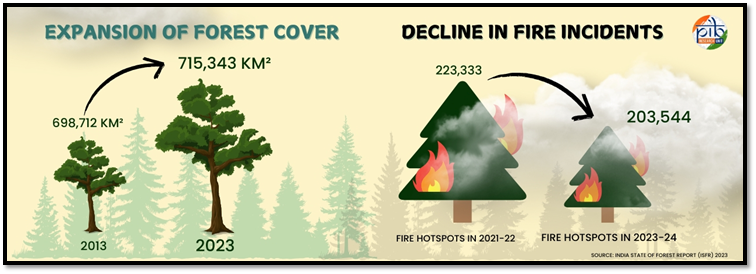
- Since its inception in 1987, this is the 18th edition of the report. The ISFR 2023 reveals notable growth in India’s forest cover, which has expanded from 698,712 km² in 2013 to 715,343 km² in 2023.
- Additionally, fire incidents have shown a decline, with 203,544 fire hotspots reported in 2023-24 compared to 223,333 in 2021-22. Aligning with India's Nationally Determined Contributions (NDCs), the nation has achieved a carbon sink of 30.43 billion tonnes of CO2 equivalent, adding 2.29 billion tonnes since 2005.
- This progress brings India closer to its goal of an additional 2.5–3.0 billion tonnes of CO2 equivalent by 2030. These advancements underscore India's commitment to sustainable environmental conservation
The Forest Survey of India (FSI) has played a crucial role in enhancing forest monitoring through initiatives such as improved forest cover mapping, the establishment of an upgraded Forest Fire Alert System, and the successful completion of the National Forest Inventory's first five-year cycle, which has yielded vital data on forest growth and carbon stocks. Additionally, digitizing forest boundaries in 25 States and Union Territories has significantly enhanced the accuracy of forest cover assessments. These advancements, along with efforts by the Ministry of Environment, Forest and Climate Change to expand forest and tree cover and conserve mangroves and wetlands, have greatly bolstered forest development.
Key schemes supporting these initiatives include:
- National Mission for a Green India (GIM): Launched in 2014, this mission focuses on protecting, restoring, and expanding forest cover through Joint Forest Management Committees (JFMCs). Rs. 944.48 crore has been allocated to 17 States and one Union Territory for plantation and eco-restoration projects.
- Nagar Van Yojana (NVY): Introduced in 2020, this program promotes green spaces in urban and peri-urban areas, with 546 projects approved across 31 States/UTs and a budget allocation of Rs. 431.77 crore.
- School Nursery Yojana (SNY): This initiative raises awareness about tree planting in schools. With Rs. 4.80 crore allocated, 743 projects have been sanctioned in 19 States/UTs.
- Mangrove Initiative for Shoreline Habitats & Tangible Incomes (MISHTI): Running from 2023 to 2028, this program aims to restore mangroves along India’s coastline, with Rs. 17.96 crore allocated to states like Andhra Pradesh, Gujarat, Kerala, Odisha, West Bengal, and Puducherry.
- National Coastal Mission: This program includes funding under the "Conservation and Management of Mangroves and Coral Reefs" component to safeguard coastal ecosystems in 9 coastal states and one Union Territory.
- National Plan for Conservation of Aquatic Ecosystems (NPCA): A collaborative initiative between the Central and State Governments for wetland conservation and management.
- Ek Ped Maa Ke Naam: Launched by the Prime Minister in June 2024, this campaign encourages tree planting in honor of mothers, fostering a cultural connection to nature.
- Compensatory Afforestation Fund Management and Planning Authority (CAMPA): This scheme mitigates forest cover loss caused by land diversion for non-forestry purposes under the Forest Conservation Act, 1980.
- Afforestation Targets under the Twenty-Point Programme: Annual afforestation targets are set using resources from Central and State Government schemes, NGOs, private organizations, and civil society.
- Awareness Campaigns and Plantation Drives: Events like Van Mahotsav, World Environment Day, and International Day of Forests encourage mass participation in tree planting and environmental awareness.
- Indian Forest Management Standard: Part of the National Working Plan Code – 2023, this standard provides a framework for monitoring sustainable forest management and supports the Indian Forest and Wood Certification Scheme for small-scale timber producers.
- National Action Plan on Forest Fire-2018: Offers preventive measures, resilience building, and community capacity enhancement for managing forest fires.
- Joint Forest Management and Eco Development Committees: In line with the 1988 National Forest Policy, these committees engage communities in forest and wildlife conservation, ensuring local involvement in sustainable management practices
|
Legal Framework to protect Wildlife
India's forest and wildlife resources are safeguarded and managed under a robust legal framework that promotes conservation and sustainable use. Prominent laws include the Indian Forest Act, 1927; the Forest Conservation Act, 1980; and the Wildlife Protection Act, 1972. These laws aim to protect wildlife and their habitats through measures like establishing national parks and wildlife sanctuaries. Additionally, State Forest Acts address region-specific forest management, while Tree Preservation Acts and Rules focus on safeguarding trees in both urban and rural settings. The implementation and enforcement of these legal provisions are primarily the responsibility of State Governments and Union Territories, ensuring the effective protection and management of forests and wildlife
|
|
For Prelims: Forest Survey of India (FSI), Indian State of Forest Report (ISFR)
For Mains: GS Paper III - Environment and Conservation, Climate Change
|
FOREIGN DIRECT INVESTMENT (FDI)
- India's net foreign direct investment (FDI) inflows experienced a decline, decreasing by nearly 31% to $25.5 billion during the first 10 months of the 2023-24 fiscal year. The Finance Ministry attributed this decline to a broader trend of slowing investments in developing countries, while expressing optimism for a potential increase in investments in the current calendar year.
- Although global FDI flows overall saw a 3% rise to approximately $1.4 trillion in 2023, economic uncertainty and elevated interest rates impacted global investment, resulting in a 9% decrease in FDI flows to developing nations, as outlined in the Ministry's February assessment of economic performance.
- Reflecting the global trend of reduced FDI flows to developing countries, gross FDI inflows to India also experienced a slight decline, from $61.7 billion to $59.5 billion during the period from April 2023 to January 2024. In terms of net inflows, the corresponding figures were $25.5 billion versus $36.8 billion. The decrease in net inflows was primarily attributed to an increase in repatriation, while the decline in gross inflows was minimal.
- While a modest uptick in global FDI flows is anticipated for the current calendar year, attributed to a decrease in inflation and borrowing costs in major markets that could stabilize financing conditions for international investment, significant risks persist, according to the Ministry. These risks include geopolitical tensions, elevated debt levels in numerous countries, and concerns regarding further fragmentation of the global economy
- FDI involves the transfer of funds and resources from one country to another. This capital inflow can help stimulate economic growth in the host country by providing funds for investment in infrastructure, technology, and other areas.
- FDI often leads to the creation of jobs in the host country. When foreign companies establish subsidiaries or invest in existing businesses, they typically hire local employees, which can help reduce unemployment and improve living standards
- Foreign investors often bring advanced technologies, processes, and management practices to the host country. This technology transfer can enhance the host country's productivity, competitiveness, and industrial capabilities
- FDI can provide access to new markets for both the host country and the investing company. Foreign investors can tap into the host country's consumer base, while the host country gains access to the investing company's global distribution networks.
- FDI can contribute to overall economic development in the host country by promoting industrialization, improving infrastructure, and fostering innovation and entrepreneurship.
-
Automatic Route: Under the automatic route, FDI is allowed without the need for prior approval from the RBI or the government. Investors only need to notify the RBI within a specified time frame after the investment is made. This route is available for most sectors, except those that are prohibited or require government approval.
-
Government Route: In sectors or activities that are not covered under the automatic route, FDI requires government approval. Investors must apply for approval through the Foreign Investment Facilitation Portal (FIFP) or the Foreign Investment Promotion Board (FIPB), depending on the sector.
- Under the automatic route, FDI of up to 100% is allowed for manufacturing of automobiles and components.
- For the manufacturing of electric vehicles (EVs), 100% FDI is allowed under the automatic route.
- In single-brand retail trading, 100% FDI is allowed, with up to 49% allowed under the automatic route. Beyond 49%, government approval is required.
- Multi-brand retail trading (supermarkets and department stores) with FDI is permitted in some states, subject to certain conditions and restrictions. The FDI limit is typically capped at 51%.
- FDI in the insurance sector is allowed up to 74%, with up to 49% under the automatic route. Beyond 49%, government approval is needed
- In the telecom sector, 100% FDI is allowed, with up to 49% under the automatic route. Beyond 49%, government approval is required
- In the defense sector, FDI up to 74% is allowed under the automatic route, with government approval required for investments beyond 49%
- In most segments of the media and broadcasting sector, including print and digital media, 100% FDI is allowed, with up to 49% under the automatic route
- FDI is prohibited in the atomic energy sector, which includes activities related to the production of atomic energy and nuclear power generation.
- FDI is generally prohibited in the gambling and betting industry, which includes casinos and online betting platforms
- FDI is not allowed in the lottery business, except for state-run lotteries
- FDI is prohibited in chit funds, which are traditional Indian savings and credit schemes.
- Nidhi companies are non-banking finance companies (NBFCs) that facilitate mutual benefit funds. FDI is typically not permitted in these entities
- While FDI is allowed in single-brand retail trading, it is generally prohibited in multi-brand retail trading of agricultural products. Some states have allowed it under specific conditions, but this remains a highly regulated area.
- FDI is not allowed in the trading of transferable development rights (TDRs) pertaining to the construction of real estate
- FPIs invest in a country's financial markets, primarily by buying and selling securities traded on stock exchanges and fixed-income instruments like bonds and government securities
- FPIs often seek to diversify their investment portfolios by spreading their investments across different asset classes, sectors, and countries. This diversification helps manage risk and enhance returns
- FPIs have the flexibility to buy and sell securities in the secondary market, providing liquidity to the market and contributing to price discovery
- FPIs typically have a shorter investment horizon compared to Foreign Direct Investors (FDIs). They may engage in short-term trading or hold securities for a few months to a few years.
- FPIs are subject to regulatory frameworks and restrictions in the countries where they invest. These regulations are designed to ensure that foreign investments do not pose undue risks to the local financial markets and economy.
| FPI (Foreign Portfolio Investment) | FDI (Foreign Direct Investment) |
| FPI involves the purchase of financial assets such as stocks, bonds, mutual funds, and other securities in a foreign country. These investments are typically made with the intention of earning returns on capital and do not result in significant control or ownership of the underlying businesses | FDI entails making an investment in a foreign country with the primary objective of establishing a lasting interest and significant control or influence over a business enterprise or physical assets. FDI often involves the acquisition of a substantial ownership stake (typically at least 10%) in a company or the establishment of new business operations. |
| FPI is generally characterized by a shorter investment horizon. Investors in FPI may engage in trading and portfolio rebalancing activities, and their investments are often more liquid. The focus is on earning capital gains and income from investments. | FDI is characterized by a longer-term commitment. Investors in FDI intend to engage in the day-to-day management or decision-making of the business, contribute to its growth and development, and generate profits over an extended period. |
| FPI investors typically have little to no influence or control over the companies in which they invest. They are passive investors who participate in the financial markets and rely on market dynamics to drive returns. | FDI investors actively participate in the management and decision-making of the businesses they invest in. They often seek to exercise control over company operations and strategy, which may include appointing board members or key executives. |
| FPI investments are often made through financial instruments like stocks, bonds, and securities. Investors may use instruments like mutual funds or exchange-traded funds (ETFs) to gain exposure to foreign markets | FDI investments involve a direct equity stake in a company, either through share acquisition or the establishment of a subsidiary or branch in the host country. FDI can also involve the purchase of real assets such as land, factories, or infrastructure |
| FPI can provide short-term capital inflows, but it may be more susceptible to market volatility and sudden capital outflows. It may not have as direct an impact on job creation and economic development as FDI. | FDI often contributes to long-term economic development by creating jobs, stimulating infrastructure development, transferring technology and expertise, and enhancing the competitiveness of local industries |
| FPI investments are subject to regulations that vary by country and may include foreign ownership limits, reporting requirements, and tax considerations. | FDI is subject to regulations that can be more stringent and may involve government approval, sector-specific conditions, and investment protection measures |
|
For Prelims: Economic and Social Development-Sustainable Development, Poverty, Inclusion, Demographics, Social Sector Initiatives, etc
For Mains: General Studies III: Indian Economy and issues relating to planning, mobilization, of resources, growth, development and employment
|
|
Previous Year Questions
1. Both Foreign Direct Investments (FDI) and Foreign Institutional Investor (FII) are related to investment in a country. (UPSC CSE 2011)
Which one of the following statements best represents an important difference between the two?
A.FII helps bring better management skills and technology, while FDI only brings in capital
B.FII helps in increasing capital availability in general, while FDI only targets specific sectors C.FDI flows only into the secondary markets, while FII targets primary market
D.FII is considered to the more stable than FDI
Answer (B)
|
CHINA-PAKISTAN ECONOMIC CORRIDOR (CPEC)
1. Context
2. About China-Pakistan Economic Corridor (CPEC)
- The China-Pakistan Economic Corridor (CPEC) is a bilateral project between China and Pakistan that aims to connect the Gwadar Port in Balochistan, Pakistan to Kashgar in Xinjiang, China via a network of highways, railways, and pipelines.
- The project is part of China's Belt and Road Initiative (BRI), which is a massive infrastructure development program that aims to create new trade and investment links between China and the rest of the world.
2.1. Objectives of CPEC
- CPEC aims to enhance economic cooperation between China and Pakistan by promoting trade, investment, and economic growth.
- It seeks to strengthen the economic ties between the two countries.
- Pakistan faces chronic energy shortages, and CPEC addresses this issue through the development of energy projects, including coal, hydro, and solar power plants.
- These projects are vital for meeting Pakistan's growing energy demands.
- CPEC includes the construction of new highways, railways, and pipelines.
- This improved infrastructure is essential for facilitating the movement of goods and people, reducing transportation costs, and promoting regional connectivity.
2.2. Components of CPEC
- Gwadar Port is a central component of CPEC. It is located in Balochistan and is being developed into a deep-sea port and regional trade hub.
- Gwadar's strategic location provides China with access to the Arabian Sea, which is significant for its maritime trade.
- CPEC involves the construction and upgrading of transportation networks.
- This includes the development of the Karakoram Highway, the construction of the Gwadar-Ratodero Motorway, and the expansion of railway lines connecting Gwadar to China's western regions.
- Energy infrastructure is a critical part of CPEC. Several power projects, including coal-fired, hydroelectric, and solar power plants, are being developed to address Pakistan's energy deficit.
- These projects enhance energy security and promote economic development.
- CPEC envisions the establishment of Special Economic Zones in various regions of Pakistan.
- These SEZs are designed to attract Chinese and other foreign investors by offering tax incentives, infrastructure, and a conducive business environment.

2.3. Strategic Significance
- CPEC offers China a shorter and more secure route for its energy imports from the Middle East, reducing its reliance on the longer sea route through the Strait of Malacca.
- This enhances China's energy security, a vital consideration for its economic growth.
- China's investments and presence in Pakistan through CPEC strengthen its geopolitical influence in South Asia.
- It provides Beijing with a stake in the region's stability and development.
- Gwadar Port gives China access to the Arabian Sea and the Indian Ocean, enabling it to bypass potential chokepoints in the South China Sea.
- This has implications for China's naval presence in the Indian Ocean.
3. Impact on India
- CPEC has been a source of significant geopolitical tension between India and Pakistan.
- A portion of CPEC passes through Pakistan-administered Gilgit-Baltistan, which India claims as part of its own territory.
- India views this as a violation of its sovereignty and has protested against the project, further straining Indo-Pak relations.
- India perceives CPEC as part of China's broader strategy to encircle India by strengthening its presence in neighbouring countries.
- This perceived encirclement has led to increased security concerns for India.
- To counterbalance China's influence in the region, India has pursued its own regional connectivity initiatives.
- These include the International North-South Transport Corridor (INSTC) and the Chabahar Port project in Iran.
- India is also deepening its engagement with other South Asian countries to maintain its influence.
- India is concerned about the security implications of CPEC. The corridor passes through regions of Pakistan that have experienced instability and terrorism, raising fears that extremist elements could target CPEC infrastructure.
- CPEC's potential to boost Pakistan's economy and its strategic location as a trade corridor poses economic challenges for India.
- It has the potential to divert trade away from India and impact India's economic interests in the region.
- India has engaged in diplomatic efforts to voice its concerns about CPEC on various international platforms.
- However, these efforts have yielded limited results, as many countries have chosen to engage with CPEC due to its economic potential.
4. Way forward
- The China-Pakistan Economic Corridor (CPEC) has far-reaching implications for India, affecting both its geopolitical and economic interests.
- India's concerns about sovereignty, security, and the economic impact of CPEC have led to a complex and challenging dynamic in its relations with both China and Pakistan.
- As CPEC continues to evolve and shape the regional landscape, India will need to carefully navigate these challenges while seeking to protect its own interests and explore alternative avenues for regional cooperation and connectivity.
|
For Prelims: China-Pakistan Economic Corridor, energy, water management, climate change, Belt and Road Initiative, Special Economic Zones, International North-South Transport Corridor, Chabahar Port,
For Mains:
1. Discuss the challenges and opportunities presented by CPEC for India in the context of regional cooperation and economic competitiveness. How can India navigate these challenges effectively? (250 Words)
|
|
Previous Year Questions
Prelims:
1. Belt and Road Initiative’ is sometimes mentioned in the news in the context of the affairs of (UPSC CSE 2016) (a) African Union Answer: D 2. The Ministry of Environment, Forest and Climate Change recently published the draft Environment Impact Assessment (EIA) Notification, in 2020. Which of the following statements is correct about EIA? (Punjab Civil Service 2020)
1. It predicts the effect of a proposed industrial/infrastructural project on the environment.
2. It prevents the proposed activity/project from being approved without proper oversight or taking adverse consequences into account.
3. It compares various alternatives for a project and seeks to identify the one which represents the best combination of economic and environmental costs and benefits.
4. As per the new notification, Coal and non-Coal mineral prospecting and solar photovoltaic projects do not need prior environmental clearance.
Select the correct answer using the code given below:
A. Only 1 and 2
B. Only 2, 3 and 4
C. Only 1, 2 and 3
D. Only 1, 2 and 4
Answer: D
3. In the context of India’s preparation for Climate -Smart Agriculture, consider the following statements: (UPSC 2021)
1. The ‘Climate-Smart Village’ approach in India is part of a project led by the Climate Change, Agriculture and Food Security (CCAFS), an international research program.
2. The project of CCAFS is carried out under the Consultative Group on International Agricultural (CGIAR) headquartered in France.
3. The International Crops Research Institute for the Semi-Arid Tropics (ICRISAT) in India is one of the CGIAR’s research centers.
Which of the statements given above is correct?
(a) 1 and 2 only (b) 2 and 3 only (c) 1 and 3 only (d) 1, 2 and 3
Answer: D
4. With reference to the water on the planet Earth, consider the following statements : (UPSC 2021)
1. The amount of water in the rivers and lakes is more than the amount of groundwater.
2. The amount of water in polar ice caps and glaciers is more than the amount of groundwater.
Which of the statements given above is/are correct?
A. 1 only
B. 2 only
C. Both 1 and 2
D. Neither 1 nor 2
Answer: B
5. Consider the following statements: (UPSC 2020)
1. 36% of India's districts are classified as "overexploited" or "critical" by the Central Ground Water Authority (CGWA).
2. CGWA was formed under the Environment (Protection) Act.
3. India has the largest area under groundwater irrigation in the world.
Which of the statements given above is/are correct?
A. 1 only
B. 2 and 3 only
C. 2 only
D. 1 and 3 only
6. Consider the following statements:
1. On the planet Earth, the freshwater available for use amounts to less than 1% of the total water found.
2. Of the total freshwater found on the planet Earth 95% is bound up in polar ice caps and glaciers.
Which of the statements given above is/are correct?
A. 1 only
B. 2 only
C. Both 1 and 2
D. Neither 1 nor 2
Answer: A
7. Special Economic Zones (SEZ) have been created first time in the: (OPSC OAS 2019)
A. EXIM Policy, 2000
B. EXIM Policy, 2005
C. Industrial Policy, 1956
D. Industrial Policy, 1991
Answer: A
8. Consider the statement: "India wants Chabahar port to be included in the 13-nations International North-South Transport Corridor (INSTC) that extends from India to Russia." Which of the following country/countries is/are members of INSTC? (Haryana Civil Services 2021)
1. Iran
2. Iraq
3. China
4. Mongolia
Select the correct answer using the code given below:
A. 1 only B. 2 and 3 only C. 3 and 4 only D. 1, 3 and 4
Answer: A
9. What is the importance of developing Chabahar Port by India? (UPSC CSE 2017)
A. India's trade with African countries will enormously increase.
B. India's relations with oil-producing Arab countries will be strengthened.
C. India will not depend on Pakistan for access to Afghanistan and Central Asia.
D. Pakistan will facilitate and protect the installation of a gas pipe between Iraq and India.
Answer: C
Mains
1. The China-Pakistan Economic Corridor (CPEC) is viewed as a cardinal subset of China’s larger ‘One Belt One Road’ initiative. Give a brief description of CPEC and enumerate the reasons why India has distanced itself from the same. (UPSC CSE 2018) 2. China and Pakistan have entered into an agreement for the development of an economic corridor. What threat does this pose for India’s security? Critically examine. (UPSC CSE 2014) 3. “China is using its economic relations and positive trade surplus as tools to develop potential military power status in Asia”. In the light of this statement, discuss its impact on India as her neighbour. (UPSC CSE 2017) |
INDEX OF INDUSTRIAL PRODUCTION (IIP)
1. Context
2. About the Index of Industrial Production (IIP)
- The Index of Industrial Production (IIP) is a macroeconomic indicator that measures the changes in the volume of production of a basket of industrial goods over some time.
- It is a composite index that reflects the performance of the industrial sector of an economy.
- The IIP is compiled and released by the Central Statistical Organisation (CSO) in India.
- The IIP is calculated using a Laspeyres index formula, which means that the weights assigned to different industries are based on their relative importance in a base year. The current base year for the IIP is 2011-12.
- The eight core sector industries represent about 40% of the weight of items that are included in the IIP.
- The eight core industries are Refinery Products, Electricity, Steel, Coal, Crude Oil, Natural Gas, Cement and Fertilizers.
- It covers 407 item groups included into 3 categories viz. Manufacturing, Mining and Electricity.
- The IIP is a useful tool for assessing the health of the industrial sector and the overall economy.
- It is used by policymakers, businesses, and investors to track trends in industrial production and make informed decisions.
3. Significance of IIP
The IIP is a significant economic indicator that provides insights into the following aspects
- The IIP reflects the growth or decline of the industrial sector, which is a major contributor to overall economic growth.
- The IIP measures the level of industrial activity, indicating the production volume of various industries.
- The IIP serves as a guide for policymakers to assess the effectiveness of economic policies and make informed decisions.
- Businesses use the IIP to assess market conditions, make production plans, and evaluate investment opportunities.
- The IIP influences investor sentiment as it reflects the overall health of the industrial sector.
4. Service Sector and IIP
- The IIP does not include the service sector. It focuses on the production of goods in the industrial sector, such as manufacturing, mining, and electricity.
- The service sector is measured by a separate index, the Index of Services Production (ISP).
- The IIP data is released monthly by the Central Statistical Organisation (CSO) in India.
- The data is released with a lag of six weeks, allowing for the collection and compilation of information from various industries.
5. Users of IIP Data
The IIP data is used by a wide range of stakeholders, including:
- Government agencies and central banks use the IIP to assess economic conditions and formulate policies.
- Companies use the IIP to evaluate market trends, make production decisions, and assess investment opportunities.
- Investors use the IIP to gauge the health of the industrial sector and make investment decisions.
- Economic analysts and researchers use the IIP to study economic trends and develop forecasts.
- The IIP is widely reported in the media and is of interest to the general public as an indicator of economic performance.
6. Manufacturing Drives Industrial Production Growth
- Factory output gained on the back of a 9.3 per cent increase in manufacturing, which accounts for 77.6 per cent of the weight of the IIP (Index of Industrial Production).
- Manufacturing output had grown by 5 per cent in July and had contracted by 0.5 per cent in August 2022.
- In absolute terms, it improved to 143.5 in August from 141.8 in July and 131.3 in the year-ago period.
- As per the IIP data, seven of the 23 sectors in manufacturing registered a contraction in August, with furniture, apparel, and computer and electronics among the significant non-performers.
- Among the performing sectors, fabricated metal products, electrical equipment and basic metals fared better.
- Garments and chemicals witnessed negative growth. This can be attributed to lower growth in exports as these two are export-dependent.
- The electronics industry also witnessed negative growth, which again can be linked to existing high stocks and lower export demand.
- In terms of the use-based industries, consumer durables output returned to positive territory for the second time this fiscal with 5.7 per cent growth in August, reflecting a pickup in consumption demand.
- However, it came on the back of a 4.4 per cent contraction in consumer durables output in the year-ago period.
- Primary, infrastructure/ construction, and capital goods recorded double-digit growth rates in August at 12.4 per cent, 14.9 per cent and 12.6 per cent, respectively.
|
For Prelims: The Index of Industrial Production (IIP), Central Statistical Organisation,
For Mains:
1. Discuss the significance of the Index of Industrial Production (IIP) as an economic indicator and its role in assessing the health of the industrial sector and the overall economy. (250 Words)
|
| Previous Year Questions
1. In India, in the overall Index of Industrial Production, the Indices of Eight Core Industries have a combined weight of 37.90%. Which of the following are among those Eight Core Industries? (UPSC CSE 2012)
1. Cement
2. Fertilizers
3. Natural gas
4. Refinery products
5. Textiles
Select the correct answer using the codes given below:
A. 1 and 5 only B. 2, 3 and 4 only C. 1, 2, 3 and 4 only D. 1, 2, 3, 4 and 5
Answer: C
|
PRESIDENTIAL REFERENCE
The Supreme Court's advisory role, as outlined in Article 143, traces its origins to the Government of India Act of 1935. This act granted the Governor-General the authority to seek the opinion of the federal court on significant legal matters.
A comparable feature exists in the Canadian Constitution, where the Supreme Court of Canada is empowered to give advisory opinions on legal issues referred by either the federal or provincial governments. In contrast, the U.S. Supreme Court has consistently refused to issue advisory opinions to the executive branch, adhering strictly to the principle of separation of powers embedded in the American Constitution
|
Under Article 143 of the Constitution, the President has the authority to seek the Supreme Court’s opinion on any legal or factual issue deemed to be of public significance. This referral is made based on the advice of the Union Council of Ministers. According to Article 145, such matters must be examined by a bench comprising at least five judges of the Supreme Court. Following the hearing, the Court may deliver its opinion as it deems appropriate. While the opinion is not legally binding on the President and does not set a judicial precedent, it holds considerable persuasive value. Consequently, it is generally respected and adhered to by both the executive and the judiciary |
3. Past instances
- Since 1950, approximately fifteen presidential references have been made to the Supreme Court, excluding the most recent one. Below are brief summaries of some notable opinions delivered by the Court in response to these references.
- The first such reference came in the Delhi Laws Act case (1951), where the Court outlined the concept of delegated legislation, allowing the legislature to delegate certain law-making powers to the executive for efficient law implementation.
- In the Kerala Education Bill case (1958), the Court established the principle of harmonious interpretation between Fundamental Rights and the Directive Principles of State Policy, while also clarifying the constitutional safeguards for minority-run educational institutions under Article 30.
- In the Berubari Union case (1960), the Court held that any transfer or acquisition of Indian territory requires a constitutional amendment as per Article 368. The Keshav Singh case (1965) addressed the scope of legislative powers and privileges.
- In the Presidential Election case (1974), the Court ruled that elections for the President must proceed even if there are vacancies in the electoral college due to the dissolution of state assemblies.
- The Special Courts Bill reference (1978) was particularly important, as the Court clarified that it can choose not to respond to a reference, that the questions posed must be clear and precise, and that the judiciary must not intrude into Parliament's domain when giving its opinion.
- The Third Judges case (1998) resulted in a comprehensive set of guidelines shaping the collegium system for appointing judges to the higher judiciary.
- Although the Supreme Court is not bound to respond to every reference, it has declined to provide an opinion on only one occasion — in 1993, concerning the Ram Janmabhoomi dispute
4. Current reference
- The current presidential reference stems from a recent Supreme Court ruling that established specific timelines for the President and State Governors to act on Bills passed by State legislatures.
- In that judgment, the Court also asserted that the decisions made by the President and Governors regarding such Bills are open to judicial scrutiny. This reference has posed 14 key questions, mainly focusing on the interpretation of Articles 200 and 201 of the Constitution.
- The central government has raised concerns about whether courts can impose timelines when the Constitution itself does not prescribe any. It also questions whether the actions of the President and Governors, taken before a Bill becomes law, can be subjected to judicial review. Additionally, the reference seeks clarity on the scope of the Supreme Court’s powers under Article 142.
- This legal dispute has largely been driven by political tensions between the Union government and Opposition-led State governments. In its judgment, the Supreme Court had referred to the timelines mentioned in a Ministry of Home Affairs Office Memorandum concerning the President's assent to Bills.
- Notably, in the Cauvery dispute reference (1992), the Court had stated that, in an advisory capacity, it does not have the authority to review its previous rulings.
- Nevertheless, a definitive opinion in the present case is expected to bring clarity to important constitutional questions, thereby aiding in the effective functioning of federalism and democratic governance
|
For Prelims: Article 143, Supreme Court's advisory jurisdiction
For Mains: General Studies II - Indian Polity & Governance
|
|
Previous Year Questions
Prelims
1. Consider the following statements: (UPSC 2017) 1. The Election Commission of India is a five-member body.
2. Union Ministry of Home Affairs decides the election schedule for the conduct of both general elections and bye-elections.
3. Election Commission resolves the disputes relating to splits/mergers of recognised political parties.
Which of the statements given above is/are correct? A. 1 and 2 only B. 2 only C. 2 and 3 only D. 3 only Answer: D 2. With reference to the Constitution of India, prohibitions or limitations or provisions contained in ordinary laws cannot act as prohibitions or limitations on the constitutional powers under Article 142. It could mean which one of the following? (UPSC CSE 2019) Answer: B 3. Consider the following statements : (UPSC 2021) 1. In India, there is no law restricting the candidates from contesting in one Lok Sabha election from three constituencies.
2. In the 1991 Lok Sabha Election, Shri Devi Lal contested from three Lok Sabha constituencies.
3. As per the- existing rules, if a candidate contests in one Lok Sabha election from many constituencies, his/her party should bear the cost of bye-elections to the constituencies vacated by him/her in the event of him/her winning in all the constituencies.
Which of the statements given above is/are correct?
A. 1 only B. 2 only C. 1 and 3 D. 2 and 3
4. Consider the following statements about Electoral Bond Scheme 2018: (RPSC RAS Prelims 2018)
(A) The aim of this scheme is to bring about transparency in the funding process of political parties.
(B) Only the political parties recognized by the Election Commission which secured not less than one per cent of the votes polled in the last general election to the House of People or the Legislative Assembly of the State shall be eligible to receive the Electoral Bonds.
(C) Electoral Bonds shall be valid for fifteen calendar days from the date of issue.
(D) The Electoral Bond deposited by an eligible political party in its account shall be credited on the same day.
Which of the above statements are correct?
1. Only (A) and (B)
2. (A), (B), (C) and (D)
3. Only (B), (C) and (D)
4. Only (A), (C) and (D)
Answer: 2
5. With reference to the PM CARES Fund, consider the following statements: (AFCAT 27 2022)
I. The amount collected by it directly goes to the Consolidated Fund of India.
II. It can avail donations from the foreign contribution and donations to fund can also avail 100% tax exemption.
Which of the above statements is/are correct?
A. I only B. II only C. Both I and II D. Neither I nor II
Answer: B
6. The Prime Minister's National Relief Fund is operated by which one of the following bodies? (CDS 2019)
A. The Prime Minister's Office (PMO)
B. The National Disaster Management Authority
C. The Ministry of Finance
D. The National Development Council (NDC)
Answer: A
Mains 1. In the light of recent controversy regarding the use of Electronic Voting Machines (EVM), what are the challenges before the Election Commission of India to ensure the trustworthiness of elections in India? (UPSC 2018) 2. Discuss the role of the Election Commission of India in the light of the evolution of the Model Code of Conduct. ( UPSC 2022) |
INTERNATIONAL ATOMIC ENERGY AGENCY (IAEA)
-
The International Atomic Energy Agency (IAEA) was founded in 1957 in response to growing global concerns and hopes regarding the expansion of nuclear technology. Its establishment was inspired by U.S. President Dwight D. Eisenhower’s landmark “Atoms for Peace” speech delivered to the United Nations General Assembly on December 8, 1953.
-
In recognition of its significant contributions to global peace and safety, the IAEA and its Director General at the time, Mohamed ElBaradei, were awarded the Nobel Peace Prize in 2005. The award acknowledged their efforts to prevent the military use of nuclear energy while promoting its safe application for peaceful purposes.
-
IAEA safeguards are rooted in binding international agreements, which countries voluntarily accept upon entering into treaties with the agency. These safeguards are crucial in ensuring states adhere to nuclear non-proliferation commitments through independent monitoring and verification.
-
The IAEA categorizes its safeguards into three primary types, all of which can be supplemented by an Additional Protocol (AP):
(a) Comprehensive Safeguards Agreements, applicable to non-nuclear-weapon states under the Nuclear Non-Proliferation Treaty (NPT);
(b) Voluntary Offer Agreements, involving nuclear-weapon states that are parties to the NPT;
(c) Item-Specific Safeguards Agreements, which are applied to countries outside the NPT framework. -
In 2014, India officially ratified the Additional Protocol, enhancing the IAEA’s ability to monitor its civilian nuclear facilities. India, along with Pakistan and Israel, has signed item-specific safeguard agreements with the IAEA. These nations, although nuclear-capable, are not part of the Nuclear Suppliers Group (NSG).
-
The IAEA created the Incident and Emergency Centre in 2009 to manage international cooperation and provide assistance in the event of nuclear or radiological emergencies, irrespective of their origin or magnitude
-
After India conducted its nuclear tests in 1974, the United States advocated for the creation of the Nuclear Suppliers Group (NSG), a coalition of 48 countries that establishes and enforces common guidelines for the export of nuclear technology and materials. The primary objective of this group is to prevent nuclear proliferation, and decisions on membership require unanimous agreement.
-
Since 2008, India has actively sought membership in the NSG. Gaining entry would allow India to participate in shaping the rules of global nuclear trade and eventually enable it to engage in the sale of nuclear equipment.
-
The NSG operates in alignment with the broader global nuclear non-proliferation framework, which is centered around the 1968 Nuclear Non-Proliferation Treaty (NPT). The NPT only recognizes countries that tested nuclear weapons before January 1, 1967, as nuclear-weapon states. As India conducted its tests later, it does not qualify under this definition and, like Pakistan and Israel, has not signed the treaty.
-
Although nuclear energy was seen as a potential area for international collaboration, India's non-membership in the NPT meant it was excluded from access to nuclear technology. The signing of the US-India Civil Nuclear Agreement helped break this deadlock.
-
Under this agreement, India committed to separating its military and civilian nuclear facilities, placing the latter under the oversight of the International Atomic Energy Agency (IAEA). India also aligned its export control policies with those of the NSG and three other major non-proliferation regimes — the Missile Technology Control Regime (MTCR), the Wassenaar Arrangement, and the Australia Group.
-
In February 2025, both India and the United States reaffirmed their commitment to fully implement the US-India 123 Civil Nuclear Agreement. They also agreed to advance cooperation on the development of American-designed nuclear reactors in India, emphasizing large-scale domestic manufacturing and potential transfer of technology
- Missile Technology Control Regime (MTCR): Formed in 1987, the MTCR is a voluntary association of countries committed to preventing the spread of missiles and related technologies capable of delivering weapons of mass destruction. It currently includes 35 member nations. India became a member in June 2016, while China remains outside the group.
- Australia Group: This is an informal coalition of countries working together to ensure that exports of chemical and biological materials do not aid in the development of weapons. By coordinating export control policies, the group seeks to prevent the misuse of these materials. India officially joined as the 43rd member on January 19, 2018.
- Wassenaar Arrangement (WA): Established in 1996, the Wassenaar Arrangement promotes openness and responsible behavior in the trade of conventional weapons and dual-use technologies to prevent excessive stockpiling and to keep such items out of the hands of terrorists. India became the 42nd member state of the WA in 2017
|
For Prelims: Non-Proliferation Treaty (NPT), Nuclear Suppliers Group (NSG), Wassenaar Arrangement (WA)
For Mains: GS III -International Atomic Energy Agency (IAEA)
|
|
Previous Year Questions
1.In India, why are some nuclear reactors kept under “IAEA safeguards” while others are not? (2020) (a) Some use uranium and others use thorium (b) Some use imported uranium and others use domestic supplies (c) Some are operated by foreign enterprises and others are operated by domestic enterprises (d) Some are State-owned and others are privately owned Answer (b) 2.In the Indian context, what is the implication of ratifying the ‘Additional Protocol’ with the ‘International Atomic Energy Agency (IAEA)’? (UPSC CSE 2018) (a) The civilian nuclear reactors come under IAEA safeguards. (b) The military nuclear installations come under the inspection of IAEA. (c) The country will have the privilege to buy uranium from the Nuclear Suppliers Group (NSG). (d) The country automatically becomes a member of the NSG. Answer (a) |


