
GREEN REVOLUTION
Key features and components of the Green Revolution include:
-
Introduction of High-Yielding Varieties (HYVs): One of the central elements of the Green Revolution was the development and widespread adoption of high-yielding crop varieties, particularly for wheat and rice. These new varieties produced significantly higher yields per acre compared to traditional varieties.
-
Use of Modern Farming Techniques: Alongside HYVs, the Green Revolution promoted the use of modern agricultural practices, including the use of synthetic fertilizers, pesticides, and irrigation. These technologies helped boost crop yields.
-
Expansion of Irrigation: Increasing access to irrigation was a critical component of the Green Revolution. Irrigation allowed for better water management and more consistent crop production.
-
Access to Credit and Infrastructure: The Green Revolution often included measures to provide farmers with access to credit, improved transportation, and marketing infrastructure to support their increased agricultural production.
-
Research and Education: Government and international organizations invested in agricultural research and extension services to disseminate knowledge about the new agricultural practices to farmers.
-
Public and Private Sector Collaboration: Collaboration between public sector institutions, such as research institutions and agricultural extension agencies, and the private sector, including seed companies, played a crucial role in the Green Revolution's success.
-
Increased Crop Production: As a result of these efforts, many countries experienced substantial increases in crop production, particularly in staple crops like rice, wheat, and maize. This helped alleviate hunger and food shortages in many regions
The Green Revolution had a number of positive impacts on India, including:
- The Green Revolution led to a significant increase in agricultural production in India. Wheat production increased by 170% between 1965 and 1980, while rice production increased by 270%. This increase in production helped to alleviate poverty and hunger in India.
- The Green Revolution helped India to become self-sufficient in food production. This meant that India was no longer dependent on imported food to feed its population.
- The Green Revolution contributed to India's economic growth. The increase in agricultural production led to an increase in incomes for farmers and rural communities. This increased spending power boosted the demand for goods and services, which helped to drive economic growth.
- The Green Revolution led to an increase in the use of fertilizers and pesticides, which can have a negative impact on the environment.
- The use of water also increased significantly during the Green Revolution, leading to water shortages in some areas
- The Green Revolution benefited large farmers more than small farmers. Large farmers were able to invest in the new technologies, such as high-yielding varieties of seeds and fertilizers, which led to significant increases in their production.
- Small farmers, on the other hand, often did not have the resources to invest in these new technologies, and their production did not increase as much
- The Green Revolution led to an increase in rural indebtedness. Many farmers borrowed money to invest in the new technologies, but they were unable to repay their loans when agricultural prices fell. This led to a debt crisis in rural India
|
For Prelims: Bt Cotton, High Yielding Varieties (HYV), Green Revolution
For Mains: 1.The Green Revolution is often credited with increasing agricultural productivity in India. However, it has also faced criticism for its environmental and social repercussions. Analyze the positive and negative aspects of the Green Revolution and its long-term sustainability
2.Critically evaluate the impact of the Green Revolution on income distribution among farmers in India. Has it contributed to income inequality within the agricultural sector? Provide examples and data to support your analysis
|
|
Previous Year Questions
1.Which one of the following most appropriately describes the nature of Green Revolution of the late sixties of 20th century? (BPSC CCE 2015)
A.Intensive cultivation of green vegetable
B.Intensive agriculture district programme
C.High-yielding varieties programme
D.Seed-Fertilizer-Water technology
E.None of the above/More than one of the above
Answer (E)
|
FOREIGN DIRECT INVESTMENT (FDI)
- India's net foreign direct investment (FDI) inflows experienced a decline, decreasing by nearly 31% to $25.5 billion during the first 10 months of the 2023-24 fiscal year. The Finance Ministry attributed this decline to a broader trend of slowing investments in developing countries, while expressing optimism for a potential increase in investments in the current calendar year.
- Although global FDI flows overall saw a 3% rise to approximately $1.4 trillion in 2023, economic uncertainty and elevated interest rates impacted global investment, resulting in a 9% decrease in FDI flows to developing nations, as outlined in the Ministry's February assessment of economic performance.
- Reflecting the global trend of reduced FDI flows to developing countries, gross FDI inflows to India also experienced a slight decline, from $61.7 billion to $59.5 billion during the period from April 2023 to January 2024. In terms of net inflows, the corresponding figures were $25.5 billion versus $36.8 billion. The decrease in net inflows was primarily attributed to an increase in repatriation, while the decline in gross inflows was minimal.
- While a modest uptick in global FDI flows is anticipated for the current calendar year, attributed to a decrease in inflation and borrowing costs in major markets that could stabilize financing conditions for international investment, significant risks persist, according to the Ministry. These risks include geopolitical tensions, elevated debt levels in numerous countries, and concerns regarding further fragmentation of the global economy
- FDI involves the transfer of funds and resources from one country to another. This capital inflow can help stimulate economic growth in the host country by providing funds for investment in infrastructure, technology, and other areas.
- FDI often leads to the creation of jobs in the host country. When foreign companies establish subsidiaries or invest in existing businesses, they typically hire local employees, which can help reduce unemployment and improve living standards
- Foreign investors often bring advanced technologies, processes, and management practices to the host country. This technology transfer can enhance the host country's productivity, competitiveness, and industrial capabilities
- FDI can provide access to new markets for both the host country and the investing company. Foreign investors can tap into the host country's consumer base, while the host country gains access to the investing company's global distribution networks.
- FDI can contribute to overall economic development in the host country by promoting industrialization, improving infrastructure, and fostering innovation and entrepreneurship.
-
Automatic Route: Under the automatic route, FDI is allowed without the need for prior approval from the RBI or the government. Investors only need to notify the RBI within a specified time frame after the investment is made. This route is available for most sectors, except those that are prohibited or require government approval.
-
Government Route: In sectors or activities that are not covered under the automatic route, FDI requires government approval. Investors must apply for approval through the Foreign Investment Facilitation Portal (FIFP) or the Foreign Investment Promotion Board (FIPB), depending on the sector.
- Under the automatic route, FDI of up to 100% is allowed for manufacturing of automobiles and components.
- For the manufacturing of electric vehicles (EVs), 100% FDI is allowed under the automatic route.
- In single-brand retail trading, 100% FDI is allowed, with up to 49% allowed under the automatic route. Beyond 49%, government approval is required.
- Multi-brand retail trading (supermarkets and department stores) with FDI is permitted in some states, subject to certain conditions and restrictions. The FDI limit is typically capped at 51%.
- FDI in the insurance sector is allowed up to 74%, with up to 49% under the automatic route. Beyond 49%, government approval is needed
- In the telecom sector, 100% FDI is allowed, with up to 49% under the automatic route. Beyond 49%, government approval is required
- In the defense sector, FDI up to 74% is allowed under the automatic route, with government approval required for investments beyond 49%
- In most segments of the media and broadcasting sector, including print and digital media, 100% FDI is allowed, with up to 49% under the automatic route
- FDI is prohibited in the atomic energy sector, which includes activities related to the production of atomic energy and nuclear power generation.
- FDI is generally prohibited in the gambling and betting industry, which includes casinos and online betting platforms
- FDI is not allowed in the lottery business, except for state-run lotteries
- FDI is prohibited in chit funds, which are traditional Indian savings and credit schemes.
- Nidhi companies are non-banking finance companies (NBFCs) that facilitate mutual benefit funds. FDI is typically not permitted in these entities
- While FDI is allowed in single-brand retail trading, it is generally prohibited in multi-brand retail trading of agricultural products. Some states have allowed it under specific conditions, but this remains a highly regulated area.
- FDI is not allowed in the trading of transferable development rights (TDRs) pertaining to the construction of real estate
- FPIs invest in a country's financial markets, primarily by buying and selling securities traded on stock exchanges and fixed-income instruments like bonds and government securities
- FPIs often seek to diversify their investment portfolios by spreading their investments across different asset classes, sectors, and countries. This diversification helps manage risk and enhance returns
- FPIs have the flexibility to buy and sell securities in the secondary market, providing liquidity to the market and contributing to price discovery
- FPIs typically have a shorter investment horizon compared to Foreign Direct Investors (FDIs). They may engage in short-term trading or hold securities for a few months to a few years.
- FPIs are subject to regulatory frameworks and restrictions in the countries where they invest. These regulations are designed to ensure that foreign investments do not pose undue risks to the local financial markets and economy.
| FPI (Foreign Portfolio Investment) | FDI (Foreign Direct Investment) |
| FPI involves the purchase of financial assets such as stocks, bonds, mutual funds, and other securities in a foreign country. These investments are typically made with the intention of earning returns on capital and do not result in significant control or ownership of the underlying businesses | FDI entails making an investment in a foreign country with the primary objective of establishing a lasting interest and significant control or influence over a business enterprise or physical assets. FDI often involves the acquisition of a substantial ownership stake (typically at least 10%) in a company or the establishment of new business operations. |
| FPI is generally characterized by a shorter investment horizon. Investors in FPI may engage in trading and portfolio rebalancing activities, and their investments are often more liquid. The focus is on earning capital gains and income from investments. | FDI is characterized by a longer-term commitment. Investors in FDI intend to engage in the day-to-day management or decision-making of the business, contribute to its growth and development, and generate profits over an extended period. |
| FPI investors typically have little to no influence or control over the companies in which they invest. They are passive investors who participate in the financial markets and rely on market dynamics to drive returns. | FDI investors actively participate in the management and decision-making of the businesses they invest in. They often seek to exercise control over company operations and strategy, which may include appointing board members or key executives. |
| FPI investments are often made through financial instruments like stocks, bonds, and securities. Investors may use instruments like mutual funds or exchange-traded funds (ETFs) to gain exposure to foreign markets | FDI investments involve a direct equity stake in a company, either through share acquisition or the establishment of a subsidiary or branch in the host country. FDI can also involve the purchase of real assets such as land, factories, or infrastructure |
| FPI can provide short-term capital inflows, but it may be more susceptible to market volatility and sudden capital outflows. It may not have as direct an impact on job creation and economic development as FDI. | FDI often contributes to long-term economic development by creating jobs, stimulating infrastructure development, transferring technology and expertise, and enhancing the competitiveness of local industries |
| FPI investments are subject to regulations that vary by country and may include foreign ownership limits, reporting requirements, and tax considerations. | FDI is subject to regulations that can be more stringent and may involve government approval, sector-specific conditions, and investment protection measures |
|
For Prelims: Economic and Social Development-Sustainable Development, Poverty, Inclusion, Demographics, Social Sector Initiatives, etc
For Mains: General Studies III: Indian Economy and issues relating to planning, mobilization, of resources, growth, development and employment
|
|
Previous Year Questions
1. Both Foreign Direct Investments (FDI) and Foreign Institutional Investor (FII) are related to investment in a country. (UPSC CSE 2011)
Which one of the following statements best represents an important difference between the two?
A.FII helps bring better management skills and technology, while FDI only brings in capital
B.FII helps in increasing capital availability in general, while FDI only targets specific sectors C.FDI flows only into the secondary markets, while FII targets primary market
D.FII is considered to the more stable than FDI
Answer (B)
|
CENSUS
1. Context
2. Key Takeaways
- India had conducted the Census every 10 years since 1881, but in 2020, the decennial exercise for Census 2021 had to be postponed due to the pandemic.
- Though the government has not announced fresh dates for the Census, the groundwork is being laid and details are emerging about some of the features.
- It will be the first digital Census allowing citizens to "self-enumerate". The NPR (National Population Register) has been made compulsory for citizens who want to exercise the right to fill out the Census form on their own rather than through government enumerators.
- For this, the Office of the Registrar General of India (RGI) has designed a "self-enumeration, Aadhaar or mobile number will be mandatorily collected.
3. Status of the Census exercise
- A January 2 notification extending the deadline for freezing administrative boundaries in States until June 30 has ruled out the exercise at least till September.
- As preparation and training take at least three months, the Census will have to be pushed to next year.
- Around 30 lakh government officials will be assigned as enumerators and each will have the task to collect the details of 650-800 people through both online and offline modes, covering an estimated population of 135 crore people.
- The Lok Sabha election is due in April-May 2024 and it is unlikely that the Census will be carried out before that since the same workforce will be dedicated to the elections.
- The completion of both phases of the Census will take at least 11 months, even if done at an accelerated pace from October 1.
4. Holding up the Census
- One reason which is holding up the exercise is the amendments proposed to the Registration of Births and Deaths Act, of 1969.
- The government wants to have a centralised register of births and deaths that can be used to update the population register, electoral register, Aadhaar, ration card, passport and driving license databases.
- The centrally stored data will be updated in real-time without a human interface leading to addition and deletion from electoral rolls when an individual turns 18 and after an individual's death respectively.
- A Bill to link the births and deaths registered with the population register and others are expected to be tabled in the next session of Parliament.
5. NPR
- The NPR, unlike the Census, is a comprehensive identity database of every "usual resident" in the country and the data proposed to be collected at the family level can be shared with States and other government departments.
- Though Census also collects similar information, the Census Act of 1948 bars sharing any individual's data with the State or Centre and only aggregate data at the administrative level can be released.
- According to Citizenship Rules 2003 under the Citizenship Act, 1955, NPR is the first step towards a compilation of the National Register of Indian Citizens (NRIC/NRC).
- Assam is the only State where an NRC has been compiled based on the directions of the Supreme Court, with the final draft of Assam's NRC excluding 19 lakhs of the 3.29 crores applicants.
- Assam Government has rejected the NRC in its current form and demanded re-verification of 30 per cent of names included in the NRC in areas bordering Bangladesh and 10 per cent in the remaining State.
- In 2020, the NPR was opposed by several State governments such as West Bengal, Kerala, Rajasthan, Odisha, Bihar, Andhra Pradesh, Telangana, Punjab and Chhattisgarh and Civil Society Organisations due to its link with the proposed NRC as it might leave many people stateless for want of legacy documents.
- There are apprehensions that the Citizenship Amendment Act 9 (CAA), 2019 allows citizenship based on religion to six undocumented religious communities from Pakistan, Afghanistan and Bangladesh who entered India on or before December 31, 2014, will benefit non-Muslims excluded from the proposed citizens' register, while excluded.
- Muslims will have to prove their citizenship. The government has denied that the CAA and NRC are linked and there are currently any plans to compile a countrywide NRC.
5.1. The current status of NPR
- The NPR was first collected in 2010 when the Congres government was in power at the Centre.
- It was updated in 2015 and already has details of 119 crore residents.
- In March 2020, the Ministry of Home Affairs (MHA) amended the Census Rules framed in 1990 to capture and store the Census data in an electronic form and enabled self-enumeration by respondents.
- The NPR is scheduled to be updated with the first phase of Census 2021.
- For this phase (house listing and household phase), 31 questions have been notified, while for the population enumeration, the second and main phase 28 questions have been finalised but are yet to be notified.
- The NPR is expected to collect details on 21 parameters of all family members, up from 14 questions in 2010 and 2015.
- The Sub-heads include passport number, relationship to head of the family, whether divorced/ widowed or separated, mother tongue if non-worker, cultivator, labourer, government employee, daily wage earner among others.
- The form also has a column on Aadhar, mobile phone, Voter ID and driver's licence.
- Though the government has claimed that the NPR form has not been finalised yet, the sample form is part of the Census of India 2021 Handbook for Principal/District Census Officers and Charge Officers in 2021.
- The NPR has retained contentious questions such as "mother tongue, place of birth of father and mother and last place of residence", possible indicators to determine inclusion in the Citizenship register.
- The questions were opposed by the State governments of West Bengal, Kerala, Rajasthan and Odisha in 2020.
- The final set of questions of both the phases and NPR was asked during a pre-test exercise in 2019 in 76 districts in 36 States and Union Territories covering a population of more than 26 lakhs.
6. Expected expenditure for Census
- The initial draft was prepared by the office of the Registrar General of India and circulated to key Ministries and the Prime Minister's Office called for the conduct of Census 2021 at a cost of ₹9, 275 crores and not the NPR.
- The draft Expenditure Finance Committee (EFC) not was then revised and a financial provision of ₹4, 442.15 crores for updating the NPR was added on the directions of the MHA "subsequently".
- The proposal was cleared on August 16, 2019, and it received the Union Cabinet's nod on December 24, 2019.
- It was decided that the enumerator engaged for Census would also collect details for NPR.
- The Covid-19 pandemic struck in March 2020 and since then both exercises are on hold.
- Now, the NPR has been made compulsory if citizens want to exercise the right to fill out the Census form on their own.
- The deleted Handbook said that it is "mandatory for every usual resident of India to register in the NPR".
- Census is also mandatory and giving false information is a punishable offence.
|
For Prelims: NPR, CAA, Census, Covid-19, Expenditure Finance Committee, Registrar General of India, Registration of Births and Deaths Act, of 1969, The Treatise on Indian Censuses Since 1981, Assam,
For Mains:
1. How can citizens file Census details online? Explain the norms being laid down and discuss the reasons for National Population Register being made compulsory for those who want to fill out the form digitally. (250 Words)
|
|
Previous Year Questions
Prelims:
1. Consider the following statements: (UPSC 2009)
1. Between Census 1951 and Census 2001, the density of the population of India has increased more than three times.
2. Between Census 1951 and Census 2001, the annual growth rate (exponential) of the population of India has doubled.
Which of the statements given above is/are correct?
(a) 1 only (b) 2 only (c) Both 1 and 2 (d) Neither 1 nor 2
Answer: D
2. In the context of vaccines manufactured to prevent COVID-19 pandemic, consider the following statements: (UPSC 2022)
1. The Serum Institute of India produced COVID-19 vaccine named Covishield using mRNA platform.
2. Sputnik V vaccine is manufactured using vector based platform.
3. COVAXIN is an inactivated pathogen based vaccine.
Which of the statements given above are correct?
A. 1 and 2 only B. 2 and 3 only C. 1 and 3 only D. 1, 2 and 3
Answer: B
3. Sinovac given for Covid-19 is a (UPPSC Combined State Exam 2022)
A. Protein sub-unit
B. Non-replicating viral vector
C. Whole virus vaccine
D. mRNA vaccine
Answer: C
4. Along with the Budget, the Finance Minister also places other documents before the Parliament which Include "The Macro Economic Framework Statement". The aforesaid document is presented because this is mandated by (UPSC 2020)
A. Long-standing parliamentary convention
B. Article 112 and Article 110 (1) of the Constitution of India
C. Article 113 of the Constitution of India
D. Provisions of the Fiscal Responsibility and Budget Management Act, 2003
Answer: D
5. Who is the Census Commissioner of India in 2021? (ICAR Technician 2022)
A. Dr Vivek Joshi
B. Dr C Chandramouli
C. Shri Sailesh
D. DK Sikri
Answer: A
6. The Registration of Birth and Death Act came into force in the year _____. (UPSSSC Junior Assistant 2020)
A. 1964 B. 1969 C. 1972 D.1981
Answer: B
7. Consider the following States: (UPSC 2022)
1. Andhra Pradesh
2. Kerala
3. Himachal Pradesh
4. Tripura
How many of the above are generally known as tea-producing States?
A. Only one State
B. Only two States
C. Only three States
D. All four States
Answer: C
8. Consider the following rivers (UPSC 2014)
1. Barak
2. Lohit
3. Subansiri
Which of the above flows/flow through Arunachal Pradesh?
A. 1 only B.2 and 3 only C. 1 and 3 only D. 1, 2 and 3
Answer: B
Mains:
1. Two parallel run schemes of the Government, viz the Adhaar Card and NPR, one as voluntary and the other as compulsory, have led to debates at national levels and also litigations. On merits, discuss whether or not both schemes need run concurrently. Analyse the potential of the schemes to achieve developmental benefits and equitable growth. (UPSC 2014)
|
INTERNATIONAL SOLAR ALLIANCE (ISA)
- The International Solar Alliance (ISA) is an initiative led by India and France, launched during the United Nations Climate Change Conference (COP21) in Paris in 2015.
- It aims to promote the use of solar energy globally, especially in solar-rich countries lying fully or partially between the Tropic of Cancer and the Tropic of Capricorn. However, membership is now open to all UN member countries
- India, as a founding member, uses ISA as a platform to advance its renewable energy targets, including the ambitious goal of achieving 500 GW of renewable capacity by 2030.
- The ISA complements India's domestic initiatives, like the National Solar Mission
- In 2021, the United States joined the ISA, signaling global support for solar energy adoption.
- The One Sun, One World, One Grid (OSOWOG) initiative, also led by India, aligns with ISA’s objectives by advocating for a transnational solar grid that connects renewable energy sources globally.
-
The ISA was intended to act as a catalyst, helping countries tackle challenges like financial, technological, and regulatory barriers to adopt solar energy effectively.
-
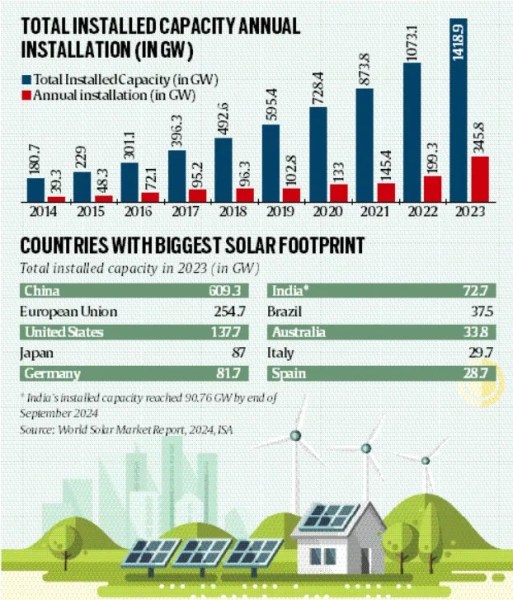
Despite significant advancements in solar energy deployment, ISA has had limited success in facilitating a large number of projects. Over the past five years, global solar power capacity has grown by over 20% annually, with a more than 30% increase reported last year, as indicated by ISA’s World Solar Market Report 2024.
-
Ajay Mathur, director general of ISA, noted that most of these new installations are concentrated in a few countries, with China leading the way. Of the 345 GW of solar capacity added in 2023, China alone contributed over 216 GW, representing more than 62% of the total.
-
More than 80% of global solar energy investments go to developed countries, China, and major emerging markets like India.
-
Many countries lack experience with large-scale energy projects, especially in solar, which is a relatively new technology. Local developers are often absent, meaning international companies are needed for investment. However, these investors typically look for policy stability and well-defined regulatory frameworks.
-
ISA has partnered with governments and local organizations to help establish regulatory frameworks, prepare power purchase agreements, and train local professionals
| India’s dedication to renewable energy and climate action was fundamental to the establishment of the ISA. With a goal of reaching 500 GW of non-fossil fuel energy by 2030, India’s renewable energy targets align with the ISA’s mission to promote solar energy worldwide. This target is part of India’s broader Panchamrit Initiative, which focuses on reducing carbon emissions and advancing sustainable development. Additionally, India is instrumental in shaping ISA’s programs and promoting global cooperation. Its extensive experience in scaling solar energy projects and developing supportive policies serves as a model for other member nations, particularly those aiming to expand energy access. By sharing best practices and technical knowledge, India seeks to support other countries in advancing their solar energy initiatives. |
- Solar energy plays a pivotal role in the global shift to renewable energy, which is essential for addressing climate change. It is the fastest-growing renewable source, though it does face the challenge of intermittency.
-
In many parts of the world, solar is now the most cost-effective energy source when sunlight is available. Projections for solar energy capacity show it could expand by 3 to 15 times by 2050, depending on the pathway chosen to reach global net-zero emissions.
-
China leads in solar PV installations, accounting for about 43% of the world's total. The top ten markets together hold over 95% of installed capacity, while less than 2% of new solar installations are in Africa—a region where nearly 80% of the 745 million people without electricity reside.
-
The ISA was founded with a broader strategic vision for India, aiming to enhance its influence, especially among the Global South, with a particular focus on African nations
- The International Solar Alliance (ISA) seeks to mobilize $1 trillion in solar investments by 2030 through its 'Towards 1000' strategy, which aims to lower both technology and financing costs.
- This ambitious plan targets energy access for 1 billion people and the installation of 1,000 GW of solar capacity. Achieving these objectives would reduce global carbon emissions by approximately 1,000 million tonnes of COâ‚‚ per year.
- ISA’s programs focus on three core areas—Analytics & Advocacy, Capacity Building, and Programmatic Support—to establish a supportive environment for solar investments and share best practices among member nations.
- ISA also drives solar adoption across sectors such as agriculture, healthcare, transportation, and power generation. By promoting policies and facilitating the exchange of successful strategies, ISA enables member countries to encourage solar energy deployment.
- The alliance has introduced innovative business models, supported governments in developing solar-friendly policies via its Ease of Doing Solar analytics, and pooled demand to reduce costs of solar technologies.
- Additionally, ISA enhances financing access by lowering investment risks, making the solar sector more attractive to private investors and paving the way toward a sustainable energy future.
- India's solar sector is growing rapidly, placing the country fifth globally in terms of solar power capacity. As of September 2024, India’s installed solar capacity has reached around 90.76 GW, a 30-fold increase over the last nine years. According to the National Institute of Solar Energy, the country’s solar potential is estimated at 748 GW.
- India’s Panchamrit targets include: (i) achieving 500 GW of non-fossil fuel energy capacity by 2030, (ii) sourcing 50% of its energy from renewables by 2030, (iii) reducing projected carbon emissions by one billion tonnes by 2030, (iv) cutting carbon intensity by 45% by 2030, and (v) reaching Net Zero by 2070.
- India has made significant progress, with its non-fossil fuel capacity increasing by 396% over the past 8.5 years, and 46.3% of its total energy capacity now comes from non-fossil sources, underscoring its dedication to sustainable energy as highlighted in international climate forums.
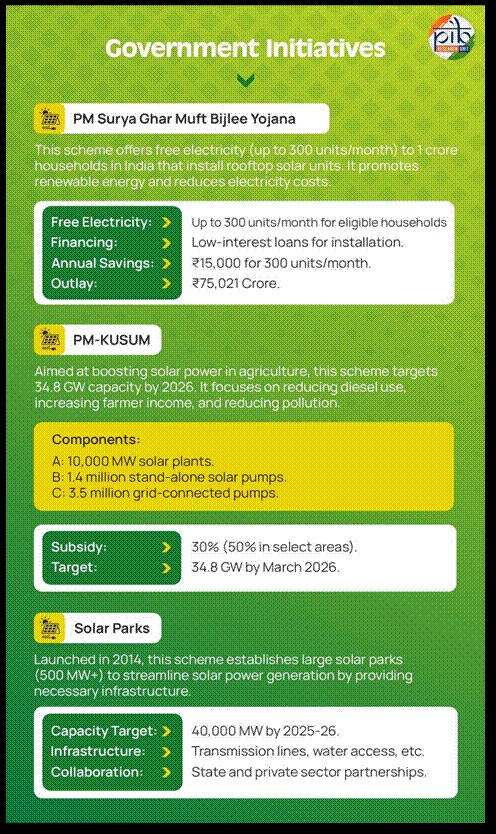
- Government policies, including the 100% FDI allowance in renewable energy projects, have enhanced the sector's appeal to investors. Additionally, technological advancements and a strong regulatory framework are creating an enabling environment for the continued expansion of solar energy projects
The International Solar Alliance (ISA) represents a pivotal shift towards a sustainable energy future, with India at the forefront of this initiative. The ISA’s mission extends beyond improving energy access and security to making substantial global carbon emissions reductions. The upcoming assembly offers an essential platform for nations to collaborate and emphasize the urgent need to accelerate solar energy adoption.
As more countries align with ISA’s mission, solar energy is positioned to play a central role in the global energy landscape. The ISA’s efforts, coupled with India’s strong commitment to solar advancement, pave the way for a cleaner, more sustainable world for future generations. Through international cooperation and innovative approaches, the ISA is well-positioned to contribute meaningfully to global climate objectives and universal energy access
|
For Prelims: General issues on Environmental ecology, Bio-diversity & climate change For Mains: GS-III: Conservation, environmental pollution and degradation, environmental impact assessment. |
|
Previous Year Questions
1.Consider the following statements: (2016)
Which of the statements given above is/are correct? (a) 1 only Answer (a)
|
DIGITAL PERSONAL DATA PROTECTION RULES

- The Government of India issued the Digital Personal Data Protection (DPDP) Rules, 2025 on 14 November 2025, completing the implementation of the Digital Personal Data Protection Act, 2023.
- With both the Act and Rules now in place, India has a comprehensive, citizen-oriented framework that balances personal data rights with legitimate data processing requirements.
- Before finalising the Rules, the Ministry of Electronics and Information Technology sought inputs from the public. Consultations were organised across several major cities—Delhi, Mumbai, Guwahati, Kolkata, Hyderabad, Bengaluru and Chennai—drawing participation from startups, MSMEs, industry associations, civil society organisations, and government bodies.
- Citizens also contributed actively. Altogether, 6,915 suggestions and comments were submitted, significantly influencing the final version of the Rules.
- The notification of these Rules establishes a practical, innovation-supportive data protection regime for the country. It promotes clarity, encourages adherence to the law, and enhances public confidence in India’s expanding digital landscape.
- The Digital Personal Data Protection Act was passed by Parliament on 11 August 2023, establishing a comprehensive legal structure for safeguarding digital personal information in India.
- It outlines the responsibilities of organisations when they gather or process such data. The Act is built on the SARAL philosophy—Simple, Accessible, Rational and Actionable—using straightforward language and clear examples so that individuals and businesses can easily understand the requirements.
- The Act is anchored in seven foundational principles: consent and transparency, limitation of purpose, minimal collection of data, accuracy, restricted data retention, strong security measures and accountability. These principles shape each step of data handling and ensure that personal information is processed only for legitimate and defined purposes.
- A key highlight of the law is the establishment of the Data Protection Board of India, an autonomous authority responsible for monitoring compliance, investigating violations and ensuring that necessary corrective actions are taken.
- The Board is central to protecting user rights and fostering confidence in the data protection framework
Key Terms under the DPDP Act, 2023
|
The Digital Personal Data Protection Rules, 2025 operationalise the DPDP Act, 2023, creating a practical and transparent system for safeguarding personal data in India’s rapidly growing digital landscape. These Rules place strong emphasis on citizen rights and responsible data handling by organisations. Their objective is to prevent misuse of personal information, minimise digital risks, and foster an environment that supports safe innovation—thereby strengthening trust in India’s digital economy.
To achieve these goals, the Rules lay down several key provisions:
- A phased compliance period of 18 months has been introduced so organisations have adequate time to upgrade systems and adopt sound data-protection practices.
- All Data Fiduciaries must issue a separate, easy-to-read consent notice clearly stating the specific purpose for which personal data is collected and processed.
- Consent Managers—entities that help people manage their permissions—must operate as companies incorporated in India.
- The Rules also define a clear and prompt procedure for reporting data breaches. In the event of a breach, the Data Fiduciary must immediately notify every affected person in simple language, outlining what occurred, potential consequences and the corrective measures taken. The communication must also include relevant contact details for assistance.
- Each Data Fiduciary is required to provide accessible contact information for queries related to personal data—whether that is a designated officer or a Data Protection Officer. Significant Data Fiduciaries have additional responsibilities: they must conduct external audits, undertake impact assessments and implement stricter controls when using emerging or sensitive technologies.
- They may also be required to comply with government directions regarding restricted data categories, including localisation requirements when necessary.
- The Rules strengthen the rights granted under the Act. Individuals can request access to their personal information, corrections or updates, and deletion in permitted situations.
- They may also authorize another person to exercise these rights on their behalf. Data Fiduciaries must respond to such requests within 90 days.
- Additionally, the Rules provide for a fully digital Data Protection Board of India with four members. Citizens will be able to submit complaints online and track them through a dedicated website and mobile app, making grievance resolution faster and more efficient.
- Appeals against the Board’s orders will be handled by the Telecom Disputes Settlement and Appellate Tribunal (TDSAT)
The DPDP framework puts citizens at the heart of India’s data protection regime. Its core purpose is to ensure that individuals have clear authority over their personal information and can trust that it is handled responsibly. The rules are drafted in simple, user-friendly language so people can easily understand their rights, while also ensuring that organisations remain accountable for how they manage personal data.
Key Rights and Safeguards Provided to Citizens:
- Right to Give or Withhold Consent
Individuals have the freedom to agree or refuse the use of their personal data. Consent must be informed, specific, and easy to comprehend, and it can be withdrawn at any point. - Right to Know How Data is Used
People are entitled to know what information has been collected about them, the purpose of its collection, and the ways it is being processed. Organisations must share this information in a clear and straightforward format. - Right to Access Personal Data
Any individual may request a copy of the personal data that a Data Fiduciary holds about them. - Right to Correct Personal Data
Citizens can ask for corrections if their personal information is wrong, inaccurate, or incomplete. - Right to Update Personal Data
Individuals may request updates when their details change—such as a new phone number or address. - Right to Delete Personal Data
People have the option to seek erasure of their personal data under specific circumstances. The Data Fiduciary must review and act on such requests within the stipulated timeframe. - Right to Appoint a Representative
Every person may nominate someone else to exercise their data rights on their behalf—useful during illness or other situations where they cannot act themselves. - Mandatory Response Within 90 Days
Data Fiduciaries must respond to requests for access, correction, updating, or deletion within a maximum of ninety days, promoting timely redressal and accountability. - Protection in Case of Data Breaches
If a data breach occurs, affected individuals must be informed promptly. The notification must explain the incident and outline the steps they can take to reduce any potential harm. - Clear Contact Point for Help
Organisations must provide easily accessible contact details—either of a designated official or a Data Protection Officer—for queries or complaints related to personal data. - Extra Safeguards for Children
Processing children’s personal data requires verifiable consent from a parent or guardian, except when the data is used for essential services like medical care, education or immediate safety.
- As the DPDP Act and its Rules strengthen citizens’ privacy protections, they also clarify how these enhanced rights coexist with the Right to Information (RTI) Act, which ensures public access to information.
- The amendments made through the DPDP Act modify Section 8(1)(j) of the RTI Act in a manner that upholds both privacy and transparency without undermining either.
- This change is consistent with the Supreme Court’s recognition of privacy as a fundamental right in the Puttaswamy judgment.
- It aligns the RTI law with judicial reasoning that has, for years, applied reasonable limits to protect personal information.
- By formally incorporating this approach into the statute, the amendment removes ambiguity and avoids any clash between the RTI Act’s transparency mandate and the privacy protections embedded in the DPDP framework.
- Importantly, the updated provision does not prohibit the release of personal data. Instead, it requires authorities to make a careful, case-specific assessment before sharing such information, keeping the individual’s privacy interests in mind.
- Meanwhile, Section 8(2) of the RTI Act remains unchanged. It empowers public authorities to disclose information whenever the public interest is compelling enough to outweigh potential harm to protected interests.
- This ensures that the core purpose of the RTI Act—promoting openness, accountability and informed citizen participation—continues to shape how information requests are handled
|
For Prelims: Personality rights, Delhi High Court, Madras High Court, Right to property, trademark, right to privacy, Article 21, Copyright Act, 1957
For Mains:
1. Explain how can the legal framework for protecting personality rights in India be strengthened to better address the challenges of the digital age. (250 Words)
|
|
Previous Year Questions
1. What is the position of the Right to Property in India? (UPSC 2021)
A. Legal right available to citizens only
B. Legal right available to any person
C. Fundamental Right available, to citizens only
D. Neither Fundamental Right nor legal right
Answer: B
2. In order to comply with TRIPS Agreement, India enacted the Geographical Indications of Goods (Registration & Protection) Act, 1999. The difference/differences between a "Trade Mark" and a Geographical Indication is/are (UPSC 2010)
1. A Trade Mark is an individual or a company's right whereas a Geographical Indication is a community's right.
2. A Trade Mark can be licensed whereas a Geographical Indication cannot be licensed.
3. A Trade Mark is assigned to the manufactured goods whereas the Geographical Indication is assigned to the agricultural goods/products and handicrafts only.
Which of the statements given above is/are correct?
A. 1 only B. 1 and 2 only C. 2 and 3 only D. 1, 2 and 3
Answer: B
3. Which of the following statements regarding Article 21 of the Constitution of India is/ is correct? (CDS GK 2017)
1. Article 21 is violated when under-trial prisoners are detained under judicial custody for an indefinite period.
2. Right to life is one of the basic human rights and not even the state has the authority to violate that right.
3. Under Article 21, the right of a woman to make reproductive choices is not a dimension of personal liberty.
Select the correct answer using the code given below.
A. 1, 2 and 3 B. 1 and 2 only C. 1 and 3 only D. 2 only
Answer: B
4. Article 21 of Indian Constitution secures: (OPSC OAS 2018)
A. Right to life only
B. Right to personal liberty only
C. Right to liberty and privacy
D. Right to life, personal liberty and right to privacy
Answer: D
5. ‘Right to Privacy’ is protected under which Article of the Constitution of India? (UPSC 2021) (a) Article 15 Answer: C 6. Right to Privacy is protected as an intrinsic part of Right to Life and Personal Liberty. Which of the following in the Constitution of India correctly and appropriately imply the above statement? (2018) (a) Article 14 and the provisions under the 42nd Amendment to the Constitution. (b) Article 17 and the Directive Principles of State Policy in Part IV. (c) Article 21 and the freedoms guaranteed in Part III. (d) Article 24 and the provisions under the 44th Amendment to the Constitution. Answer: C |
COMMISSION FOR AIR QUALITY MANAGEMENT (CAQM)
A synthesis of studies on the causes of air pollution in Delhi, sought by the Commission for Air Quality Management (CAQM) in the National Capital Region, has found that the largest contributor to winter pollution is secondary particulate matter at 27%, followed by transport at 23%, biomass burning at 20% including municipal solid waste and crop-residue burning, dust at 15% and industry at 9%
- The Commission for Air Quality Management (CAQM) in the National Capital Region (NCR) and nearby areas was initially established through an ordinance in 2020, which was subsequently replaced by an Act of Parliament in 2021.
- Its primary mandate is to enhance coordination, conduct research, identify issues, and address challenges related to air quality and associated concerns.
- At its inception, the CAQM comprised 15 members, including current and former officials from the Ministry of Environment and other Union government departments, along with representatives from various State governments, NGOs, and other organizations. Currently, the commission, led by Rajesh Verma, has expanded to 27 members.
- The CAQM succeeded the Environmental Pollution (Prevention and Control) Authority (EPCA), which was created by the Supreme Court in 1998. Unlike the CAQM, the EPCA lacked statutory authority, which experts criticized as limiting its ability to enforce compliance among defiant agencies.
- Nevertheless, several initiatives now overseen by the CAQM, such as the Graded Response Action Plan (GRAP)—a framework of temporary emergency measures to combat air pollution—were originally implemented under the EPCA's guidance
|
Powers of CAQM
The Commission for Air Quality Management in the National Capital Region and Adjoining Areas Act, 2021, empowers the CAQM to undertake any necessary measures, issue directives, and address grievances aimed at safeguarding and enhancing air quality in the NCR and surrounding regions. According to Section 14 of the Act, the commission is authorized to take strict action against officials who fail to comply with its directives
|
- The Supreme Court recently criticized the Commission for Air Quality Management (CAQM) for delays in enforcing stricter anti-pollution measures as Delhi's air quality worsened.
- Despite the Air Quality Index (AQI) reaching hazardous levels, the CAQM postponed the implementation of Stage 4 measures under the Graded Response Action Plan (GRAP), prompting the Court to question the lack of urgency in addressing the crisis.
- The justices emphasized that such measures should be triggered as soon as AQI levels indicate severe pollution to prevent further deterioration.
- The Court also highlighted systemic failures, including inadequate action against stubble burning in Punjab and Haryana, and criticized the CAQM for focusing on meetings without concrete enforcement of rules.
- It warned against scaling down measures prematurely and stressed the need for stricter penalties and immediate action to curb pollution sources effectively
- Although the CAQM formulates strategies and coordinates with various agencies, the actual implementation of these measures rests with the respective agencies.
- A CAQM official noted that the commission has significantly improved coordination and planning efforts.
- For instance, while paddy stubble burning—a major contributor to severe air pollution—occurs primarily in October and November, discussions with State officials begin as early as February and continue throughout the season.
- In 2022, the CAQM collaborated with Punjab and Haryana to develop action plans for managing stubble burning, which are reviewed and updated annually.
|
For Prelims: Graded Response Action Plan, National Capital Region (NCR),Environmental pollution(prevention control)Authority (EPCA).
For Mains:
1. What is GRAP? What is the Delhi-NCR action plan as air pollution increases? (250 words).
|


