
RETAIL INFLATION
1. Context
2. What is Inflation?
- It is the rise in prices of goods and services within a particular economy wherein consumers' purchasing power decreases, and the value of the cash holdings erodes.
- In India, the Ministry of Statistics and Programme Implementation (MoSPI) measures inflation.
- Some causes that lead to inflation are demand increases, reduction in supply, demand-supply gap, excess circulation of money, increase in input costs, devaluation of the currency, and rise in wages, among others.
3. Retail Inflation
4. How Inflation is measured?
- In India, inflation is primarily measured by two main indices- WPI (Wholesale Price Index) and CPI (Consumer Price Index), Which measures Wholesale and retail-level price changes, respectively.
- The CPI calculates the difference in the price of commodities and services such as food, medical care, education, electronics, etc, which Indian consumers buy for use.
- On the other hand, the goods or services sold by businesses to smaller businesses for selling further are captured by the WPI.
- Both WPI (Wholesale Price Index) and CPI (Consumer Price Index) are used to measure inflation in India.
5. What is the Inflation Target?
- Under Section 45ZA, in consultation with the RBI Act, the Central Government determines the inflation target in terms of the Consumer Price Index (CPI), once in five years and notifies it in the Official Gazette.
- Accordingly, on August 5, 2016, the Central Government notified in the Official Gazette 4 percent Consumer Price Index (CPI) inflation as the target for the period from August 5, 2016, to March 31, 2021, with the upper tolerance limit of 6 percent and the lower tolerance limit of 2 percent.
- On March 31, 2021, the Central Government retained the inflation target and the tolerance band for the next 5-year period-April 1, 2021 to March 31, 2026.
- Section 45ZB of the RBI Act provides for the constitution of a six-member Monetary Policy Committee (MPC) to determine the policy rate required to achieve the inflation target.
6. Monetary Policy Committee (MPC)
- The MPC is a statutory and institutionalized framework under the RBI Act, of 1934, for maintaining price stability, keeping in mind the objective of growth. It was created in 2016.
- It was created to bring transparency and accountability in deciding monetary policy.
- MPC determines the policy interest rate required to achieve the inflation target.
- The committee comprises six members and Governor RBI acts as an ex-officio chairman. Three members are from RBI and three are selected by the government. The inflation target is to be set once every five years. It is set by the Government of India, in consultation with the Reserve Bank of India.
- The current inflation target is pegged at 4% with -2/+2 tolerance till March 31, 2021.
7. What Caused the drop in Inflation?
- Retail Inflation or price gains based on the Consumer Price Index, slowed to 6.77 % last month, from September's 7.41%, aided by an appreciable deceleration in food price inflation.
- The year-on-year inflation based on the Consumer Food Price Index eased by almost 160 basis points in October, to 7.01%, from the preceding month's 8.60%, helped by a 'decline in prices of vegetables, fruits, pulses and oils, and fats', the Government said.
- With the food and beverages sub-index representing almost 46% of the CPI's weight, the slowdown in food price gains understandably steered overall inflation lower even as price gains in three other essential categories, namely clothing, and footwear, housing, and health remained either little changed from September or quickened.
- Inflation at the Wholesale Prices Level also continued to decelerate, with the headline reading easing into single digits for the first time in 19 months. A favorable base effect along with a distinct cooling in international prices of commodities including crude oil and steel amid gathering uncertainty in advanced economies was largely instrumental in tempering wholesale price gains.
8. Recent Measures by the Government
For Prelims & Mains
|
For Prelims: Inflation, MPC, CPI, WPI, food Inflation, RBI, Headline inflation, Core inflation For Mains:
1. Explain the concept of inflation and its impact on an economy. Discuss the various causes of inflation and the measures that can be taken to control it, with specific reference to India. (250 Words)
2. What are the challenges and opportunities associated with managing inflation in India? Evaluate the effectiveness of recent policy measures in addressing inflationary pressures and maintaining price stability. Suggest strategies for sustainable economic growth while managing inflation risks. (250 Words)
|
|
Previous Year Questions
1. Consider the following statements: (UPSC 2021)
1. The Governor of the Reserve Bank of India (RBI) is appointed by the Central Government.
2. Certain provisions in the Constitution of India give the Central Government the right to issue directions to the RBI in the public interest.
3. The Governor of the RBI draws his natural power from the RBI Act.
Which of the above statements is/are correct?
A. 1 and 2 only B. 2 and 3 only C. 1 and 3 only D. 1, 2 and 3
2. Concerning the Indian economy, consider the following: (UPSC 2015)
Which of the above is/are component(s) of Monetary Policy? (a) 1 only (b) 2, 3 and 4 (c) 1 and 2 (d) 1, 3 and 4
3. An increase in Bank Rate generally indicates: (UPSC 2013) (a) Market rate of interest is likely to fall.
(b) Central bank is no longer making loans to commercial banks.
(c) Central bank is following an easy money policy.
(d) Central bank is following a tight money policy.
4. Which of the following statements is/are correct regarding the Monetary Policy Committee (MPC)? (UPSC 2017) 1. It decides the RBI's benchmark interest rates.
2. It is a 12-member body including the Governor of RBI and is reconstituted every year.
3. It functions under the chairmanship of the Union Finance Minister.
Select the correct answer using the code given below: A. 1 only B. 1 and 2 only C. 3 only D. 2 and 3 only 5. Read the following passage and answer the question that follows. Your answers to these items should be based on the passage only.
Policymakers and media have placed the blame for skyrocketing food prices on a variety of factors, including high fuel prices, bad weather in key food producing countries, and the diversion of land to non-food production. Increased emphasis, however, has been placed on a surge in demand for food from the most populous emerging economics. It seems highly probable that mass consumption in these countries could be well poised to create a food crisis.
With reference to the above passage, the following assumptions have been made: (UPSC 2021)
1. Oil producing countries are one of the reasons for high food prices.
2. If there is a food crisis in the world in the near future, it will be in the emerging economies. Which of the above assumptions is/are valid?
A. 1 only B. 2 only C. Both 1 and 2 D. Neither 1 nor 2
6. India has experienced persistent and high food inflation in the recent past. What could be the reasons? (UPSC 2011)
1. Due to a gradual switchover to the cultivation of commercial crops, the area under the cultivation of food grains has steadily decreased in the last five years by about 30.
2. As a consequence of increasing incomes, the consumption patterns of the people have undergone a significant change.
3. The food supply chain has structural constraints.
Which of the statements given above are correct?
A. 1 and 2 only B. 2 and 3 only C. 1 and 3 only D. 1, 2 and 3
7. With reference to inflation in India, which of the following statements is correct? (UPSC 2015)
A. Controlling the inflation in India is the responsibility of the Government of India only
B. The Reserve Bank of India has no role in controlling the inflation
C. Decreased money circulation helps in controlling the inflation
D. Increased money circulation helps in controlling the inflation
8. With reference to the Agreement at the UNFCCC Meeting in Paris in 2015, which of the following statements is/are correct? (UPSC 2016)
1. The Agreement was signed by all the member countries of the UN and it will go into effect in 2017
2. The Agreement aims to limit greenhouse gas emissions so that the rise in average global temperature by the end of this century does not exceed 2°C or even 1.5°C above pre-industrial levels.
3. Developed countries acknowledged their historical responsibility in global warming and committed to donate $ 1000 billion a year from 2020 to help developing countries to cope with climate change.
Select the correct answer using the code given below:
A. 1 and 3 only B. 2 only C. 2 and 3 only D. 1, 2 and 3
Answers: 1-C, 2-C, 3-D, 4-A, 5-D, 6-B, 6-C, 7-B
|
EARTH OBSERVATION SATELLITES (EOS)

- Earth observation satellites, also known as Earth remote sensing satellites, are designed to monitor and collect data about the Earth from orbit. This category includes both military spy satellites and those intended for non-military purposes, such as environmental monitoring, weather forecasting, cartography, and more.
- These satellites are crucial for overseeing and safeguarding our environment, managing resources, responding to global humanitarian crises, and supporting sustainable development. They offer valuable insights into various aspects like ocean salinity, ice thickness, crop health, and air quality.
- The most common type of Earth observation satellites are Earth-imaging satellites, which capture images similar to aerial photographs. However, some EO satellites conduct remote sensing without creating images, such as those using GNSS radio occultation techniques
- The PSLV-C61 mission is set to deploy the Earth Observation Satellite EOS-09 into a Sun Synchronous Polar Orbit (SSPO). After the satellite is successfully separated, Orbit Change Thrusters (OCT) will be activated to lower the altitude of the spent PS4 stage, thereby minimizing its orbital lifespan.
- This will be followed by passivation of the stage. The launch is scheduled from the First Launch Pad (FLP) at the Satish Dhawan Space Centre (SDSC) in Sriharikota.
- In alignment with ISRO's goal of conducting responsible and sustainable space missions, this launch will be debris-free. Adequate fuel has been allocated to facilitate the satellite’s de-orbiting after its operational life, ensuring it descends to a lower orbit and disintegrates naturally within two years
4.Types of Earth Observation Satellites
Earth observation satellites are crucial tools for monitoring our planet. They provide valuable data for various applications, including weather forecasting, environmental monitoring, and disaster management
Earth observation (EO) satellites can be categorized into two main types depending on their imaging techniques: passive and active.
-
Passive Satellites: These satellites detect radiation that is reflected off the Earth's surface, including visible light and infrared. They generally cannot operate effectively through cloud cover.
-
Active Satellites: These satellites emit energy towards the Earth's surface and measure the reflected signal to gather information. They are capable of penetrating cloud cover to obtain data
- Earth observation satellites operate in various orbits, providing different viewpoints of the Earth. Due to constraints in power and storage, most satellites do not continuously collect data.
- Some satellites provide consistent and reliable data, while others gather it intermittently over time.
- The collected data is stored on the satellite until it can be transmitted to a ground station when it comes into view.
- The duration from image capture to data availability can range from a month to just a few minutes, with advancements in technology reducing this time.
- As multiple companies own these satellites, there are various data providers with distinct pricing models.
- ISRO has deployed numerous operational remote sensing satellites. Currently, thirteen of these satellites are in sun-synchronous orbits, while four are in geostationary orbits.
- The data collected from these satellites supports a range of applications including agriculture, water resources, urban planning, rural development, mineral exploration, environmental monitoring, forestry, ocean resource management, and disaster response
- Climate Change: Track changes in climate patterns, ice melt, sea level rise, and greenhouse gas concentrations.
- Natural Disasters: Monitor and assess the impact of natural disasters like hurricanes, earthquakes, and floods in real-time.
- Agriculture: Provide data on crop health, soil conditions, and irrigation needs, helping optimize agricultural practices and increase yields.
- Water Resources: Monitor water bodies, track changes in water availability, and manage water resources more effectively.
- Land Use: Assist in urban planning and land use management by providing detailed imagery and data on land development and changes.
- Infrastructure: Support infrastructure development by providing accurate and up-to-date information on land and environmental conditions
|
For Prelims: LOS, PSLV, GSLV
For Mains: GS III - Science & technology
|
|
Previous Year Questions
1. With reference to India's satellite launch vehicles, consider the following statements: (UPSC 2018)
1. PSLVs launch satellites useful for Earth resources monitoring whereas GSLVs are designed mainly to launch communication satellites.
2. Satellites launched by PSLV appear to remain permanently fixed in the same position in the sky, as viewed from a particular location on Earth.
3. GSLV Mk III is a four- staged launch vehicle with the first and third stages using solid rocket motors; and the second and fourth stages using liquid rocket engines.
Which of the statements given above is/are correct?
A. 1 only
B. 2 and 3
C. 1 and 2
D. 3 only
Answer: A
|
KUKI-ZOMI TRIBE
The Kuki-Zomi people are a diverse group of ethnicities inhabiting the mountainous regions of Northeast India, Myanmar, and Bangladesh. They share a common ancestry and cultural heritage, and their name reflects this shared identity: "Kuki" is a more general term encompassing various sub-tribes, while "Zomi" is a relatively recent term adopted by some Kuki communities to emphasize their distinct identity and cultural heritage.
- The exact origins of the Kuki-Zomi people remain unclear, but linguistic evidence suggests they migrated from Southeast Asia centuries ago. Today, they are found primarily in the Indian states of Manipur, Mizoram, Assam, Nagaland, and Tripura, as well as in Chin State, Myanmar, and the Chittagong Hill Tracts of Bangladesh.
- The Kuki-Zomi people comprise numerous sub-tribes, each with its own distinct dialect and cultural practices. Some of the major sub-tribes include the Hmar, Thadou, Paite, Gangte, Vaiphei, Zou, Aimol, and Anal. These sub-tribes speak various Kuki-Chin languages, which belong to the Tibeto-Burman language family.
- The Kuki-Zomi people have a rich and vibrant culture characterized by strong communal bonds, traditional music and dance, and colorful handicrafts. Their traditional attire is often adorned with intricate beadwork and embroidery, reflecting their artistic skills and cultural pride.
- The Kuki-Zomi people have faced various challenges throughout their history, including displacement, conflict, and marginalization. However, they have demonstrated remarkable resilience and adaptability, preserving their unique culture and traditions despite these hardships.
- In recent years, the Kuki-Zomi people have made significant strides in education, entrepreneurship, and political representation. They are increasingly active in advocating for their rights and cultural identity, and their contributions to the social and economic development of the regions they inhabit are becoming increasingly recognized.
3. Delisting Proposal in Manipur
- The representation calling for the potential removal of specific Kuki and Zomi tribes from the Scheduled Tribes (ST) list in Manipur stems from the ongoing ethnic conflict that has persisted for eight months.
- This conflict, initiated on May 3, 2023, arose following an order from the Manipur High Court directing the State government to recommend the inclusion of Meiteis in the ST list to the Centre.
- As the Centre now requests the State government to examine the representation for the delisting of Kuki and Zomi tribes, there is a risk of exacerbating existing tensions between the valley-based Meitei people and the hills-based Kuki-Zo (ST) people in the State.
- One significant factor driving the Meiteis' demand for ST status is their inability to own land in the forested hill districts, where only STs are permitted to own land.
- Notably, this marks the first instance where members of the Meitei community are advocating for their inclusion in the ST list by contending that specific Kuki and Zomi tribes should not be part of it.
- This development may also have broader implications for the criteria used to designate groups as Scheduled Tribes, a framework that has remained unchanged since its introduction by the Lokur Commission in 1965.
Key Arguments in the Kuki-Zomi Delisting Proposal
- In Mr. Thounaojam’s representation, objections have been raised against the inclusion of three specific entries in the Scheduled Tribes (ST) list of Manipur namely, “Any Mizo(Lushai) Tribes,” “Zou,” and “Any Kuki Tribes.”
- The primary argument put forth for the exclusion of these entries is that they are not considered "indigenous" to the land of Manipur.
- According to the representation, there is no historical mention of these specific tribes residing in Manipur in pre-Independence Censuses.
- Furthermore, the representation contends that the vagueness surrounding the terms "Any Mizo (Lushai) Tribes" and "Any Kuki Tribes" in the ST list has purportedly facilitated illegal immigrants from Myanmar and Bangladesh in wrongfully obtaining benefits intended for Scheduled Tribes in India.
The Lokur Commission, officially known as the Advisory Committee on the Revision of Lists of Scheduled Castes and Scheduled Tribes, played a significant role in shaping the landscape of tribal communities in India. Established in 1965 by the Government of India. Chaired by Justice N.N. Lokur, a former Chief Justice of India. Tasked with revising the lists of Scheduled Castes (SCs) and Scheduled Tribes (STs) in a rational and scientific manner.
Criteria for Scheduled Tribes:
- The Commission established five key criteria for identifying a community as an ST:
- Primitive Traits and Distinctive Culture
- Geographical Isolation
- Shyness of Contact with the Community at Large
- Backwardness
- Pre-dominantly Tribal Population
Impact on Tribal Communities
- The Lokur Commission's recommendations led to the addition of several new communities to the ST list, granting them access to educational and economic benefits reserved for STs.
- However, the criteria employed, particularly the emphasis on "primitive traits," have been criticized for being outdated, stereotypical, and potentially hindering social progress for tribal communities.
Criticisms and Debates
- The Commission's classification of certain communities as "primitive" has been challenged for being derogatory and inaccurate.
- The criteria used have been accused of being subjective and open to misinterpretation, leading to inconsistencies and exclusion of deserving communities.
- Debates continue regarding the need for revising or even abolishing the existing criteria altogether, with calls for a more nuanced approach based on social, economic, and cultural factors.
Legacy
- Despite the criticisms, the Lokur Commission's work remains influential in the administration of tribal affairs in India.
- Its report and recommendations form the basis for the current ST list and continue to be referenced in discussions about tribal inclusion and development.
- The Commission's legacy highlights the importance of ongoing discussions about the definition of "tribal" identity and the need for criteria that are fair, inclusive, and responsive to the evolving realities of tribal communities in India.
The National Commission for Backward Classes (NCBC) stands as a crucial advocate for the rights and welfare of Other Backward Classes (OBCs) in India. Established in 1993 and elevated to constitutional status in 2018, the NCBC plays a multi-faceted role in ensuring social justice and equality for OBC communities.
Mandate and Responsibilities
- The NCBC probes cases of discrimination and denial of rights due to OBC status. It monitors the implementation of various government policies and schemes aimed at OBC development.
- The Commission regularly assesses the social, educational, and economic advancement of OBCs. It provides recommendations to the government on policies and programs to bridge existing gaps and address emerging challenges.
- Individuals from OBC communities can approach the NCBC with complaints related to violations of their rights or benefits. The Commission takes necessary action to address these grievances and ensure justice.
- The NCBC conducts research on the diverse OBC communities, analyzing their specific needs and vulnerabilities. It promotes awareness about OBC issues and advocates for their inclusive participation in various spheres of Indian society.
Key Achievements
- The NCBC played a significant role in implementing the Right to Education Act (2009) and ensuring reservation quotas for OBC students in educational institutions.
- The Commission has been instrumental in promoting entrepreneurship and skill development programs among OBC communities, leading to greater economic participation and self-reliance.
- The NCBC has consistently pushed for legislation and policy changes that benefit OBCs, such as reservations in government jobs and promotions, access to healthcare, and land rights.
Challenges and Future Directions
- OBCs are a diverse group with varying needs and levels of marginalization. The NCBC faces the challenge of addressing these internal disparities and ensuring inclusivity within its advocacy efforts.
- The Commission often operates with limited resources, hindering its ability to effectively reach out to remote OBC communities and conduct comprehensive research.
- Ensuring proper implementation of the NCBC's recommendations on the ground remains a crucial challenge. Stronger collaboration with state governments and local authorities is essential.
6. Examining Claims of Non-Indigeneity and Misuse
|
For Prelims: kuki-zomi tribes, manipur, National Commission for Backward classes, STs, Lokur Commission, Other Backward Classes
For Mains:
1. Discuss the potential political and developmental implications of the proposed delisting. How might it affect land rights, access to resources, and inter-community relations in Manipur? (250 Words)
2. Assess the role of the National Commission for Backward Classes (NCBC) in addressing the complexities of tribal identity and ensuring social justice for marginalized communities. How can the NCBC be strengthened to better address issues like the Kuki-Zomi delisting proposal? (250 Words)
|
|
Previous Year Questions
1. Who was appointed as the head of the OBC Sub-categorisation Commission?
(Maharashtra Talathi 2019)
A. Justice Geeta Mittal
B. Justice Manjula Chellur
C. Justice Tahilramani
D. Justice G. Rohini
2. Which of the following pairs of list and contents is/are correctly matched? (UPSC CAPF 2019)
1. State list Public health and sanitation
2. Union list Citizenship, naturalisation and aliens
3. Concurrent list Legal, medical and other
Select the correct answer using the code given below:
A. 1 only B. 1, 2 and 3 C. 2 and 3 only D. 3 only
Answers:1-D, 2- B
|
PARIS AGREEMENT
1. Context
2. What is Paris Agreement?
- Paris Agreement is a multinational agreement that was signed as part of the UNFCCC with the intention of reducing and mitigating greenhouse gas emissions.
- 196 nations ratified the climate change agreement at the Conference of the Parties (COP 21) in Paris in December 2015. It is an international agreement that is binding on all parties involved.
- Achieving the long-term temperature goal was the purpose of the Paris Climate Accord. To attain a world without greenhouse gas emissions by the middle of the century, nations strive to peak global greenhouse gas emissions as soon as possible.
- The Paris Climate Accord's major objective is to keep global warming well below 2° Celsius and ideally below 1.5° Celsius in comparison to pre-industrial levels.
- The Paris Agreement is a watershed moment in the multilateral climate change process because it brings all nations together for the first time in a binding agreement to undertake ambitious efforts to combat climate change and adapt to its effects.
3. COP21
- To keep the rise in the average world temperature to well under 2°C above pre-industrial levels. To continue making efforts to keep global warming to 1.5°C over pre-industrial levels, knowing that doing so would greatly lessen the dangers and effects of climate change.
- The Agreement also mentions achieving the global peaking of emissions by the middle of the century while taking into account the fact that developing nation Parties will have a longer peaking period.
4. What are NDCs
- At the Conference of the Parties (COP21) of the U.N. Framework Convention on Climate Change (UNFCCC), which took place in Paris in December 2015, nations from all over the world pledged to establish a new global climate agreement by that time.
- In advance of a new international agreement, nations have committed to publicly state their Intended Nationally Determined Contributions or the climate activities they plan to take after 2020.
- The 2015 agreement's ambitious goals and whether the world is put on a course toward a low-carbon, climate-resilient future will be largely determined by the INDCs.
- The Intended Nationally Determined Contribution (INDC) of India has also been submitted to the United Nations Framework Convention on Climate Change.
- Countries communicate actions they will take to reduce greenhouse gas emissions to meet the Paris Agreement's goals in their NDCs.
- Countries also communicate actions they will take to build resilience to adapt to the effects of rising temperatures in their NDCs.
.png)
5. Highlights of the report on the performance of the Paris Agreement
- After the signing of the Agreement, the last eight years (2015-2022) have consecutively been the warmest years on record globally.
- The situation could have been far worse if the La Nina weather event had not occurred in the past three years, which has a cooling effect on the weather system.
- Globally updated Nationally Determined Contributions (NDCs) to limit global warming to 1.5 degrees Celsius have failed even to achieve a 2-degree Celsius target.
- The Paris Agreement has not been able to equitably phase out fossil fuels predominantly responsible for the climate crisis.
- Neither the NDCs nor the disaster risk reduction and climate risk management plans are in place to combat climate-induced extreme weather phenomena.
6. A series of climate records fell over in 2022, the report showed.
- Global mean temperature rising: The global mean temperature in 2022 was 1.15°C, ranging from 1.02°C to 1.28°C above the 1850–1900 average. This was the highest on record for the past eight years. The value is about 0.2°C higher than the statistic before 2015. The pre-industrialisation era is considered a benchmark as there was no significant anthropogenic emission at the time.
- Record melting of Antarctica ice: Sea ice in Antarctica dropped to an all-time low, 1.92 million square kilometres, on February 25, 2022. This was almost a million sq km below the mean of the last three decades till 2020.
- Greenhouse gases surged: The levels of three major greenhouse gases — carbon dioxide, methane, and nitrous oxide — continued to increase in 2022. The data shows that growth rates of all three gases have increased around 20 per cent compared to 2011-15 levels.
- Sea level rise doubled: Global mean sea level continued to rise in 2022. It has doubled to 4.62 millimetres per year during 2013–2022 from 2.27 mm recorded in the first decade of the satellite record (1993–2002). The rate of increase quickened after 2015. Ocean heat content, which measures this gain in energy, reached a new observed record.
- Record thinning of glaciers: Long-term observational data is available for glaciers, which were found to have thinned over 1.3 metres between October 2021 and October 2022. The loss is much larger than before. The cumulative thickness loss since 1970 amounts to almost 30 metres.
- More than half of the oceans saw marine heatwaves in 2022: Despite continuing La Nina conditions, 58 per cent of the ocean surface experienced at least one marine heatwave during 2022.
- Heatwaves killed 15,000 in Europe: Record-breaking heatwaves affected China and Europe during the summer, with excess deaths associated with the heat in Europe exceeding 15000. Casualties were reported across Spain, Germany, the United Kingdom, France and Portugal.
- 1,600 suffered deaths from weather extremes in India: India suffered from significant flooding at various stages during monsoon, particularly in the northeast in June, with over 700 deaths reported from flooding and landslides and a further 900 from lightning.
|
For Prelims: Paris Agreement, Conference of the Parties (COP 21), World Meteorological Organization (WMO), UNFCCC, Nationally Determined Contributions (NDCs).
For Mains: 1. Describe the major outcomes of the 26th session of the Conference of the Parties (COP) to the United Nations Framework Convention on Climate Change (UNFCCC). What are the commitments made by India in this conference? (UPSC 2021)
|
Previous year Question1. With reference to the Agreement at the UNFCCC Meeting in Paris in 2015, which of the following statements is/are correct? (UPSC 2016)
1. The Agreement was signed by all the member countries of the UN and it will go into effect in 2017. 2. The Agreement aims to limit greenhouse gas emissions so that the rise in average global temperature by the end of this century does not exceed 2°C or even 1.5°C above pre-industrial levels. 3. Developed countries acknowledged their historical responsibility for global warming and committed to donate $1000 billion a year from 2020 to help developing countries cope with climate change.
Select the correct answer using the code given below
A. 1 and 3 only
B. 2 only C. 2 and 3 only D. 1, 2 and 3 Answer: B
2. The term ‘Intended Nationally Determined Contributions’ is sometimes seen in the news in the context of ( UPSC 2016)
A. pledges made by the European countries to rehabilitate refugees from the war-affected Middle East B. plan of action outlined by the countries of the world to combat climate change C. capital contributed by the member countries in the establishment of the Asian Infrastructure Investment Bank D. plan of action outlined by the countries of the world regarding Sustainable Development Goals Answer: B |
Source: Down to Earth
INTERNATIONAL SOLAR ALLIANCE (ISA)
- The International Solar Alliance (ISA) is an initiative led by India and France, launched during the United Nations Climate Change Conference (COP21) in Paris in 2015.
- It aims to promote the use of solar energy globally, especially in solar-rich countries lying fully or partially between the Tropic of Cancer and the Tropic of Capricorn. However, membership is now open to all UN member countries
- India, as a founding member, uses ISA as a platform to advance its renewable energy targets, including the ambitious goal of achieving 500 GW of renewable capacity by 2030.
- The ISA complements India's domestic initiatives, like the National Solar Mission
- In 2021, the United States joined the ISA, signaling global support for solar energy adoption.
- The One Sun, One World, One Grid (OSOWOG) initiative, also led by India, aligns with ISA’s objectives by advocating for a transnational solar grid that connects renewable energy sources globally.
-
The ISA was intended to act as a catalyst, helping countries tackle challenges like financial, technological, and regulatory barriers to adopt solar energy effectively.
-
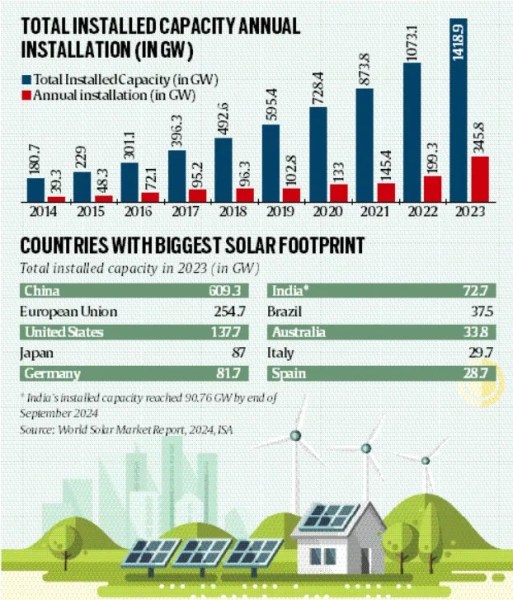
Despite significant advancements in solar energy deployment, ISA has had limited success in facilitating a large number of projects. Over the past five years, global solar power capacity has grown by over 20% annually, with a more than 30% increase reported last year, as indicated by ISA’s World Solar Market Report 2024.
-
Ajay Mathur, director general of ISA, noted that most of these new installations are concentrated in a few countries, with China leading the way. Of the 345 GW of solar capacity added in 2023, China alone contributed over 216 GW, representing more than 62% of the total.
-
More than 80% of global solar energy investments go to developed countries, China, and major emerging markets like India.
-
Many countries lack experience with large-scale energy projects, especially in solar, which is a relatively new technology. Local developers are often absent, meaning international companies are needed for investment. However, these investors typically look for policy stability and well-defined regulatory frameworks.
-
ISA has partnered with governments and local organizations to help establish regulatory frameworks, prepare power purchase agreements, and train local professionals
| India’s dedication to renewable energy and climate action was fundamental to the establishment of the ISA. With a goal of reaching 500 GW of non-fossil fuel energy by 2030, India’s renewable energy targets align with the ISA’s mission to promote solar energy worldwide. This target is part of India’s broader Panchamrit Initiative, which focuses on reducing carbon emissions and advancing sustainable development. Additionally, India is instrumental in shaping ISA’s programs and promoting global cooperation. Its extensive experience in scaling solar energy projects and developing supportive policies serves as a model for other member nations, particularly those aiming to expand energy access. By sharing best practices and technical knowledge, India seeks to support other countries in advancing their solar energy initiatives. |
- Solar energy plays a pivotal role in the global shift to renewable energy, which is essential for addressing climate change. It is the fastest-growing renewable source, though it does face the challenge of intermittency.
-
In many parts of the world, solar is now the most cost-effective energy source when sunlight is available. Projections for solar energy capacity show it could expand by 3 to 15 times by 2050, depending on the pathway chosen to reach global net-zero emissions.
-
China leads in solar PV installations, accounting for about 43% of the world's total. The top ten markets together hold over 95% of installed capacity, while less than 2% of new solar installations are in Africa—a region where nearly 80% of the 745 million people without electricity reside.
-
The ISA was founded with a broader strategic vision for India, aiming to enhance its influence, especially among the Global South, with a particular focus on African nations
- The International Solar Alliance (ISA) seeks to mobilize $1 trillion in solar investments by 2030 through its 'Towards 1000' strategy, which aims to lower both technology and financing costs.
- This ambitious plan targets energy access for 1 billion people and the installation of 1,000 GW of solar capacity. Achieving these objectives would reduce global carbon emissions by approximately 1,000 million tonnes of COâ‚‚ per year.
- ISA’s programs focus on three core areas—Analytics & Advocacy, Capacity Building, and Programmatic Support—to establish a supportive environment for solar investments and share best practices among member nations.
- ISA also drives solar adoption across sectors such as agriculture, healthcare, transportation, and power generation. By promoting policies and facilitating the exchange of successful strategies, ISA enables member countries to encourage solar energy deployment.
- The alliance has introduced innovative business models, supported governments in developing solar-friendly policies via its Ease of Doing Solar analytics, and pooled demand to reduce costs of solar technologies.
- Additionally, ISA enhances financing access by lowering investment risks, making the solar sector more attractive to private investors and paving the way toward a sustainable energy future.
- India's solar sector is growing rapidly, placing the country fifth globally in terms of solar power capacity. As of September 2024, India’s installed solar capacity has reached around 90.76 GW, a 30-fold increase over the last nine years. According to the National Institute of Solar Energy, the country’s solar potential is estimated at 748 GW.
- India’s Panchamrit targets include: (i) achieving 500 GW of non-fossil fuel energy capacity by 2030, (ii) sourcing 50% of its energy from renewables by 2030, (iii) reducing projected carbon emissions by one billion tonnes by 2030, (iv) cutting carbon intensity by 45% by 2030, and (v) reaching Net Zero by 2070.
- India has made significant progress, with its non-fossil fuel capacity increasing by 396% over the past 8.5 years, and 46.3% of its total energy capacity now comes from non-fossil sources, underscoring its dedication to sustainable energy as highlighted in international climate forums.
- Government policies, including the 100% FDI allowance in renewable energy projects, have enhanced the sector's appeal to investors. Additionally, technological advancements and a strong regulatory framework are creating an enabling environment for the continued expansion of solar energy projects
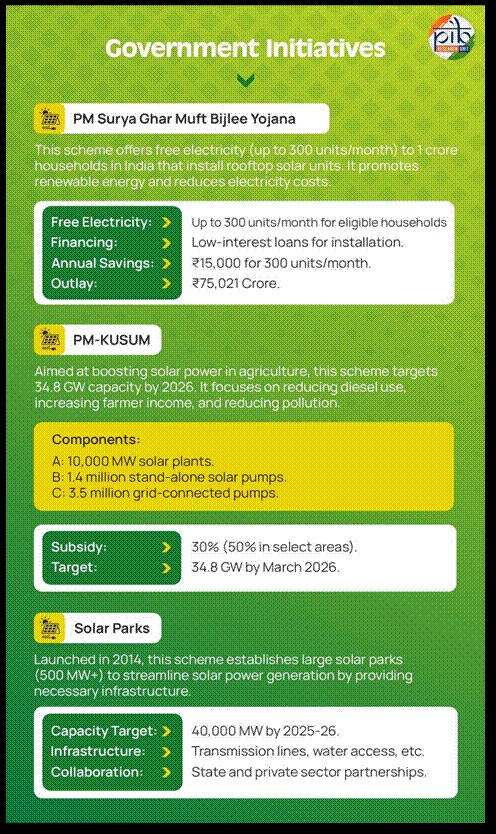
The International Solar Alliance (ISA) represents a pivotal shift towards a sustainable energy future, with India at the forefront of this initiative. The ISA’s mission extends beyond improving energy access and security to making substantial global carbon emissions reductions. The upcoming assembly offers an essential platform for nations to collaborate and emphasize the urgent need to accelerate solar energy adoption.
As more countries align with ISA’s mission, solar energy is positioned to play a central role in the global energy landscape. The ISA’s efforts, coupled with India’s strong commitment to solar advancement, pave the way for a cleaner, more sustainable world for future generations. Through international cooperation and innovative approaches, the ISA is well-positioned to contribute meaningfully to global climate objectives and universal energy access
|
For Prelims: General issues on Environmental ecology, Bio-diversity & climate change For Mains: GS-III: Conservation, environmental pollution and degradation, environmental impact assessment. |
|
Previous Year Questions
1.Consider the following statements: (2016)
Which of the statements given above is/are correct? (a) 1 only Answer (a)
|
BUDDHISM
-
The event, titled ‘Buddha Dhamma and the Culture of Northeast India’, aims to emphasize the Northeast's important role as a hub for Buddhist practices, monastic life, and cultural heritage.
-
According to Abhijit Halder, Director-General of the International Buddhist Confederation (IBC), a global organization based in New Delhi, the region has played a vital role in preserving and promoting diverse Buddhist traditions, including TheravÄda, MahÄyÄna, and VajrayÄna.
-
Halder also noted that various indigenous communities in Northeast India have harmoniously blended Buddha Dhamma with their own customs. He highlighted the example of TheravÄda Buddhism in the Namsai district, calling it an inspiring example of spiritual perseverance, cultural strength, and contemporary revival. One of the key goals of the conclave, he said, is to showcase this unique legacy to the global audience
Buddhism originated in India around the 5th to 6th centuries BCE, during what historians describe as the "Second Urbanisation"—a period marked by significant socio-cultural shifts in the Gangetic plains. It arose alongside other non-orthodox traditions like Jainism as a reaction against the rigid, ritual-heavy practices of Vedic Hinduism.
The Four Noble Truths
At the heart of the Buddha’s teachings lie the Four Noble Truths:
-
The Truth of Suffering (Dukkha): Suffering is an inherent part of human existence. Life is marked by pain, dissatisfaction, and the inevitability of loss.
-
The Truth of the Origin of Suffering (Dukkhasamudaya): Suffering has a cause, rooted in a chain of twelve interconnected elements known as the dvÄdaÅ›a nidÄna or bhavachakra (wheel of becoming). These links are:
(i) AvidyÄ (ignorance),
(ii) SamskÄra (karmic formations),
(iii) VijñÄna (consciousness at conception),
(iv) NÄmarÅ«pa (mind and body),
(v) á¹¢aá¸Äyatana (six sense organs),
(vi) Sparśa (contact),
(vii) VedanÄ (sensation),
(viii) Tá¹›á¹£á¹‡Ä (craving),
(ix) UpÄdÄna (attachment),
(x) Bhava (becoming),
(xi) JÄti (birth),
(xii) JarÄ-maraṇa (aging and death). -
The Truth of the Cessation of Suffering (Nirodha): Liberation from suffering is possible. When ignorance (AvidyÄ), the root cause, is eliminated, the chain of dependent links collapses, ultimately ending suffering.
-
The Truth of the Path Leading to the End of Suffering (Magga): There is a practical path to overcome suffering, known as the Eightfold Path, which guides individuals toward enlightenment and freedom from the cycle of rebirth and suffering
The Eightfold Path is elaborated in the MahÄparinibbÄna Sutta found in the DÄ«gha NikÄya of the Sutta Piá¹aka. By following this path, an individual can achieve ultimate enlightenment and eliminate suffering by eradicating ignorance, which is the root cause. The path consists of eight interconnected principles:
-
Right Understanding (SammÄ diá¹á¹hi)
-
Right Intention (SammÄ saá¹…kappa)
-
Right Action (SammÄ kammanta)
-
Right Speech (SammÄ vÄcÄ)
-
Right Effort (SammÄ vÄyÄma)
-
Right Livelihood (SammÄ ÄjÄ«va)
-
Right Mindfulness (SammÄ sati)
-
Right Concentration (SammÄ samÄdhi)
|
Three Gems
Buddhism prescribes the three gems (triratna) as the means of liberation. These are: 1. Knowledge (PrajñÄ), 2. Conduct (Å›ila), and 3. Meditation (samÄdhi) |
The Buddha aimed to guide people toward liberation, and to effectively communicate his message to the general population, he chose to teach in the PÄli language. His teachings were later compiled into a sacred Buddhist text known as the Tipiá¹aka, which translates to "Three Baskets" and is held in the highest regard within the Buddhist tradition.
This canonical text is divided into three main sections:
-
Sutta Piá¹aka (the "Basket of Discourses") – the most extensive section, containing the Buddha’s teachings, sermons, and some religious verses.
-
Vinaya Piá¹aka (the "Basket of Discipline") – focused on the codes of conduct and rules governing the monastic community or sangha.
-
Abhidhamma Piá¹aka – a more analytical and philosophical segment that delves deeper into Buddhist doctrines and psychological teachings
Following the death of the Buddha, his disciples began interpreting his teachings in varied ways, which eventually led to doctrinal differences and the rise of distinct branches of Buddhism, namely TheravÄda, MahÄyÄna, and VajrayÄna.
TheravÄda Buddhism
-
Considered the most traditional and orthodox form of Buddhism, TheravÄda adherents identify as followers of the theras—venerable elder monks—committed to the early teachings.
-
It is primarily practiced in South and Southeast Asia. Philosophical sub-sects under the broader HinayÄna category include VaibhÄsika and SautrÄntika.
-
TheravÄda emphasizes the historical figure of Gautama Buddha and stays true to his original teachings and monastic discipline. It focuses on personal enlightenment through meditation and self-control.
-
The scriptures of this tradition are composed in the PÄli language. Emperor Ashoka played a key role in its dissemination.
MahÄyÄna Buddhism
-
Originating in the 1st century CE, MahÄyÄna doctrines were further refined during the Fourth Buddhist Council held under Emperor Kanishka in Kashmir.
-
Central to MahÄyÄna thought is the ideal of the Bodhisattva—a compassionate being who forgoes final liberation in order to assist others on their spiritual journey.
-
This tradition is dominant in northern and northeastern parts of Asia. Its key philosophical schools include YogÄcÄra and MÄdhyamika.
VajrayÄna Buddhism
-
VajrayÄna evolved out of MahÄyÄna during the 6th–7th centuries CE. It found its stronghold in regions such as Bengal, Bihar, and Tibet, where it continues to be practiced.
-
In this tradition, enlightenment is believed to be attainable through esoteric rituals and the acquisition of mystical powers, symbolized by the Vajra (meaning thunderbolt or diamond).
-
VajrayÄna also places emphasis on female deities, who are seen as powerful forces (Shakti) behind male Buddhas or Bodhisattvas. These divine consorts, especially the TÄrÄs, are revered as saviors in this sect
|
For Prelims: Dalai Lama, Janang tradition of Tibetan Buddhism, reincarnation, Khalkha Jetsun Dhampa,
For Mains:
1. What is Tibetan Buddhism? Discuss the Hierarchy and Reincarnation in the Tibetan Buddhist tradition. (250 Words)
|
Previous Year Questions1. With reference to the history of philosophical thought in India, consider the following statements regarding Sankhya school: (UPSC 2013)
1. Sankhya does not accept the theory of rebirth or transmigration of the soul.
2. Sankhya holds that it is self-knowledge that leads to liberation and not any exterior influence or agent.
Which of the statements given above is/are correct?
A. 1 only B. 2 only C. Both 1 and 2 D. Neither 1 nor 2
Answer: 2
2. Which one of the following describes best the concept of Nirvana in Buddhism?
A. The extinction of the flame of desire
B. The complete annihilation of self
C. A state of bliss and rest
D. A mental stage beyond all comprehension
Answer: A
3. With reference to Indian history, who among the following is a future Buddha, yet to come to save the world? (UPSC 2018)
A. Avalokiteshvara
B. Lokesvara
C. Maitreya
D. Padmapani
Answer: C 4. With reference to the religious history of India, consider the following statements: (UPSC 2016)
Which of the statements given above is/are correct? (a) 1 only
(b) 2 and 3 only
(c) 2 only
(d) 1, 2 and 3
Answer: B
5. Lord Buddha’s image is sometimes shown with the hand gesture called ‘Bhumisparsha Mudra’. It symbolizes (2012) (a) Buddha’s calling of the Earth to watch over Mara and to prevent Mara from disturbing his meditation
(b) Buddha’s calling of the Earth to witness his purity and chastity despite the temptations of Mara
(c) Buddha’s reminder to his followers that they all arise from the Earth and finally dissolve into the Earth, and thus this life is transitory
(d) Both the statements (a) and (b) are correct in this context
Answer: B |
Source: The Indian Express


