
COLLEGIUM VS NJAC
1. Context
2. Collegium System
- The Collegium system is not rooted in the Constitution. Instead, it has evolved through judgments of the Supreme Court.
- Under the system, the Chief Justice of India along with four senior-most Supreme Court judges recommend appointments and transfers of judges.
- A High Court Collegium, meanwhile, is led by the incumbent Chief Justice and the two senior-most judges of that court.
- In this system, the government’s role is limited to getting an inquiry conducted by the Intelligence Bureau (IB) if a lawyer is to be elevated as a judge in a High Court or the Supreme Court.
- The government can also raise objections and seek clarifications regarding the Collegium’s choices, but, if the Collegium reiterates the same names, the government is bound, under Constitution Bench judgments, to appoint them to the post.
3. Evolution of Collegium System
- In the First Judges case, the court held that the consultation with the CJI should be "full and effective".
- The Second Judges Case introduced the collegium system in 1993, as they ordered the CJI to consult a collegium of his two senior judges in the apex court on judicial appointments, such a "collective opinion" of the collegium would have primacy over the government.
- The Third Judges case in 1998, expanded the judicial collegium to its present composition of the CJI and four of its senior-most judges.
4. Constitutional Provisions for Appointment of Judges
5. Procedure for replacement of Collegium System
- Replacing the Collegium system calls for a Constitutional Amendment Bill.
- It requires a majority of not less than two-thirds of MPs (Members of Parliament) present and voting in Lok Sabha as well as Rajya Sabha.
- It also needs the ratification of legislatures of not less than one-half of the states.
6. What are the concerns associated with the Collegium system?
- Constitutional Status: The Collegium is not prescribed in the Constitution. Article 124 mentions consultation, which the SC interpreted as ‘concurrence’ in Second Judges Case (1993). During the hearing against the NJAC, the then SC Bar President had argued that the Constituent Assembly had considered a proposal for making Judges’ appointment ‘in concurrence’ with the CJI but had eventually rejected it.
- Transparency: There is no official procedure for selection or any written manual for the functioning of the Collegium. The parameters considered for selection (or rejection) are not available in the public domain.
- Accountability: The selection of Judges by the Judges is considered undemocratic. Judges are not accountable to the people or any other organ of the State (Legislature or Executive). It can add an element of arbitrariness in functioning.
- Criticism by Judges: Many retired Judges have criticized the working of the Collegium, especially the lack of transparency. Several controversial appointments have been made despite objections by the member-Judges of the Collegium.
- No Checks: There are no checks on the process. Nor has there been any review regarding the effectiveness of the process. Critics of the system argue the phenomena of ‘Uncle Judges’ wherein near relatives, kith, and kin of sitting Judges are appointed to the higher judiciary leading to nepotism. Law Commission in its 230th Report (2012) recommended that that the Judges, whose kith and kin are practicing in a High Court, should not be appointed in the same High Court. The absence of transparency, accountability, and external checks creates space for subjectivity and individual bias in appointments. In some cases, the principle of seniority has been ignored.
- No Reforms: The Supreme Court did not amend the contentious provisions of the NJAC Act or added safeguards to the Act. Instead, it struck down the whole Act. The Supreme Court reverted to the old Collegium System. However, the Court did not take any steps to address the concerns associated with the Collegium System.
7. What is National Judicial Appointments Commission (NJAC)
- The Constitution (99th Amendment) Act, which established the NJAC and the NJAC Act, was passed by Parliament in 2014 to set up a commission for appointing judges,
replacing the Collegium system. - This would essentially increase the government’s role in the appointment of judges.
- The laws were repealed in October 2015 after the Supreme Court struck them down.
7.1 Composition of NJAC
- The Chief Justice of India as the ex officio Chairperson.
- Two senior-most Supreme Court Judges as ex officio members.
- The Union Minister of Law and Justice as ex officio members.
- Two eminent persons from civil society (one of whom would be nominated by a committee consisting of the CJI, Prime Minster, and the Leader of Opposition in the Lok Sabha, and the other would be nominated from the SC/ST/OBC/minority communities or women.
|
For Prelims: Collegium system, National Judicial Appointments Commission (NJAC), Supreme court, High court, Intelligence Bureau (IB), First Judges case, Second Judges Case, Third Judges Case, Article 124(2), Article 217, Law Commission, and 99th Constitutional Amendment Act.
For Mains: 1. What are the two systems of the appointment of Judges that has triggered the fresh debate on the Judicial system in India? (250 Words).
|
|
Previous year Question
1. With reference to the Indian judiciary, consider the following statements: (UPSC 2021)
1. Any retired judge of the Supreme Court of India can be called back to sit and act as a Supreme Court judge by the Chief Justice of India with the prior permission of the President of India.
2. A High Court in India has the power to review its own judgment as the Supreme Court does.
Which of the statements given above is/are correct?
A. 1 only
B. 2 only
C. Both 1 and 2
D. Neither 1 nor 2
Answer: A
2. In India, Judicial Review implies (UPSC 2017)
A. the power of the Judiciary to pronounce upon the constitutionality of laws and executive orders
B. the power of the Judiciary to question the wisdom of the laws enacted by the Legislatures
C. the power of the Judiciary to review all the legislative enactments before they are assented to by the President
D. the power of the Judiciary to review its own judgments given earlier in similar or different cases
Answer: A
3. Consider the following statements:
1. The motion to impeach a Judge of the Supreme Court of India cannot be rejected by the Speaker of the Lok Sabha as per the Judges (Inquiry) Act, 1968.
2. The Constitution of India defines and gives details of what constitutes 'incapacity and proved misbehavior' of the Judges of the Supreme Court of India
3. The details of the process of impeachment of the Judges of the Supreme Court of India are given in the Judges (Inquiry) Act, of 1968.
4. If the motion for the impeachment of a Judge is taken up for voting, the law requires the motion to be backed by each House of the Parliament and supported by a majority of the total membership of that House and by not less than two-thirds of total members of that House present and voting.
Which of the statements given above is/are correct?
A. 1 and 2
B. 3 only
C. 3 and 4 only
D. 1, 3 and 4
Answer: C
|
NATIONAL HUMAN RIGHTS COMMISSION (NHRC)
- The National Human Rights Commission (NHRC) is a statutory body established in India in 1993 under the Protection of Human Rights Act, 1993.
- It serves as an autonomous public institution tasked with the protection and promotion of human rights across the country.
- The NHRC investigates complaints of human rights violations, conducts inquiries, and recommends remedial action to the government.
- It also plays a role in promoting awareness of human rights and providing education on related issues.
- The commission consists of a chairperson and several members appointed by the President of India, and it operates at both the central and state levels
- The National Human Rights Commission (NHRC) was established in India on October 12, 1993, under the Protection of Human Rights Act, 1993.
- This Act was enacted to fulfill the obligations India undertook by becoming a signatory to the Vienna Declaration and Programme of Action, which called for the establishment of national institutions for the promotion and protection of human rights.
- The NHRC was founded with the aim of addressing human rights violations and promoting awareness and respect for human rights across the country. It operates as an autonomous body, independent of the government, to ensure impartiality and effectiveness in its functioning.
- Since its inception, the NHRC has played a crucial role in investigating complaints of human rights violations, conducting inquiries, and making recommendations to the government for remedial action. It also engages in advocacy, education, and awareness programs to promote a culture of human rights in India.
- Over the years, the NHRC has evolved and expanded its scope to address various human rights issues, including those related to civil, political, economic, social, and cultural rights. It operates at both the central and state levels, with a chairperson and members appointed by the President of India.
- The NHRC's history is marked by its efforts to uphold the principles of justice, equality, and dignity enshrined in the Indian Constitution and international human rights instruments
The composition of the National Human Rights Commission (NHRC) includes a chairperson and several members appointed by the President of India. According to the Protection of Human Rights Act, 1993, the NHRC consists of:
-
Chairperson: The chairperson is appointed by the President of India and must be a retired Chief Justice of the Supreme Court or a serving or retired Judge of the Supreme Court.
-
Members: The NHRC can have up to four members, including a member who is or has been a Judge of the Supreme Court, a member who is or has been the Chief Justice of a High Court, and two other members who have knowledge or practical experience in matters relating to human rights.
These appointments aim to ensure the independence, expertise, and credibility of the NHRC in addressing human rights issues effectively. The members serve fixed terms as specified by the Act, and they collectively contribute to the commission's efforts to protect and promote human rights across the country
5.Appointment of NHRC Members
The appointment of members to the National Human Rights Commission (NHRC) follows a process outlined in the Protection of Human Rights Act, 1993. Here's an overview of the appointment procedure:
-
Selection Committee: A Selection Committee is constituted to recommend candidates for appointment as Chairperson and members of the NHRC. The Selection Committee is chaired by the Prime Minister of India and includes the following members:
- The Speaker of the Lok Sabha (House of the People) or the Deputy Speaker, in case the Speaker is unable to attend.
- The Minister in charge of the Ministry of Home Affairs in the Government of India.
- The Leader of the Opposition in the Lok Sabha.
- The Leader of the Opposition in the Rajya Sabha (Council of States) in the absence of the Leader of the Opposition in the Lok Sabha
- The NHRC is authorized to inquire into complaints of human rights violations received from individuals or groups. It can investigate violations committed by public servants or by any authority or person acting under the government's authority
- The Commission has the power to monitor human rights violations, including through suo moto action, where it can initiate an inquiry based on media reports, complaints, or its own knowledge
- Following investigations or inquiries, the NHRC can make recommendations to the concerned authorities for remedial action, prosecution, or compensation to victims of human rights violations
- The NHRC engages in activities to raise awareness about human rights issues through seminars, workshops, publications, and other educational programs
- It advises the government on policies and measures to promote and protect human rights effectively
- The NHRC can intervene in court proceedings related to human rights violations, either as a party or as amicus curiae (friend of the court)
- The Commission conducts research and studies on human rights issues to better understand the challenges and formulate appropriate responses
- Based on its findings and experiences, the NHRC can recommend legislative reforms to strengthen human rights protection in the country
- The NHRC collaborates with international human rights organizations and participates in international forums to promote human rights globally
- The NHRC has the authority to visit and monitor places of detention, such as prisons and juvenile homes, to ensure that inmates' human rights are respected
- The NHRC lacks direct enforcement authority. It can investigate human rights violations, make recommendations, and issue guidelines, but it cannot enforce its decisions or ensure their implementation. Its recommendations are non-binding, and compliance by government agencies or other authorities is voluntary.
- The process of investigation and resolution of complaints by the NHRC can be lengthy and time-consuming, leading to delays in providing justice to victims of human rights violations. This delay can undermine the effectiveness of the NHRC in addressing urgent and serious violations
- The NHRC operates with limited resources, including budgetary allocations and staffing. This constraint can affect its capacity to handle a large number of complaints effectively and conduct thorough investigations into human rights violations
- The NHRC's jurisdiction is limited to investigating human rights violations committed by public servants or authorities acting under the government's authority. It may not have jurisdiction over violations by non-state actors or in certain areas like the armed forces, where separate mechanisms exist
- There have been instances where political pressures or interference have affected the independence and impartiality of the NHRC. Political influence can hinder its ability to address human rights violations objectively and without bias
- Many people, especially in rural areas and marginalized communities, may not be aware of the NHRC's existence or how to access its services. This lack of awareness and accessibility can prevent victims of human rights violations from seeking redress through the commission
- Even when the NHRC makes recommendations for remedial action or compensation, there may be instances where these recommendations are not implemented fully or effectively by the concerned authorities
|
For Prelims: National Human Rights Commission
For Mains: Emerging Human Rights Challenges, Role and Functions of the National Human Rights Commission (NHRC)
|
|
Previous Year Questions
1.Other than the Fundamental Rights, which of the following parts of the Constitution of India reflect/reflects the principles and provisions of the Universal Declaration of Human Rights (1948)? (UPSC CSE 2020)
Select the correct answer using the code given below: (a) 1 and 2 only Answer: (d) 2.Consider the following: (UPSC CSE 2011)
Which of the above is/are Human Right/Human Rights under “Universal Declaration of Human Rights”? (a) 1 only Answer: (d)
1.Though the Human Rights Commissions have contributed immensely to the protection of human rights in India, yet they have failed to assert themselves against the mighty and powerful. Analysing theirstructural and practical limitations, suggest remedial measures. (UPSC CSE Mains GS 1 2021) |
NATIONAL COMMISSION FOR MINORITIES
1. Context
Currently, the National Commission for Minorities (NCM) has no chairman or members. There have also been whispers regarding its uncertain future. The Delhi High Court, while hearing a Public Interest Litigation (PIL) pleading for directions to reconstitute the Commission, has recently sought the response of the Union government.
2. National Commission for Minorities
The Union Government set up the National Commission for Minorities (NCM) under the National Commission for Minorities Act, 1992. Initially five religious communities, viz., Muslims, Christians, Sikhs, Buddhists and Zoroastrians (Parsis) were notified as minority communities by the Union Government.
3. Evolution
- In 1978,setting up of the Minorities Commission (MC) was envisaged in the Ministry of Home Affairs Resolution.
- In 1984,the MC was detached from the Ministry of Home Affairs and placed under the newly created Ministry of Welfare, which excluded linguistic minorities from the Commission’s jurisdiction in 1988.
- In 1992,with the enactment of the NCM Act, 1992, the MC became a statutory body and was renamed as the NCM.
- In 1993,the first Statutory National Commission was set up and five religious communities viz the Muslims, Christians, Sikhs, Buddhists and Zoroastrians (Parsis) were notified as minority communities.
- In 2014, Jains were also notified as a minority community.
4. Composition
- NCM consists of a Chairperson, a Vice-Chairperson and five members and all of them shall be from amongst the minority communities.
- Total of 7 persons to be nominated by the Central Government should be from amongst persons of eminence, ability and integrity.
- Tenure: Each Member holds office for a period of three years from the date of assumption of office.
5. Functions
- Evaluation of the progress of the development of minorities under the Union and States.
- Monitoring of the working of the safeguards for minorities provided in the Constitution and in laws enacted by Parliament and the state legislatures.
- Ensures that the Prime Minister's 15-point programme for the welfare of minorities is implemented and the programmes for minority communities are actually functioning.
- Making recommendations for the effective implementation of safeguards for the protection of the interests of minorities by the central or state governments.
- Looking into specific complaints regarding deprivation of rights and safeguards of minorities and taking up such matters with the appropriate authorities.
- Investigates matters of communal conflict and riots. For example, the 2011 Bharatpur communal riots, as well as the 2012 Bodo-Muslim clashes in Assam, were investigated by the commission and their findings were submitted to the government.
- Observes the Minorities Right Day every year on 18th December which marks the adoption of the “Declaration on the Rights of Persons belonging to National or Ethnic, Religious and Linguistic Minorities” by the United Nations in 1992.
6. Measures Needed to make Natioanal Commission for Minorities more effective
- To reduce pendency of cases at the organizational level, the Commission should set certain baseline targets related to the pendency rates.
- At regular intervals, conducting a staffing needs assessment may be a useful solution to address the problem of vacant positions at the leadership level.
- NCM should develop a Stakeholder Satisfaction Survey for parties to anonymously provide feedback regarding how their appeal was processed, irrespective of the decision made.
- Technological upgrades including investment in more sophisticated information management systems could help reduce the pendency rates of cases in the Commission such as e-hearing.
- The strengthening of the State Commissions and setting up new state-level commissions, where these do not yet exist, can help in reducing the pendency rates and increasing hearings’ effectiveness of the Commission.
- NCM could fulfil its duties assigned in its mandate if the greater legal and constitutional authority is extended to the Commission. The Commission could be more effective if it has greater authority to conduct independent enquiries in cases of the transgression of rights of the minorities.
For Prelims & Mains
|
For Prelims: National Commission for Minorities (NCM), NCM Act, 1992, Muslims, Christians, Sikhs, Buddhists and Zoroastrians (Parsis).
For Mains: 1. Discuss about the rights conferred on minorities by the Constitution.
|
Source: PIB
RETAIL INFLATION
1. Context
2. What is Inflation?
- It is the rise in prices of goods and services within a particular economy wherein consumers' purchasing power decreases, and the value of the cash holdings erodes.
- In India, the Ministry of Statistics and Programme Implementation (MoSPI) measures inflation.
- Some causes that lead to inflation are demand increases, reduction in supply, demand-supply gap, excess circulation of money, increase in input costs, devaluation of the currency, and rise in wages, among others.
3. Retail Inflation
4. How Inflation is measured?
- In India, inflation is primarily measured by two main indices- WPI (Wholesale Price Index) and CPI (Consumer Price Index), Which measures Wholesale and retail-level price changes, respectively.
- The CPI calculates the difference in the price of commodities and services such as food, medical care, education, electronics, etc, which Indian consumers buy for use.
- On the other hand, the goods or services sold by businesses to smaller businesses for selling further are captured by the WPI.
- Both WPI (Wholesale Price Index) and CPI (Consumer Price Index) are used to measure inflation in India.
5. What is the Inflation Target?
- Under Section 45ZA, in consultation with the RBI Act, the Central Government determines the inflation target in terms of the Consumer Price Index (CPI), once in five years and notifies it in the Official Gazette.
- Accordingly, on August 5, 2016, the Central Government notified in the Official Gazette 4 percent Consumer Price Index (CPI) inflation as the target for the period from August 5, 2016, to March 31, 2021, with the upper tolerance limit of 6 percent and the lower tolerance limit of 2 percent.
- On March 31, 2021, the Central Government retained the inflation target and the tolerance band for the next 5-year period-April 1, 2021 to March 31, 2026.
- Section 45ZB of the RBI Act provides for the constitution of a six-member Monetary Policy Committee (MPC) to determine the policy rate required to achieve the inflation target.
6. Monetary Policy Committee (MPC)
- The MPC is a statutory and institutionalized framework under the RBI Act, of 1934, for maintaining price stability, keeping in mind the objective of growth. It was created in 2016.
- It was created to bring transparency and accountability in deciding monetary policy.
- MPC determines the policy interest rate required to achieve the inflation target.
- The committee comprises six members and Governor RBI acts as an ex-officio chairman. Three members are from RBI and three are selected by the government. The inflation target is to be set once every five years. It is set by the Government of India, in consultation with the Reserve Bank of India.
- The current inflation target is pegged at 4% with -2/+2 tolerance till March 31, 2021.
7. What Caused the drop in Inflation?
- Retail Inflation or price gains based on the Consumer Price Index, slowed to 6.77 % last month, from September's 7.41%, aided by an appreciable deceleration in food price inflation.
- The year-on-year inflation based on the Consumer Food Price Index eased by almost 160 basis points in October, to 7.01%, from the preceding month's 8.60%, helped by a 'decline in prices of vegetables, fruits, pulses and oils, and fats', the Government said.
- With the food and beverages sub-index representing almost 46% of the CPI's weight, the slowdown in food price gains understandably steered overall inflation lower even as price gains in three other essential categories, namely clothing, and footwear, housing, and health remained either little changed from September or quickened.
- Inflation at the Wholesale Prices Level also continued to decelerate, with the headline reading easing into single digits for the first time in 19 months. A favorable base effect along with a distinct cooling in international prices of commodities including crude oil and steel amid gathering uncertainty in advanced economies was largely instrumental in tempering wholesale price gains.
8. Recent Measures by the Government
For Prelims & Mains
|
For Prelims: Inflation, MPC, CPI, WPI, food Inflation, RBI, Headline inflation, Core inflation For Mains:
1. Explain the concept of inflation and its impact on an economy. Discuss the various causes of inflation and the measures that can be taken to control it, with specific reference to India. (250 Words)
2. What are the challenges and opportunities associated with managing inflation in India? Evaluate the effectiveness of recent policy measures in addressing inflationary pressures and maintaining price stability. Suggest strategies for sustainable economic growth while managing inflation risks. (250 Words)
|
|
Previous Year Questions
1. Consider the following statements: (UPSC 2021)
1. The Governor of the Reserve Bank of India (RBI) is appointed by the Central Government.
2. Certain provisions in the Constitution of India give the Central Government the right to issue directions to the RBI in the public interest.
3. The Governor of the RBI draws his natural power from the RBI Act.
Which of the above statements is/are correct?
A. 1 and 2 only B. 2 and 3 only C. 1 and 3 only D. 1, 2 and 3
2. Concerning the Indian economy, consider the following: (UPSC 2015)
Which of the above is/are component(s) of Monetary Policy? (a) 1 only (b) 2, 3 and 4 (c) 1 and 2 (d) 1, 3 and 4
3. An increase in Bank Rate generally indicates: (UPSC 2013) (a) Market rate of interest is likely to fall.
(b) Central bank is no longer making loans to commercial banks.
(c) Central bank is following an easy money policy.
(d) Central bank is following a tight money policy.
4. Which of the following statements is/are correct regarding the Monetary Policy Committee (MPC)? (UPSC 2017) 1. It decides the RBI's benchmark interest rates.
2. It is a 12-member body including the Governor of RBI and is reconstituted every year.
3. It functions under the chairmanship of the Union Finance Minister.
Select the correct answer using the code given below: A. 1 only B. 1 and 2 only C. 3 only D. 2 and 3 only 5. Read the following passage and answer the question that follows. Your answers to these items should be based on the passage only.
Policymakers and media have placed the blame for skyrocketing food prices on a variety of factors, including high fuel prices, bad weather in key food producing countries, and the diversion of land to non-food production. Increased emphasis, however, has been placed on a surge in demand for food from the most populous emerging economics. It seems highly probable that mass consumption in these countries could be well poised to create a food crisis.
With reference to the above passage, the following assumptions have been made: (UPSC 2021)
1. Oil producing countries are one of the reasons for high food prices.
2. If there is a food crisis in the world in the near future, it will be in the emerging economies. Which of the above assumptions is/are valid?
A. 1 only B. 2 only C. Both 1 and 2 D. Neither 1 nor 2
6. India has experienced persistent and high food inflation in the recent past. What could be the reasons? (UPSC 2011)
1. Due to a gradual switchover to the cultivation of commercial crops, the area under the cultivation of food grains has steadily decreased in the last five years by about 30.
2. As a consequence of increasing incomes, the consumption patterns of the people have undergone a significant change.
3. The food supply chain has structural constraints.
Which of the statements given above are correct?
A. 1 and 2 only B. 2 and 3 only C. 1 and 3 only D. 1, 2 and 3
7. With reference to inflation in India, which of the following statements is correct? (UPSC 2015)
A. Controlling the inflation in India is the responsibility of the Government of India only
B. The Reserve Bank of India has no role in controlling the inflation
C. Decreased money circulation helps in controlling the inflation
D. Increased money circulation helps in controlling the inflation
8. With reference to the Agreement at the UNFCCC Meeting in Paris in 2015, which of the following statements is/are correct? (UPSC 2016)
1. The Agreement was signed by all the member countries of the UN and it will go into effect in 2017
2. The Agreement aims to limit greenhouse gas emissions so that the rise in average global temperature by the end of this century does not exceed 2°C or even 1.5°C above pre-industrial levels.
3. Developed countries acknowledged their historical responsibility in global warming and committed to donate $ 1000 billion a year from 2020 to help developing countries to cope with climate change.
Select the correct answer using the code given below:
A. 1 and 3 only B. 2 only C. 2 and 3 only D. 1, 2 and 3
Answers: 1-C, 2-C, 3-D, 4-A, 5-D, 6-B, 6-C, 7-B
|
KATCHATHEEVU ISLAND
2. Location of Katchatheevu Island
Katchatheevu is a small, uninhabited island covering 285 acres situated in the Palk Strait, positioned between India and Sri Lanka. It measures approximately 1.6 kilometres in length and slightly over 300 meters wide at its widest point.
- The island is located northeast of Rameswaram, around 33 kilometres from the Indian coastline. It is situated approximately 62 kilometres southwest of Jaffna, which is at the northern tip of Sri Lanka. Moreover, Katchatheevu is about 24 kilometres away from Delft Island, an inhabited island that belongs to Sri Lanka.
- The notable feature on Katchatheevu Island is the St. Anthony’s Church, built in the early 20th century. This Catholic shrine holds cultural and religious importance, especially during its annual festival. Christian priests from both India and Sri Lanka conduct services during this festival, attracting devotees from both countries who make pilgrimages to the island. In 2023, around 2,500 Indians travelled from Rameswaram to participate in this significant event.
- Despite its religious and cultural significance, Katchatheevu is not suitable for permanent human settlement due to the absence of a reliable source of drinking water on the island. This limitation restricts any long-term habitation on the island, making it primarily a site for occasional religious gatherings and pilgrimages.
.jpg)
3. Historical Background of Katchatheevu Island
Katchatheevu Island, formed as a result of a volcanic eruption in the 14th century, holds a relatively recent place in the geological timeline.
- During the early medieval period, Katchatheevu was under the control of the Jaffna kingdom of Sri Lanka. However, by the 17th century, control shifted to the Ramnad Zamindari, which was based in Ramanathapuram, approximately 55 kilometres northwest of Rameswaram.
- With the advent of colonial rule, Katchatheevu became part of the Madras Presidency under the British administration. In 1921, both India and Sri Lanka, then British colonies, laid claim to Katchatheevu to delineate fishing boundaries in the region.
- A survey conducted during this period marked Katchatheevu as part of Sri Lanka. However, a British delegation from India contested this claim, asserting ownership of the island by the Ramnad kingdom.
- The dispute over the ownership of Katchatheevu persisted until 1974 when a final resolution was reached. This resolution marked a significant milestone in clarifying the status of the island and delineating the maritime boundaries between India and Sri Lanka.
4. Indo-Sri Lankan Maritime Agreement and Fishing Rights
In 1974, efforts were made by then-Prime Minister Indira Gandhi to resolve the maritime border dispute between India and Sri Lanka permanently. This initiative led to the establishment of the 'Indo-Sri Lankan Maritime Agreement,' which resulted in the cession of Katchatheevu to Sri Lanka by India.
- Under the agreement, Indira Gandhi decided to "cede" Katchatheevu to Sri Lanka, perceiving the island to hold little strategic value for India. This move was intended to strengthen diplomatic ties between the two neighbouring countries.
- Despite ceding the island, Indian fishermen were granted continued access to Katchatheevu as per the agreement, maintaining their traditional fishing practices in the region. However, the agreement did not explicitly address the issue of fishing rights, leading to subsequent challenges and differing interpretations.
- Sri Lanka interpreted Indian fishermen's access to Katchatheevu as limited to activities such as resting, drying nets, and visiting the Catholic shrine, without requiring a visa. This interpretation created ambiguity regarding the extent of fishing rights granted to Indian fishermen in the waters surrounding Katchatheevu.
- In 1976, another agreement during India's Emergency period further complicated matters by prohibiting both countries from fishing in each other's Exclusive Economic Zones (EEZs). However, Katchatheevu lies at the boundary of both countries' EEZs, adding to the uncertainty surrounding fishing rights and activities in the region.
- The agreements made in the 1970s regarding Katchatheevu and fishing rights have left unresolved issues, contributing to periodic tensions and disputes between Indian fishermen and Sri Lankan authorities. The lack of clear delineation and mutual understanding regarding fishing access around Katchatheevu continues to be a contentious issue between India and Sri Lanka.
5. Impact of the Sri Lankan Civil War on Katchatheevu
The period between 1983 and 2009 was marked by the Sri Lankan Civil War, during which the border dispute involving Katchatheevu took a back seat amidst the intense conflict.
- During the civil war, Sri Lankan naval forces were primarily focused on combating the Liberation Tigers of Tamil Eelam (LTTE) based in Jaffna. This preoccupation allowed Indian fishermen to venture deep into Sri Lankan waters without significant repercussions. Incursions by Indian fishermen, especially using larger trawlers, became common during this time. These activities led to tensions as they not only overfished but also caused damage to Sri Lankan fishing equipment and vessels.
- The end of the civil war in 2009 brought about significant changes. Sri Lanka bolstered its maritime defences and shifted its attention to issues such as illegal fishing activities by Indian fishermen.
- Indian fishermen, facing resource depletion in Indian waters, continued to venture into Sri Lankan waters as they had done for years. However, with increased surveillance and stricter enforcement post-civil war, they began facing arrests and other consequences by the Sri Lankan navy.
- To this day, the Sri Lankan navy regularly apprehends Indian fishermen for illegal fishing activities in Sri Lankan waters. Incidents of alleged custodial torture and deaths have also been reported, further complicating the situation. Each such incident reignites demands to revisit the issue of Katchatheevu and its impact on fishing rights and maritime boundaries between India and Sri Lanka. The historical context of the island's ownership and fishing rights continues to be a source of contention and debate between the two nations.
6. Tamil Nadu's Stance on Katchatheevu
The issue of Katchatheevu holds significant political and emotional weight in Tamil Nadu, with successive governments and leaders advocating for its retrieval and the restoration of fishing rights for Tamil fishermen.
- The decision to "cede" Katchatheevu to Sri Lanka in 1974 without consulting the Tamil Nadu state assembly sparked immediate protests. This decision was seen as infringing on traditional fishing rights and livelihoods of Indian Tamil fishermen, given the historical ties of the Ramnad Zamindari to the island.
- The Tamil Nadu Assembly has consistently demanded the retrieval of Katchatheevu and the restoration of fishing rights. Leaders like J Jayalalitha and MK Stalin, among others, have actively pursued this agenda through legal and diplomatic channels.
- In 2008, Jayalalitha filed a petition arguing that ceding Katchatheevu required a constitutional amendment and had adversely affected fishermen's rights. Similar efforts were made by other leaders, including appeals to the Supreme Court.
- Despite Tamil Nadu's persistent demands, the Union government's stance has remained unchanged. It asserts that since Katchatheevu has been under dispute historically, no territorial or sovereignty claims were ceded.
- While there is vocal demand for Katchatheevu's retrieval, practical challenges hinder such efforts. The Union government has pointed out that revisiting Katchatheevu's status would require drastic measures, potentially leading to diplomatic complexities or conflict.
7. The Way Forward
|
For Prelims: India-Sri Lanka, Katchatheevu island, LTTE, Sri Lanka Civil War, Exclusive Economic Zones
For Mains:
1. The Katchatheevu dispute highlights the complexities of maritime border demarcation. How can India ensure the security of its fishermen and promote sustainable fishing practices in the Palk Strait? (250 words)
2. You are a senior diplomat tasked with finding a solution to the Katchatheevu dispute. Outline a framework for negotiations that considers the historical, economic, and social aspects of the issue. (250 words)
|
|
Previous Year Questions
1. Katchatheevu Island was ceded by India to which Country in 1974 (SSC CPO 2017)
A. Sri Lanka B.Maldives C.Indonesia D.Myanmar
2. With reference to the United Nations Convention on the Law of Sea, consider the following statements: (UPSC 2022)
1. A coastal state has the right to establish the breadth of its territorial sea up to a limit not exceeding 12 nautical miles, measured from baseline determined in accordance with the convention.
2. Ships of all states, whether coastal or land-locked, enjoy the right of innocent passage through the territorial sea.
3. The Exclusive Economic zone shall not extend beyond 200 nautical miles from the baseline from which the breadth of the territorial sea is measured.
Which of the statements given above are correct?
A.1 and 2 only B.2 and 3 only C.1 and 3 only D.1, 2 and 3
Answers: 1-A, 2-D
|
INDIANS AND H1-B
- The H-1B visa program for skilled workers was introduced in 1990. These visas are initially issued for three years but can be extended to a maximum of six years.
- Since 2004, the issuance of new H-1B visas has been capped at 85,000 annually, with 20,000 reserved specifically for foreign students who hold master’s degrees or higher from U.S. universities.
- This cap, however, does not apply to certain entities like universities, think tanks, and other non-profit research organizations, allowing additional visas to be issued beyond the limit.
- Applicants for H-1B visas must have a job offer from a U.S.-based sponsor, such as a company or institution. The U.S. government also grants extensions for individuals already working under H-1B visas.
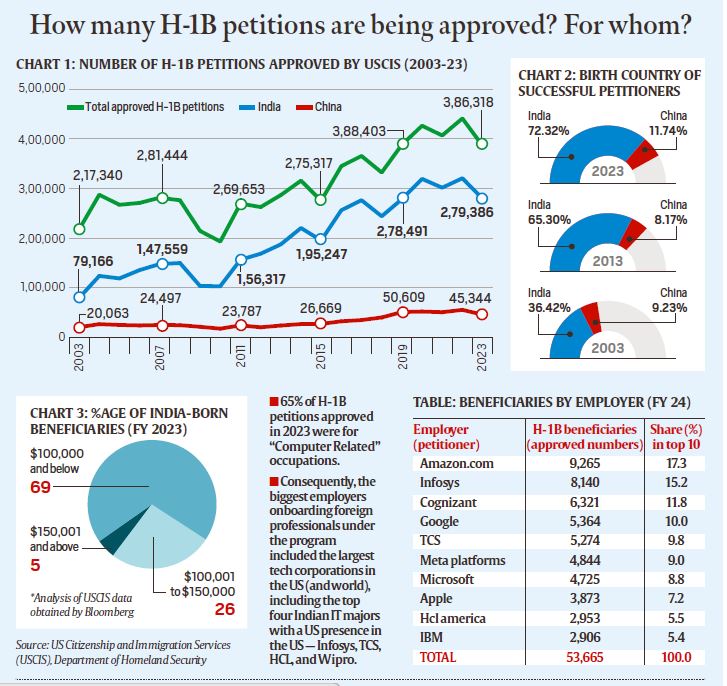
- During the fiscal year 2023 (October 2022 to September 2023), over 386,000 H-1B applications were approved. This figure includes nearly 119,000 new visas and approximately 267,000 extensions.
- The total number of approvals in 2023 reflects a decline from over 474,000 in the previous fiscal year, 2022
- Immigration remains one of the most divisive political topics in the United States. An October YouGov poll revealed that 14.6% of registered voters considered it the most critical issue in the upcoming election, a significant increase from just 2.1% in 2012.
- During election campaigns, much of the anti-immigration discourse centered on low-skilled labor migration. Beyond its inherent racial undertones, this narrative is driven by the perception that such immigration lowers wages and displaces jobs that might otherwise benefit the American working class.
- This demographic has long struggled with challenges like high unemployment, stagnant wages, inflation, a housing crisis, and other economic difficulties.
- Donald Trump effectively leveraged these concerns, pledging to improve conditions for the average American worker by restricting immigration.
- The current debate echoes many of the same themes as Trump’s rhetoric about Mexicans "stealing American jobs," though the focus has shifted to the immigration of skilled workers competing for higher-paying positions
- The H-1B visa program enables U.S. employers to hire foreign workers for roles requiring "a high level of skill" and "at least a bachelor’s degree," as outlined by the U.S. Department of Labor.
- Established in 1990, the program was designed to assist employers in filling roles that demand specialized skills not readily available within the U.S. workforce, allowing qualified foreign individuals to work temporarily in the United States.
- H-1B visas are typically issued for a maximum of six consecutive years. After this period, visa holders must either leave the U.S. for at least 12 months before returning or apply for permanent residency (a Green Card).
- Currently, the program has an annual limit of 65,000 new visas (the regular cap), with an additional 20,000 visas available for applicants holding master’s degrees or higher from U.S. universities. However, not all H-1B applications are subject to this cap, resulting in the total number of approved petitions often exceeding the cap.
- For example, in the fiscal year 2023, the United States Citizenship and Immigration Services (USCIS), under the Department of Homeland Security, approved 118,948 petitions for initial employment and 267,370 petitions for continuing employment.
- Certain applicants, such as those employed by higher education institutions, nonprofit organizations affiliated with such institutions, nonprofit research organizations, or government research entities, are exempt from the annual cap
- Indian nationals are the primary beneficiaries of the H-1B visa program, consistently accounting for over 70% of all approved H-1B petitions annually since 2015, according to U.S. government data. Chinese nationals rank a distant second, making up 12-13% of approvals since 2018.
- This significant representation of Indian professionals has drawn the attention of nativist MAGA Republicans, who have extended their anti-immigration rhetoric from low-skilled labor migration by Mexicans and Central Americans to include Indian workers in the tech industry.
- Their argument revolves around the claim that the H-1B program, originally designed to attract exceptional global talent, is being exploited by tech companies to fill lower- to mid-level positions at wages much lower than those expected by American workers.
- While proponents like Elon Musk argue that H-1B visas address a "permanent shortage of excellent engineering talent," critics counter that the issue is not a lack of skilled American workers but that they are deemed "too expensive to hire" by tech firms.
- This critique is supported by data. An analysis of 60,000 H-1B approvals from USCIS in the 2023 fiscal year, conducted by Bloomberg, revealed that nearly 70% of Indian H-1B recipients earned annual salaries below $100,000.
- For comparison, the median salary for IT professionals in the U.S. was $104,420 in May 2023, as reported by the U.S. Bureau of Labor Statistics. Approximately 25% of H-1B approvals for Indian professionals fell within the $100,000 to $150,000 salary range, while only 5% exceeded $150,000
|
For Prelims: H-1B visa, United States, U.S. Citizenship and Immigration Services, STEM fields, lottery system,
For Mains:
1. What are the implications of the new H-1B visa regime for US-India relations?
Discuss the measures can the Indian government take to support Indian IT workers affected by the new H-1B visa regime. (250 Words)
|
|
Previous Year Questions
1. Consider the following statements: (UPSC 2019)
1. Coal sector was nationalized by the Government of India under Indira Gandhi.
2. Now, coal blocks are allocated on lottery basis.
3. Till recently, India imported coal to meet the shortages of domestic supply, but now India is self-sufficient in coal production.
Which of the statements given above is/are correct?
A. 1 only B. 2 and 3 only C. 3 only D. 1, 2 and 3
Answer: A
2. Which of the following statements about town planning in British India in early 19th century is/are correct? (UPSC CAPF 2018)
1. The funds for town improvement were also raised through public lotteries.
2. The threats of epidemics gave an impetus to town planning in the early decades of 19th century.
Select the correct answer using the code given below
A.1 only B. 2 only C. Both 1 and 2 D. Neither 1 nor 2
Answer: C
|
OTHER BACKWARD CLASSES
1. Context
The Telangana government has approached the Supreme Court against a State High Court decision to stay two Government Orders that enhanced the Other Backward Classes (OBC) quota in seats in municipalities and panchayats to 42%.
2. About the sub-categorization of OBCs
- The concept of sub-categorization of OBCs involves creating sub-groups within the larger OBC category for reservation purposes.
- Currently, OBCs are granted 27% reservation in jobs and education under the central government.
- However, there has been a debate over the equitable distribution of these benefits among the various OBC communities.
- Some argue that a few affluent communities within the Central List of OBCs have disproportionately secured the majority of the reservation benefits.
- Creating sub-categories aims to ensure a fairer distribution of representation among all OBC communities.
3. The Rohini Commission's Brief
- To examine the extent of inequitable distribution of reservation benefits among the OBC castes or communities included in the Central List.
- To devise a scientific approach for sub-categorization within the OBCs, including defining the mechanism, criteria, norms, and parameters.
- To identify respective castes, communities, sub-castes, or synonyms in the Central List of OBCs and classify them into their respective sub-categories.
- To study the Central List of OBCs and rectify any repetitions, ambiguities, inconsistencies, and errors.
- The Commission's progress has faced various challenges, including the absence of data on the population of different communities to compare their representation in jobs and education.
- Initially, the Commission had requested an all-India survey to estimate the caste-wise population of OBCs but later decided against it.
- Additionally, the government has remained silent on the collection of OBC data in the Census, despite demands from OBC groups.
4. The Extent of OBC Recruitment in Central Jobs
- As part of its findings, the Commission analyzed data from the preceding five years on OBC quota-based central jobs and admissions to central higher education institutions.
- It revealed that a disproportionate number of jobs and educational seats went to a small fraction of OBC sub-castes, with 37% of the total OBC communities having no representation in jobs and educational institutions.
- Regarding OBC representation in central jobs, as of March 17, the data showed that 20.26% of Group A to Group C employees were OBCs.
- However, the representation drops to 16.88% in Group A, where the reservation for OBCs is 27%.
5. The Way Forward
- Despite the challenges faced, the Commission has made significant progress, including drafting a report on sub-categorization.
- However, the final report is yet to be submitted. The extended tenure will provide the Commission with additional time to address the complexities of OBC sub-categorization and propose measures to achieve equitable distribution of reservation benefits among all OBC communities.
|
For Prelims: Rohini Commission, OBCs, Central List
For Mains:
1. Discuss the role of the government in addressing the demand for the enumeration of OBCs in the Census and its potential impact on OBC representation and welfare." (250 Words)
|
|
Previous Year Questions
1. Who was appointed as the head of the OBC Sub-categorisation Commission?
(Maharashtra Talathi 2019)
A. Justice Geeta Mittal
B. Justice Manjula Chellur
C. Justice Tahilramani
D. Justice G. Rohini
Answer: D
2. Which of the following pairs of list and contents is/are correctly matched? (UPSC CAPF 2019)
1. State list Public health and sanitation
2. Union list Citizenship, naturalisation and aliens
3. Concurrent list Legal, medical and other
Select the correct answer using the code given below:
A. 1 only B. 1, 2 and 3 C. 2 and 3 only D. 3 only
Answer: B
|
NATIONAL COMMISSION FOR SCHEDULED CASTES (NCSC)

- The National Commission for Scheduled Castes (NCSC) in India performs various functions to safeguard the rights and interests of Scheduled Castes (SCs)
- The commission investigates and monitors the implementation of constitutional and legal safeguards for Scheduled Castes.
- It examines the factors that inhibit the full realization of the rights and safeguards provided to Scheduled Castes
- The NCSC has the authority to inquire into specific complaints and grievances regarding the deprivation of rights or atrocities committed against Scheduled Castes.
- It can summon evidence and witnesses during the inquiry process
- The commission advises the central and state governments on policy matters related to the welfare and development of Scheduled Castes.
- It recommends measures for the effective implementation of constitutional safeguards
- The NCSC reviews the progress of the development and welfare programs designed for Scheduled Castes.
- It suggests measures to ensure that these programs are effectively implemented and reach the targeted beneficiaries
- Ensuring the protection of the rights and interests of Scheduled Castes as enshrined in the Constitution of India.
- Taking steps to prevent atrocities and discrimination against Scheduled Castes
- Overseeing the implementation of reservations in educational institutions, employment, and other spheres for Scheduled Castes.
- Addressing issues related to the proper implementation of reservation policies
- Regularly reviewing the working of various constitutional safeguards and provisions for Scheduled Castes.
- Recommending amendments to existing laws or the enactment of new laws to improve the status and condition of Scheduled Castes
- The commission submits periodic and special reports to the President of India and to the Parliament on its findings, recommendations, and the overall status of Scheduled Castes
The key features of the composition are as follows:
-
Chairperson: The Chairperson is the head of the NCSC and is appointed by the President of India. The Chairperson is typically a person who has held a high judicial office or has wide experience in matters related to the Scheduled Castes.
-
Vice-Chairperson: The Vice-Chairperson, like the Chairperson, is appointed by the President of India. The Vice-Chairperson assists the Chairperson in carrying out the functions of the commission.
- Nine other Members: Appointed by the President on the recommendation of the Chairperson.
Current Composition (as of February 17, 2024):
- Chairperson: Shri Vijay Sampla
- Vice-Chairperson: Currently Vacant
- Members:
- Smt. Sunita Kumari
- Shri Mukesh Kumar Arya
- Smt. Paramjit Kaur Kainth
- Shri Parameswar Naik
- Smt. Rama Devi
- Shri Raj Kumar Valmiki
- Shri Suresh Chandra Ram
- Shri Shyam Sundar Ram
- Shri Ishwar Singh
The National Commission for Scheduled Castes (NCSC) has a rich history intertwined with the fight for equality and social justice for Scheduled Castes (SCs) in India. Here's a glimpse into its journey:
Early Beginnings (Pre-1987):
- 1950: The Constitution of India comes into effect, establishing Article 338 mandating the creation of a Special Officer for Scheduled Castes and Scheduled Tribes
- 1950-1987: The Commissioner for Scheduled Castes and Scheduled Tribes, a single-member body, investigates complaints of atrocities and discrimination against SCs and STs.
Evolution into a Multi-Member Commission (1987-Present):
-
1987: Recognizing the need for a more robust mechanism, the 65th Amendment to the Constitution replaces the single-member commission with a multi-member National Commission for Scheduled Castes and Scheduled Tribes (NCST).
-
1990: The NCST is bifurcated into two separate commissions: NCSC for SCs and the National Commission for Scheduled Tribes (NCST) for STs. This allows for focused attention on the specific needs of each community.
-
1992: The first NCSC is constituted with Shri S.H. Ramdhan as the Chairperson.
-
Since then: The NCSC has been reconstituted several times, with each Chairperson and Commission contributing to its evolving mandate and achievements.
|
For Prelims: National Commission for Scheduled Castes, Article 338 of the Constitution of India
For Mains: GS II - Indian Polity
|
|
Previous Year Questions
1. In 2001, RGI stated that Dalits who converted to Islam or Christianity are not a single ethnic group as they belong to different caste groups. Therefore, they cannot be included in the list of Scheduled Castes (SC) as per Clause (2) of Article 341, which requires a single ethnic group for inclusion. (UPSC CSE Mains GS2 2014) 2. Whether the National Commission for Scheduled Castes (NCSC) can enforce the implementation of constitutional reservation for the Scheduled Castes in the religious minority institutions? Examine. (UPSC CSE Mains GS2 2018) |
PERIODIC LABOUR FORCE SURVEY (PLFS)
1. Context
2. About The Periodic Labour Force Survey (PLFS)
- The Periodic Labour Force Survey (PLFS) is a sample survey conducted by the National Sample Survey Office (NSSO) of India to provide information on the labour force and employment situation in the country.
- The survey is conducted annually in all the states and union territories of India.
- The PLFS provides data on various employment indicators, including the labour force participation rate (LFPR), unemployment rate (UR), worker population ratio (WPR), and employment by industry and occupation.
- The PLFS sheds light on the proportion of individuals seeking employment, the unemployment rate, gender disparities in employment and wages, and the sectoral distribution of workers.
- Additionally, it details the types of employment, such as casual labour, self-employment, and regular salaried jobs.
- This comprehensive data is crucial for understanding the dynamics of the Indian labour market and formulating effective employment strategies.
- The Periodic Labour Force Survey (PLFS) collects employment data using two methods: Usual Status (US) and Current Weekly Status (CWS).
- In the US method, respondents are asked to recall their employment details for the past year, while in the CWS method, they are asked to recall their employment details for the past week.
- The labour force estimate derived from the US method includes individuals who worked or were seeking/available for work for a significant portion of the past year, as well as those who worked for at least 30 days during the reference period.
- Conversely, the labour force estimate based on the CWS method encompasses those who worked for at least one hour or sought/were available for work for at least one hour on any day during the past week.
- The global trend has shifted towards a greater emphasis on CWS data due to the improved accuracy of recall for shorter reference periods.
4. Latest findings of the Report
Unemployment Rate (UER)
- The UER is often the most talked about metric in popular discourse. Simply put, it refers to the proportion of people who demanded work over the past year and failed to get it.
- As the data in Table 1 shows, for the population above 15 years of age, the UER has fallen significantly from 6.6% to 5.1% over the last year (that is, July to June cycle).
- Simply put, 5.1% of all the people above 15 years of age who demanded work failed to get one.
Labour Force Participation Rate (LFPR)
- The Unemployment Rate (UER) is calculated as a proportion of the population that is demanding work.
- However, this population also fluctuates for various reasons. The Labor Force Participation Rate (LFPR) is a measure of the total population demanding work, expressed as a proportion of the total population above 15 years of age.
- As seen in Table 1, India's LFPR, which had been gradually increasing, has experienced a significant surge in the past year.
- As of 2022-23, 54.6% of all Indians above the age of 15 were actively seeking employment.
LFPR for women
- This metric looks at LFPR among women to ascertain where the additional demand for jobs is coming from.
- The data shows that female LFPR has gone up over the years but there were two discrete step-ups one in 2019-20 (when India’s GDP growth rate had slowed down to less than 4% and this was before the Covid pandemic hit) and the second in 2022-23 when it rose to 31.6%.
Worker Population Rate
- Since the proportion of people demanding work (the LFPR) goes up and down and the percentage of those failing to get a job (the UER) is expressed as a proportion of the former, it can throw off analysis.
- As such, there is another way to look at the labour market: Worker Population Ratio (WPR).
- The WPR is the percentage of persons employed among the persons in the population.
- Thus, instead of looking at how many demand a job and how many fail to get it, the WPR simply gives a measure of how many people have a job as a proportion of the total population.
- This metric too has been going up and especially noteworthy are the two discrete
step-ups in 2019-20 and 2022-23.
WPR among women
Monthly earnings
Distribution of workers
5. Key Trends in PLFS 2022-23
- Upon initial analysis, the Periodic Labour Force Survey (PLFS) for 2022-23 reveals several encouraging trends. The unemployment rate is on a downward trajectory, and both the Labor Force Participation Rate (LFPR) and Workforce Participation Rate (WPR) exhibit substantial increases. A particularly heartening development is the notable rise in the participation of women in the workforce. This suggests a positive correlation between economic recovery and the creation of more employment opportunities, especially for women.
- However, a closer examination of the nature and remuneration of these new jobs alters the understanding. The predominant trend is the emergence of jobs falling under the category of "self-employment." Typically, in a growing economy, businesses tend to hire more employees. Conversely, during economic challenges, individuals often transition from regular employment to "self-employed" status. This nuanced perspective prompts a reconsideration of the quality and sustainability of the employment being generated.
- Analyzing the trends among women across various metrics reveals an interesting dynamic. The data suggests that economic strains on household finances have led more women, previously outside the workforce, to join in. However, a noteworthy observation is the prevalence of women taking up roles as "unpaid helpers in household enterprises," highlighting a complex interplay between economic conditions and women's workforce participation.
- Furthermore, an examination of the sectoral landscape indicates a regressive shift in India's employment patterns. Notably, there has been an increase in the proportion of Indians employed in agriculture over the past year, while the numbers in manufacturing have witnessed a decline. This shift underscores the evolving economic dynamics and sectoral preferences shaping the employment scenario.
- In a thriving economy, one would expect an improvement in monthly incomes. However, the Indian scenario deviates from this expectation. Despite positive indicators in other areas, the data suggests that the overall economic boom is not translating into significant improvements in monthly incomes for individuals in India. This anomaly prompts a closer examination of the factors contributing to this divergence.
6. The WayForward
While there are positive signals in the headline indicators, a more nuanced analysis reveals complexities like job creation, women's participation dynamics, sectoral shifts, and income patterns. This holistic perspective is essential for a comprehensive understanding of the multifaceted impact of economic trends on the labour market in India.
|
For Prelims: Periodic Labour Force Survey, National Sample Survey Office, labour force participation rate, worker population ratio
For Mains:
1. Examine the changing nature of employment in India, as reflected in the increasing share of self-employment and the declining proportion of regular salaried jobs. Discuss the implications of this shift for the quality and sustainability of employment. (250 Words)
|
|
Previous Year Questions 1. Given below are two statements, one is labeled as Assertion (A) and the other as Reason (R). (UPPSC 2019)
Assertion (A): The labour force participation rate is falling sharply in recent years for females in India.
Reason (R): The decline in labour force participation rate is due to improved family income and an increase in education.
Select the correct answer from the codes given below:
Codes:
A. Both (A) and (R) are true and (R) is the correct explanation of (A)
B. Both (A) and (R) are true and (R) is not the correct explanation of (A)
C. (A) is true, but (R) is false
D. (A) is false, but (R) is true
2. Which of the following statements about the employment situation in India according to the periodic Labour Force Survey 2017-18 is/are correct? (UPSC CAPF 2020)
1. Construction sector gave employment to nearly one-tenth of the urban male workforce in India
2. Nearly one-fourth of urban female workers in India were working in the manufacturing sector
3. One-fourth of rural female workers in India were engaged in the agriculture sector
Select the correct answer using the code given below:
A. 2 only B. 1 and 2 only C. 1 and 3 only D. 1, 2 and 3
3. Disguised unemployment generally means (UPSC 2013)
(a) large number of people remain unemployed
4. Assertion (A): Workers - population ratio in India is low in contrast to that in developed countries. Reason (R): Rapid growth of population, low female worker population rate and omission of unpaid family workers lead to low worker-population ratio. Choose the correct answer: (Telangana Police SI Mains 2018) A. (A) is true, but (R) is false.
B. (A) is false, but (R) is true.
C. Both (A) and (R) are true, but (R) is not a correct explanation of (A).
D. Both (A) and (R) are true, but (R) is the correct explanation of (A).
Answers: 1-C, 2-B, 3-C, 4-D Mains1. Most of the unemployment in India is structural in nature. Examine the methodology adopted to compute unemployment in the country and suggest improvements. (UPSC 2023) |
Source: The Indian Express


