
FREE TRADE AGREEMENT
1. Context
2. About the Free Trade Agreement
- A Free Trade Agreement (FTA) is an agreement between two or more countries to reduce or eliminate barriers to trade, such as tariffs, quotas, and subsidies.
- FTAs can also include provisions on other issues, such as investment, intellectual property, and labour standards.
- The goal of an FTA is to promote trade and economic growth between the signatory countries.
- By reducing or eliminating trade barriers, FTAs can make it easier for businesses to export their goods and services to other countries, which can lead to increased production, employment, and innovation.
3. Types of Free Trade Agreement
- Bilateral Free Trade Agreement (BFTA) involves two countries, aiming to promote trade and eliminate tariffs on goods and services between them. It establishes a direct trade relationship, allowing for a more focused and tailored agreement between the two nations.
- Multilateral Free Trade Agreement (MFTA) Involving three or more countries, an MFTA seeks to create a comprehensive trade bloc, promoting economic integration on a larger scale. It requires coordination among multiple parties, addressing diverse economic interests and fostering a broader regional economic landscape.
- Regional Free Trade Agreement (RFTA) involves countries within a specific geographic region, aiming to enhance economic cooperation and integration within that particular area. It focuses on addressing regional economic challenges and fostering collaboration among neighbouring nations.
- Preferential Trade Agreement (PTA) involves a reciprocal reduction of tariffs and trade barriers between participating countries, granting preferential treatment to each other's goods and services. It allows countries to enjoy trading advantages with specific partners while maintaining autonomy in their trade policies with non-participating nations.
- Comprehensive Economic Partnership Agreement (CEPA) is a broad and advanced form of FTA that goes beyond traditional trade barriers, encompassing various economic aspects such as investment, intellectual property, and services. It aims for a more comprehensive economic partnership, encouraging deeper integration and collaboration between participating countries.
- Customs Union While not strictly an FTA, a Customs Union involves the elimination of tariffs among member countries and the establishment of a common external tariff against non-member nations. It goes beyond standard FTAs by harmonizing external trade policies, creating a unified approach to trade with the rest of the world.
- Free Trade Area (FTA) with Trade in Goods (TIG) and Trade in Services (TIS): Some FTAs specifically emphasize either trade in goods or trade in services, tailoring the agreement to the specific economic strengths and priorities of the participating countries. This approach allows nations to focus on areas where they have a comparative advantage, fostering specialization and efficiency.
4. India's Free Trade Agreements
India is a member of several free trade agreements (FTAs) and is currently negotiating others. India's FTAs have helped to reduce trade barriers and promote trade and economic growth. They have also helped to attract foreign investment and create jobs.
- The South Asian Free Trade Agreement (SAFTA) was signed in 1995 by the seven countries of the South Asian Association for Regional Cooperation (SAARC). SAFTA aims to reduce or eliminate tariffs on trade between the member countries.
- The India-Bangladesh FTA was signed in 2010 and came into force in 2011. It is a comprehensive FTA that covers goods, services, and investments.
- The India-Sri Lanka FTA was signed in 1999 and came into force in 2000. It is a comprehensive FTA that covers goods, services, and investments.
- The India-ASEAN Free Trade Agreement was signed in 2002 and came into force in 2010. It is a comprehensive FTA that covers goods, services, and investments.
- The India-Korea Comprehensive Economic Partnership Agreement (CEPA) was signed in 2010 and came into force in 2011. It is a comprehensive FTA that covers goods, services, and investments.
- The India-Japan Comprehensive Economic Partnership Agreement(CEPA) was signed in 2022 and came into effect in 2023. It is a comprehensive FTA that covers goods, services, and investments.
- The India-UAE Comprehensive Partnership Agreement (CEPA) was signed in 2022 and came into effect in 2022. It is a comprehensive FTA that covers goods, services, and investments.
- The India-Australia Economic Cooperation and Trade Agreement (ECTA) was signed in 2022 and came into effect in 2022. It is a comprehensive FTA that covers goods, services, and investments.
- The India-Malaysia Comprehensive Economic Cooperation Agreement (CECA) was signed in 2010 and aims to enhance economic ties by addressing trade in goods and services, as well as investment and other areas of economic cooperation.
- The India-Thailand Free Trade Agreement was signed in 2003 and focuses on reducing tariffs and promoting trade in goods and services between India and Thailand.
- The India-Singapore Comprehensive Economic Cooperation Agreement (CECA) has been operational since 2005, this agreement covers trade in goods and services, as well as investment and intellectual property.
- The India-Nepal Trade Treaty While not a comprehensive FTA, India and Nepal have a trade treaty that facilitates the exchange of goods between the two countries.
- The India-Chile Preferential Trade Agreement was signed in 2006 and aims to enhance economic cooperation and reduce tariffs on certain products traded between India and Chile.
5. India - UK Free Trade Agreement
5.1. Background
- Both countries have agreed to avoid sensitive issues in the negotiations.
- The interim (early harvest agreement) aims to achieve up to 65 per cent coverage for goods and up to 40 per cent coverage for services.
- By the time the final agreement is inked, the coverage for goods is expected to go up to "90 plus a percentage" of goods.
- India is also negotiating a similar early harvest agreement with Australia, which is supposed to set the stage for a long-pending Comprehensive Economic Cooperation Agreement that both countries have been pursuing for nearly a decade.
- While the commencement of negotiations does mark a step forward in the otherwise rigid stance adopted and when it comes to trade liberalisation, experts point to impediments and the potential for legal challenges going ahead.
5.2. GATT (General Agreement on Trade and Tariffs)
- The exception to the rule is full-scale FTAs, subject to some conditions.
- One rider, incorporated in Article XXIV.8 (b) of GATT, stipulates that a deal should aim to eliminate customs duties and other trade barriers on "Substantially all the trade" between the WTO member countries that are signatories to an FTA.
- For this Agreement, a free-trade area shall be understood to mean a group of two or more customs territories in which the duties and other restrictive regulations of commerce are eliminated on substantially all the trade between the constituent territories in products originating in such territories.
- It is often beneficial to negotiate the entire deal together, as an early harvest deal may reduce the incentive for one side to work towards a full FTA.
- These agreements are not just about goods and services but also issues like investment.
- If you are trying to weigh the costs and benefits, it is always better to have the larger picture in front of you.
- In the case of the early harvest agreement inked with Thailand, automobile industry associations had complained that relaxations extended to Bangkok in the early harvest had reduced the incentive for Thailand to work towards a full FTA.
- Early harvest agreements may serve the function of keeping trading partners interested as they promise some benefits without long delays, as India becomes known for long-drawn negotiations for FTAs.
- Government emphasis on interim agreements may be tactical so that a deal may be achieved with minimum commitments and would allow for contentious issues to be resolved later.
|
For Prelims: Free Trade Agreement, India-U.K, Bilateral Free Trade Agreement, G-20 Summit, Agenda 2030, Covid-19 Pandemic, SAARC, General Agreement on Trade and Tariffs, Comprehensive Economic Partnership Agreement, Multilateral Free Trade Agreement, Regional Free Trade Agreement, Preferential Trade Agreement, Customs Union,
For Mains:
1. Evaluate the potential impact of the India-UK FTA on the Indian economy, considering both positive and negative aspects (250 Words)
2. Critically evaluate the significance of Free Trade Agreements (FTAs) in promoting trade and economic growth, considering their potential benefits and drawbacks. (250 Words)
|
|
Previous Year Questions
1. Consider the following countries:
1. Australia
2. Canada
3. China
4. India
5. Japan
6. USA
Which of the above are among the free-trade partners' of ASEAN? (UPSC 2018)
A. 1, 2, 4 and 5 B. 3, 4, 5 and 6 C. 1, 3, 4 and 5 D. 2, 3, 4 and 6
Answer: C
2. Increase in absolute and per capita real GNP do not connote a higher level of economic development, if (UPSC 2018) (a) Industrial output fails to keep pace with agricultural output. Answer: C 3. The SEZ Act, 2005 which came into effect in February 2006 has certain objectives. In this context, consider the following: (2010)
Which of the above are the objectives of this Act? (a) 1 and 2 only (b) 3 only (c) 2 and 3 only (d) 1, 2 and 3 Answer: A 4. A “closed economy” is an economy in which (UPSC 2011) (a) the money supply is fully controlled Answer: D 5. With reference to the “G20 Common Framework”, consider the following statements: (UPSC 2022)
1. It is an initiative endorsed by the G20 together with the Paris Club. 2. It is an initiative to support Low Income Countries with unsustainable debt. Which of the statements given above is/are correct? (a) 1 only (b) 2 only (c) Both 1 and 2 (d) Neither 1 nor 2 Answer: C
|
INDIA SEMICONDUCTOR MISSION (ISM)

- Semiconductors form the backbone of modern technology, driving critical sectors such as healthcare, transport, communication, defence, and space. With increasing digitalization and automation worldwide, they have become vital for both economic security and strategic autonomy.
- Since the launch of the India Semiconductor Mission (ISM) in 2021, India has rapidly advanced from vision to execution in its semiconductor roadmap.
- To accelerate this effort, the government rolled out a ₹76,000 crore Production Linked Incentive (PLI) scheme, of which nearly ₹65,000 crore has already been allocated.
- As part of these initiatives, Prime Minister Narendra Modi will inaugurate SEMICON India 2025 on September 2 in New Delhi. Marking its fourth edition, the event will be the country’s largest, bringing together 350+ companies from 33 nations and numerous global stakeholders.
- Jointly organized by ISM under the Ministry of Electronics and IT (MeitY) and SEMI, the global semiconductor association, this event underscores India’s ambition to emerge as a global hub.
- A significant milestone was also achieved on August 28, 2025, with the launch of one of India’s first Outsourced Semiconductor Assembly and Test (OSAT) Pilot Line Facilities in Sanand, Gujarat. From this facility, CG-Semi is expected to deliver the first “Made in India” chip.
- India’s push spans chip design, packaging, and fabrication, signaling its determination to achieve self-reliance. Under the Design Linked Incentive (DLI) scheme, 23 chip design projects have been sanctioned to support startups and innovators.
- Firms like Vervesemi Microelectronics are developing advanced chips for defence, aerospace, electric vehicles, and energy solutions, highlighting India’s shift from being merely a consumer to becoming a global semiconductor creator
- The Government of India has introduced the SEMICON India Programme with an outlay of ₹76,000 crore, carried out under the framework of the India Semiconductor Mission (ISM).
- SEMICON India serves as a platform that brings together global industry leaders, policymakers, academic institutions, and startups to encourage investment, facilitate dialogue, and build strategic partnerships.
- It plays a pivotal role in furthering ISM’s objectives by promoting international collaborations, driving research-to-market transitions, strengthening skill development, and highlighting India’s emerging position in the global semiconductor supply chain.
- So far, three editions of SEMICON India have been successfully organized — Bangalore (2022), Gandhinagar (2023), and Greater Noida (2024). The upcoming SEMICON India 2025 will underscore India’s evolving role in the semiconductor ecosystem worldwide.
- Over three days, the event will convene policymakers, innovators, industry leaders, academic researchers, and other stakeholders to foster collaboration and technological progress across the value chain.
- It is expected to attract strong participation from business executives, equipment manufacturers, design professionals, scientists, engineers, researchers, students, and technicians linked to the microelectronics sector
- Semiconductors are unique materials with the ability to function as both conductors and insulators, allowing them to regulate the flow of electricity—making them ideal for electronic circuits.
- When billions of these are embedded in a single chip, they enable devices to perform complex tasks such as making phone calls, capturing photos, or even guiding a spacecraft’s landing, as seen in Chandrayaan-3’s Vikram lander, which relied on Indian-built technology and AI.
- A semiconductor chip can be imagined as a miniature city, filled with billions of transistors—tiny switches—and countless intricate components working in harmony. From smartphones and electric vehicles to national defence systems, these chips act as the hidden engines of modern life.
- They form the backbone of contemporary technology, supporting healthcare, transportation, defence, and space exploration. With the world moving rapidly towards digitalisation and automation, semiconductors have become central to economic security and strategic autonomy.
- The global shortages witnessed during the Covid-19 pandemic and the Ukraine conflict highlighted their importance, as disruptions hit electronics manufacturing worldwide.
- Demand for smaller, faster, and more efficient chips is being driven by the growth of smart devices and artificial intelligence, which requires high-performance chips for real-time data processing.
- At present, semiconductor production is dominated by Taiwan, South Korea, Japan, China, and the US. Taiwan alone produces over 60% of the world’s chips and nearly 90% of the most advanced variants, exposing global supply chains to significant vulnerabilities.
- To counter this, countries—including India—are investing in domestic semiconductor manufacturing and working to diversify supply chains, aiming to build a more secure and resilient global ecosystem for the future
The global demand for semiconductors is rising rapidly, yet the supply chain remains highly vulnerable due to the industry being concentrated in just a few regions. This highlights the urgent need for diversified global manufacturing.
India is steadily emerging as a significant player in this space. Initiatives such as prioritizing Electronics Systems Design and Manufacturing (ESDM) under the Make in India programme, along with the India Semiconductor Mission and SEMICON India, have helped build a supportive ecosystem for the sector.
The global semiconductor market is projected to reach USD 1 trillion by 2030, with India poised to capture a notable share. The country has the potential to contribute significantly across the three main pillars of the semiconductor manufacturing supply chain:
-
Equipment – Leveraging a robust MSME sector to manufacture components for semiconductor machinery.
-
Materials – Utilizing India’s abundant chemicals, minerals, and specialty gases essential for semiconductor production.
-
Services – Offering expertise in R&D, logistics, supply chain management, and a skilled workforce in AI, big data, cloud computing, and IoT
- Building on the rapid progress of its semiconductor journey, India is undergoing a transformative shift to emerge as a global leader in chip design, packaging, and manufacturing of Made in India chips.
- With the growing adoption of intelligent chips, the country is enhancing its packaging technologies to compete globally. In fabrication, India is transitioning from conventional silicon-based semiconductors to advanced Silicon Carbide (SiC) semiconductors, while in design, it plans to implement 3D glass packaging technology.
- Silicon Carbide offers greater stability and durability than traditional silicon, tolerating temperatures up to 2,400°C and high-voltage conditions, making it crucial for defence systems, missiles, radars, and space rockets.
- Thanks to coordinated industry efforts, India is set to roll out its first domestically made chip soon. These developments will establish India as a global hub for semiconductor design, fabrication, and manufacturing.
- The India Semiconductor Mission (ISM) supports investments in semiconductor fabrication, display manufacturing, and chip design, aiming to strengthen India’s position in the global electronics value chain.
- Guided by global experts, ISM seeks to build a robust semiconductor and display ecosystem and serves as the nodal agency for efficient implementation of related schemes.
- Currently, India has 10 approved semiconductor projects across six states, including its first commercial Silicon Carbide fabrication plant in Odisha and an advanced packaging unit introducing next-generation technologies.
- Together, these projects involve investments of ₹1.60 lakh crore, positioning India alongside global semiconductor leaders.
Key focus areas of the India Semiconductor Mission (ISM):
-
Establishing chip manufacturing plants (fabs)
-
Developing packaging and testing facilities
-
Supporting chip design startups
-
Training young engineers
-
Encouraging global companies to invest in India
-
Develop a long-term roadmap for building sustainable semiconductor and display manufacturing facilities, along with a robust semiconductor design ecosystem in India.
-
Support the creation of a secure and trusted microelectronics supply chain, covering raw materials, specialty chemicals, gases, and manufacturing equipment.
-
Drive exponential growth in India’s semiconductor design sector by offering essential support such as Electronic Design Automation (EDA) tools, foundry services, and other mechanisms for early-stage startups.
-
Promote the generation of indigenous Intellectual Property (IP) within the semiconductor and display industry.
-
Facilitate and incentivize Technology Transfer (ToT) from global and domestic sources.
-
Create mechanisms to leverage economies of scale within India’s semiconductor and display industry.
-
Encourage cutting-edge research in both evolutionary and revolutionary semiconductor and display technologies through grants, international collaborations, and dedicated initiatives in academia, research institutions, and industry, including the establishment of Centres of Excellence (CoEs).
-
Foster collaborations and partnerships with national and international agencies, industries, and institutions to accelerate research, commercialization, and skill development
India’s ambitious semiconductor initiative, highlighted by SEMICON India 2025, marks a transformative phase in the country’s pursuit of technological self-reliance and innovation. Supported by government programs such as the Production Linked Incentive (PLI) scheme, significant financial investments, and strategic allocation of resources, India is building a comprehensive semiconductor ecosystem. This approach not only ensures prudent investment but also strengthens the foundation for a resilient semiconductor industry capable of powering sectors from electronics to automobiles.
Beyond just chips, SEMICON India 2025 symbolizes India’s drive toward self-sufficiency, innovation, and global leadership. By promoting “Designed and Made in India” technologies, the event underscores the country’s ambition to shape the future of the global semiconductor landscape and position itself as a key player in this critical strategic sector
|
For Prelims: Semiconductor, Transistors, Fabrication Technology
For Mains:
1. Discuss the recent global chip shortage and its implications for India's semiconductor industry. What steps has India taken to enhance its domestic chip manufacturing capabilities? (250 Words)
|
|
Previous Year Questions
1. Which of the following fabrication techniques is ideally suited for digital ICs?
(KVS TGT WET 2017)
A. Monolithic B. Thin film C. Hybrid D. Thin film and hybrid
Answer: A
|
INDIA-AUSTRALIA RELATIONSHIP
- The India-Australia bilateral relationship has been underpinned by the shared values of pluralistic, Westminster-style democracies, Commonwealth traditions, expanding economic engagement, and increasing high-level interaction
- Several common traits, including strong, vibrant, secular, and multicultural democracies, a free press, an independent judicial system, and English language, serve as the foundation for closer co-operation and multifaceted interaction between the two countries
- The end of the Cold War and beginning of India’s economic reforms in 1991 provided the impetus for the development of closer ties between the two nations.
- The ever-increasing numbers of Indian students travelling to Australia for higher education, and the growing tourism and sporting links, have played a significant role in strengthening bilateral relations
- With the passage of time, ties evolved in the direction of a strategic relationship, alongside the existing economic engagement
- In recent years, the relationship has charted a new trajectory of transformational growth
- With greater convergence of views on issues such as international terrorism, and a shared commitment to a rules-based order in the Indo-Pacific region, the two democracies have taken their cooperation to plurilateral formats, including the Quad (with the United States and Japan).
- In September 2014, Australia’s Prime Minister Tony Abbott visited India, and in November that year, Modi became the first Indian Prime Minister to make an official visit to Australia after Rajiv Gandhi in 1986
- He also became the first Indian PM to address a joint sitting of the Parliament of Australia
- At the India-Australia Leaders’ Virtual Summit in June 2020, Modi and Prime Minister Scott Morrison elevated the bilateral relationship from the Strategic Partnership concluded in 2009 to a Comprehensive Strategic Partnership (CSP)
- At the 2nd India-Australia Virtual Summit in March 2022, several key announcements were made, including on a Letter of Intent on Migration and Mobility Partnership Arrangement to foster the exchange of skills, and a Letter of Arrangement for Educational Qualifications Recognition to facilitate the mobility of students and professionals
- There has been a series of high-level engagements and exchange of ministerial visits in 2022 and in 2023
- It is the first Free Trade Agreement (FTA) that India has signed with a major developed country in over a decade.
- The Agreement encompasses cooperation across the entire gamut of bilateral economic and commercial relations between the two friendly countries, and covers areas like:
- Trade in Goods, Rules of Origin
- Trade in Services
- Technical Barriers to Trade (TBT)
- Sanitary and Phytosanitary (SPS) measures
- Dispute Settlement, Movement of Natural Persons
- Telecom, Customs Procedures
- Pharmaceutical products, and Cooperation in other Areas
- The India-Australia Economic and Cooperation Trade Agreement (Ind-Aus ECTA ), which is expected to double trade between the two countries to $50 billion, came into effect.
- The Ind-Aus ECTA provides an institutional mechanism to encourage and improve trade between the two countries
- It covers almost all the tariff lines dealt by India and Australia
- India will benefit from preferential market access provided by Australia on 100% of its tariff lines, including all the labor-intensive sectors of export interest to India, such as Gems and Jewellery, Textiles, leather, footwear, furniture among other
- On the other hand, India will be offering preferential access to Australia on over 70% of its tariff lines, including lines of export interest to Australia, which are primarily raw materials and intermediaries such as coal, mineral ores and wines
- Products like agricultural products and the dairy sector - which were very sensitive for India and without which Australia has never done an agreement before - have been protected
- It is estimated that an additional 10 lakh jobs would be created in India under ECTA
|
Previous Year Questions :
1.Consider the following countries: (2018 UPSC)
Which of the above are among the ‘free-trade partners’ of ASEAN? (a) 1, 2, 4 and 5 Ans: (c) |
INTERCONTINENTAL BALLISTIC MISSILE
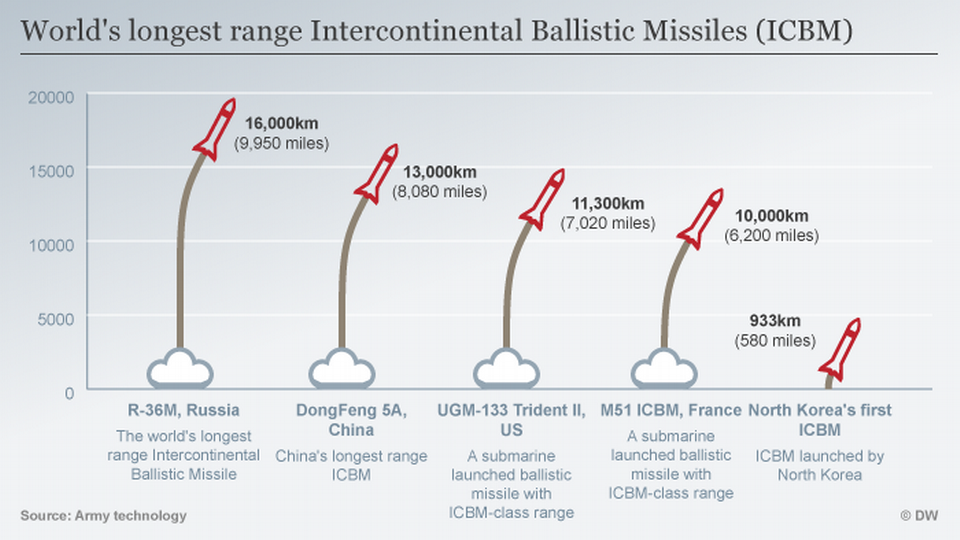
- An intercontinental ballistic missile (ICBM) is a long-range missile system designed to deliver nuclear or conventional warheads over very long distances. These missiles are capable of traveling thousands of kilometers, typically between continents, hence the term "intercontinental."
- ICBMs are one of the key components of a country's strategic nuclear arsenal and serve as a deterrent against potential adversaries. They are designed to be launched from land-based silos, mobile platforms, or submarines and can travel at high speeds, often reaching hypersonic velocities during their flight trajectory.
- The basic components of an ICBM system include the missile itself, the launch platform, and a guidance system to ensure precise targeting.
- Once launched, the missile follows a ballistic trajectory, which means it travels into space, then reenters the Earth's atmosphere to reach its target. The accuracy and reliability of ICBMs are of paramount importance in their role as a deterrent.
- ICBMs have been a significant part of the nuclear arms race during the Cold War, with the United States and the Soviet Union (and later Russia) developing extensive arsenals of these missiles. Other countries, such as China, France, and the United Kingdom, have also developed their own ICBMs.
- The possession of ICBMs provides a nation with the capability to strike targets on the other side of the globe, making them a critical element in the calculus of international security and arms control.
- A missile is a general term used for any guided weapon that is launched toward a target. Think of it as a broad family of weapons that includes many different types, such as air-to-air missiles, surface-to-air missiles, cruise missiles, anti-ship missiles, and ballistic missiles.
- What makes a missile different from an ordinary rocket or artillery shell is that it has some form of guidance system that helps it reach its target accurately.
- A ballistic missile, on the other hand, is a specific type of missile that follows a unique method of flight. After launch, powerful rocket engines propel it upward at very high speed.
- Once the fuel is exhausted, the engines stop working, and the missile continues its journey mainly under the influence of gravity, following a curved path known as a ballistic trajectory.
- This trajectory is similar to the path followed by a cricket ball thrown into the air, except that a ballistic missile travels much farther and much faster, often reaching the edge of space before descending toward its target.
- To understand the difference more clearly, imagine two ways of traveling from one city to another. In the first method, an aircraft keeps its engine running throughout the journey and can change direction whenever needed.
- This is similar to a cruise missile, which remains powered during most of its flight and continuously adjusts its course. In the second method, a projectile is launched with tremendous force, rises high into the sky, and then falls toward its destination along a predetermined path. This resembles a ballistic missile.
- For example, India's BrahMos is a cruise missile. It flies relatively low, remains powered during flight, and can maneuver to avoid detection. In contrast, Agni-V is a ballistic missile.
- It is launched vertically, climbs to a very high altitude, and then re-enters the atmosphere at extremely high speed before striking its target.
- Therefore, the relationship between the two is simple: a ballistic missile is a type of missile, but not all missiles are ballistic missiles. The key distinction lies in how they travel.
- Ordinary missiles may remain powered and guided throughout their flight, whereas ballistic missiles are powered mainly during the initial launch phase and then follow a gravity-driven ballistic path for most of their journey
Some of the countries known to have ICBMs include:
United States: The United States operates a variety of ICBMs, including the Minuteman III, which is a land-based ICBM, and the Trident II D5, which is a sea-launched ICBM.
Russia: Russia's Strategic Rocket Forces operate a range of ICBMs, including the RS-24 Yars, RS-12M Topol, and RS-28 Sarmat (nicknamed Satan 2).
China: China has developed and deployed ICBMs such as the DF-5, DF-31, and DF-41.
France: France has the M51 SLBM (Submarine-Launched Ballistic Missile) as part of its nuclear deterrent.
United Kingdom: The United Kingdom's nuclear deterrent is based on the Trident II D5 SLBM.
India: India's Agni-V is considered an ICBM, with the ability to reach intercontinental distances.
Pakistan: Pakistan has developed the Shaheen-III missile, which is capable of reaching intercontinental distances.
North Korea: North Korea has claimed to possess ICBMs, with the Hwasong-15 being one of their most advanced and longest-range missiles.
Israel: Israel has not officially confirmed the possession of ICBMs, but it is widely believed to have developed such capabilities as part of its nuclear deterrent.
5.Cruise Missiles and Ballistic Missiles: How Are They Different?
- Although both cruise missiles and ballistic missiles are designed to deliver a warhead to a target, they differ significantly in the way they fly, the technology they use, and the challenges they pose to air-defense systems.
- A ballistic missile is launched using powerful rocket engines that propel it to very high altitudes, sometimes even beyond the Earth's atmosphere.
- Once the rocket fuel is exhausted, the missile follows a curved, gravity-driven path known as a ballistic trajectory.
- It then re-enters the atmosphere and descends toward its target at extremely high speeds. In essence, a ballistic missile behaves somewhat like a stone thrown into the air: after the initial push, gravity largely determines its path.
- A cruise missile, by contrast, behaves more like a pilotless aircraft. After launch, it uses a jet engine or similar propulsion system to remain powered throughout most of its journey.
- Rather than climbing high into the sky, it typically flies at low altitudes, closely following the terrain, and continuously adjusts its course using onboard guidance systems. This allows it to navigate around obstacles and evade enemy radar.
- The difference in flight path is perhaps the most striking distinction. A ballistic missile travels in a high, arching trajectory, whereas a cruise missile flies relatively close to the ground.
- Because of this, cruise missiles are often harder to detect early, as they can remain hidden behind terrain features and below the radar horizon.
- Ballistic missiles, on the other hand, are easier to track during much of their flight because they reach very high altitudes, but they become difficult to intercept due to their tremendous speed during descent.
- Their speeds also differ considerably. Ballistic missiles are generally much faster, often traveling several times the speed of sound and, in some cases, reaching hypersonic velocities. Cruise missiles are usually slower, although some advanced systems can also achieve supersonic or hypersonic speeds.
- India provides good examples of both categories. The BrahMos is a cruise missile that remains powered throughout its flight and flies at low altitudes. In contrast, the Agni-V is a ballistic missile that follows a high-altitude ballistic trajectory before striking its target.
A Simple AnalogyImagine you want to deliver a package to a distant location:
|
- Ballistic Missile Defence (BMD) refers to a country's ability to detect, track, intercept, and destroy incoming ballistic missiles before they reach their targets. In an era when many countries possess ballistic missiles capable of carrying conventional, nuclear, chemical, or biological warheads, BMD has become a critical component of national security.
- The significance of BMD lies in the fact that ballistic missiles are among the fastest and most destructive weapons ever developed.
- Once launched, they can travel hundreds or thousands of kilometers within minutes and strike strategic targets such as cities, military bases, government installations, and critical infrastructure.
- A successful BMD system provides a defensive shield against such attacks by attempting to intercept the missile during different phases of its flight.
- For a country like India, BMD capability is particularly important because it enhances national security in a region where several countries possess ballistic missile arsenals.
- It reduces vulnerability to missile attacks and strengthens deterrence by making it more difficult for an adversary to achieve its objectives through missile strikes.
- Another major significance of BMD is the protection of population centers and strategic assets.
- Large metropolitan areas, military command centers, nuclear facilities, air bases, ports, and industrial hubs are all potential targets during a conflict.
- A functioning BMD system can provide an additional layer of security by intercepting incoming missiles before they reach these critical locations.
- BMD also contributes to strategic stability. If a country has confidence in its ability to defend against limited missile attacks, it gains greater decision-making time during crises and reduces the risk of panic-driven responses. This can help prevent escalation and provide political leaders with more options during emergencies.
- India's BMD programme, developed primarily by Defence Research and Development Organisation (DRDO), is designed as a multi-layered defense system.
- It includes interceptors capable of engaging incoming ballistic missiles both outside the atmosphere (exo-atmospheric interception) and within the atmosphere (endo-atmospheric interception).
- The objective is to create multiple opportunities to destroy an incoming missile before it reaches its target.
- However, BMD is not a perfect shield. Modern ballistic missiles may employ countermeasures such as decoys, maneuverable warheads, or multiple independently targetable reentry vehicles (MIRVs), making interception more challenging. Consequently, BMD is generally viewed as a supplement to deterrence rather than a complete replacement for it.
|
For Prelims: Current events of national importance
For Mains: General Studies-III: Achievements of Indians in science & technology; indigenization of technology and developing new technology.
|
|
Previous Year Questions
1.Consider the following statements : (UPSC CSE 2023)
1. Ballistic missiles are jet-propelled at subsonic speeds throughout their flights, while cruise missiles are rocket-powered only in the initial phase of flight.
2. Agni-V is a medium-range supersonic cruise missile, while BrahMos is a solid-fuelled intercontinental ballistic missile.
Which of the statements given above is/are correct?
A. 1 Only
B. 2 only
C. Both 1 and 2
D. Neither 1 nor 2
Answer (D)
|
STRAIT OF HORMUZ
.png)
-
The Strait of Hormuz is a strategically significant and narrow maritime passage situated between Iran and Oman, serving as a link between the Persian Gulf, the Gulf of Oman, and the Arabian Sea. The U.S. Energy Information Administration (EIA) has labeled it as the world’s most vital oil transit chokepoint, through which nearly 20% of global liquid petroleum fuels and a substantial portion of LNG trade pass. In May, more than 45% of India’s crude oil imports were estimated to have transited through this strait. Given that India is the third-largest consumer of crude oil globally and imports over 85% of its oil needs, the strait plays a crucial role in its energy security.
-
Data from the commodity analytics firm Kpler indicates that, as of June, India has been importing over 2.2 million barrels per day (bpd) of crude oil from Russia, which constitutes more than 41% of its total oil imports.
-
While oil imports from the U.S. have shown a steady rise, supplies from West Asian nations such as Iraq, Saudi Arabia, the UAE, and Kuwait have remained relatively consistent. Many of these shipments were likely planned prior to the recent escalation in tensions between Israel and Iran, and therefore, may not reflect the impact of the current geopolitical developments.
-
Over the past two to three years, India has notably adjusted its oil import strategy. Russia has emerged as India’s top crude supplier, overtaking traditional exporters from West Asia. Importantly, Russian oil bypasses the Strait of Hormuz, as it is mainly transported via alternative sea routes like the Suez Canal and Red Sea, and sometimes through the Cape of Good Hope or Pacific Ocean routes.
- The Strait of Hormuz is commonly considered the most critical maritime chokepoint in the world. It links the Persian Gulf with the Gulf of Oman and the Indian Ocean, serving as a major export corridor for regional oil producers.
- At its narrowest point, it measures only about 21 nautical miles (38 km) across. Under typical conditions, nearly 21 million barrels of oil—around one-fifth of global consumption—flow through it daily.
- Alongside crude oil, substantial quantities of liquefied natural gas from Qatar and the UAE are transported via this passage.
- A significant share, close to 80%, is destined for Asian markets, making countries like India, China, Japan, and South Korea heavily reliant on this route.
- Apart from Hormuz, international trade depends on a few other strategically vital maritime passages, including the Strait of Malacca, Bab el-Mandeb Strait, Suez Canal, and Panama Canal.
- The Strait of Malacca lies between the Malay Peninsula and Indonesia’s Sumatra island and represents the shortest maritime route connecting the Indian Ocean with the South China Sea. This makes it indispensable for trade flows linking West Asia, Africa, and East Asia.
- The Bab el-Mandeb Strait is positioned between the Arabian Peninsula and the Horn of Africa.
- It serves as the southern entrance to the Red Sea, a necessary transit point for vessels heading toward the Suez Canal and onward to the Mediterranean, thereby forming a crucial segment of Asia–Europe trade routes.
- The Suez Canal, a man-made channel across Egypt, connects the Red Sea to the Mediterranean Sea, significantly reducing travel time by eliminating the need to circumnavigate Africa.
- Further west, the Panama Canal cuts through the Isthmus of Panama, linking the Atlantic and Pacific Oceans. This strategic shortcut facilitates trade between Asia, the Americas, and Europe, removing the necessity of sailing around South America
-
India’s current oil procurement approach already demonstrates a diversified and risk-mitigated strategy, especially in light of uncertainties in West Asian oil routes, with Russian crude now making up the largest share of India’s import basket.
-
After recent U.S. air strikes targeting Iranian nuclear sites, Iran’s parliament passed a resolution on Sunday advocating the closure of the Strait of Hormuz, a vital corridor for global oil transportation. The final decision on this move now lies with Iran’s Supreme National Security Council.
-
Although Iran has repeatedly issued threats in the past to shut the strait, it has never acted on them. Even in the present context, industry analysts consider the likelihood of an actual blockade to be low. Nevertheless, the increased risk perception surrounding the potential closure is expected to trigger global alarm, including in India, by raising concerns over the security of oil and gas supplies and potentially driving up global energy prices.
- The Israel-Iran conflict poses a significant threat to global oil and gas flows due to the geopolitical sensitivity and strategic location of the region. At the heart of this issue lies the Strait of Hormuz—a narrow but crucial maritime passage through which nearly 20% of the world’s petroleum and a substantial share of liquefied natural gas (LNG) are transported.
- Iran borders this strait and has, over the years, repeatedly threatened to block it during periods of heightened tension, including in response to military actions or sanctions.
- When hostilities between Israel and Iran escalate—such as through air strikes, proxy conflicts, or cyber warfare—it increases the likelihood of retaliation from Iran that could involve disrupting maritime traffic in the Strait of Hormuz.
- Even if Iran does not fully close the strait, the mere threat or perception of such an action is enough to cause volatility in global energy markets. Tanker insurance rates rise, shipping routes are reconsidered, and countries heavily dependent on oil imports, like India, become increasingly vulnerable to supply disruptions and price shocks.
- Furthermore, any military conflict in this region risks damaging key infrastructure such as refineries, pipelines, or export terminals in the broader West Asian region.
- This would constrain oil production and distribution, affecting both the availability and price of crude oil and gas worldwide. Global markets respond quickly to these risks, often resulting in immediate spikes in prices due to concerns over supply security.
- In summary, the Israel-Iran conflict amplifies the risk to global oil and gas flows by potentially destabilizing a region that is central to global energy supply chains. It heightens fears of supply disruptions, increases market speculation, and threatens the economic stability of energy-importing countries, making it a matter of both geopolitical and economic concern
The flow of vessels through major international chokepoints is largely regulated by the United Nations Convention on the Law of the Sea. According to its provisions, straits that are used for global navigation fall under the concept of “transit passage,” which permits ships and aircraft from all countries to move through them freely, continuously, and without interference.
At the same time, coastal states bordering these straits are allowed to introduce regulations related to safety or environmental protection. However, they are not permitted to block passage or apply discriminatory restrictions on specific vessels. While this freedom of navigation is widely accepted in international law, its practical implementation often depends on the naval capabilities of states and the level of cooperation among them
|
For Prelims: Strait of Hormuz, Persian Gulf, Energy Information Administration (EIA), liquefied natural gas (LNG)
For Mains: General Studies II: Effect of policies and politics of developed and developing countries on India’s interests.
|
|
Previous Year Questions
1.Which one of the following straits is nearest to the International Date Line? (UPSC CSE 2008) (a) Malacca Strait (b) Bering Strait (c) Strait of Florida (d) Strait of Gibraltar Answer (b) The International Date Line (IDL) roughly follows the 180° longitude, which lies in the Pacific Ocean, deviating slightly to accommodate international boundaries. The Bering Strait lies between Russia and Alaska, and it is very close to the 180° meridian, making it the closest strait to the International Date Line. Here's why the other options are incorrect:
|
LINE OF ACTUAL CONTROL (LAC)

- The Line of Actual Control (LAC) is the de facto boundary that separates Indian-controlled territory from Chinese-controlled territory. Unlike a formally demarcated international border, it is not clearly marked on the ground or mutually agreed upon in precise terms by both countries. The concept of the LAC emerged after the 1962 India-China war, when hostilities ended without a final settlement of the border dispute.
- Stretching for about 3,488 kilometers, the LAC runs through three main sectors: the western sector in Ladakh, the middle sector covering parts of Himachal Pradesh and Uttarakhand, and the eastern sector that spans Arunachal Pradesh and Sikkim.
- Each side has its own perception of where the LAC lies, which often leads to overlapping claims and occasional standoffs between Indian and Chinese troops. The absence of a mutually recognized border has made this line one of the most sensitive and contested frontiers in the world.
- Over the years, both countries have signed various agreements to maintain peace and tranquillity along the LAC, emphasizing restraint and confidence-building measures. However, due to differing interpretations of the line, confrontations and incursions have continued to occur.
- The recent clashes, particularly in eastern Ladakh in 2020, highlighted the fragile nature of the arrangement and the pressing need for a clearer understanding between the two sides.
- Thus, the LAC represents more than just a boundary; it is a reflection of unresolved historical disputes and ongoing geopolitical tensions. While it serves as the working line that separates the territories under Indian and Chinese control, its ambiguous character keeps it at the center of India-China relations
|
The eastern sector which spans Arunachal Pradesh and Sikkim,
The middle sector in Uttarakhand and Himachal Pradesh, and the western sector in Ladakh
|
- The alignment of the LAC in the eastern sector is along the 1914 McMahon Line, and there are minor disputes about the positions on the ground as per the principle of the high Himalayan watershed
- This pertains to India’s international boundary as well, but for certain areas such as Longju and Asaphila
- The line in the middle sector is the least controversial but for the precise alignment to be followed in the Barahoti plains.
- The major disagreements are in the western sector where the LAC emerged from two letters written by Chinese Prime Minister Zhou Enlai to PM Jawaharlal Nehru in 1959, after he had first mentioned such a ‘line’ in 1956.
- In his letter, Zhou said the LAC consisted of “the so-called McMahon Line in the east and the line up to which each side exercises actual control in the west”
- After the 1962 War, the Chinese claimed they had withdrawn to 20 km behind the LAC of November 1959
- During the Doklam crisis in 2017, the Chinese Foreign Ministry spokesperson urged India to abide by the “1959 LAC”
- India rejected the concept of LAC in both 1959 and 1962. Even during the war, Nehru was unequivocal: “There is no sense or meaning in the Chinese offer to withdraw twenty kilometres from what they call ‘line of actual control’
- LAC was discussed during Chinese Premier Li Peng’s 1991 visit to India, where PM P V Narasimha Rao and Li reached an understanding to maintain peace and tranquillity at the LAC.
- India formally accepted the concept of the LAC when Rao paid a return visit to Beijing in 1993 and the two sides signed the Agreement to Maintain Peace and Tranquillity at the LAC
- The reference to the LAC was unqualified to make it clear that it was not referring to the LAC of 1959 or 1962 but to the LAC at the time when the agreement was signed
- To reconcile the differences about some areas, the two countries agreed that the Joint Working Group on the border issue would take up the task of clarifying the alignment of the LAC
- The LoC emerged from the 1948 ceasefire line negotiated by the UN after the Kashmir War. It was designated as the LoC in 1972, following the Shimla Agreement between the two countries. It is delineated on a map signed by DGMOs of both armies and has the international sanctity of a legal agreement.
- The LAC, in contrast, is only a concept – it is not agreed upon by the two countries, neither delineated on a map or demarcated on the ground.
- The Line of Actual Control (LAC) between India and China and the Line of Control (LoC) between India and Pakistan are both contested frontiers, but they differ fundamentally in their origin, status, and legal recognition.
- The LAC is not an internationally agreed boundary; it is simply the line that separates the territories controlled by India and China after the 1962 war. It came into existence informally as the ground reality of troop positions after hostilities, and while both countries recognize its existence, they do not agree on its precise alignment.
- This makes the LAC fluid and ambiguous, often leading to different interpretations and military face-offs. It is essentially a de facto line, with no official international recognition or treaty-based acceptance.
- In contrast, the LoC is a formally delineated line that divides the territories of India and Pakistan in Jammu and Kashmir. It originated from the ceasefire line drawn after the first India-Pakistan war of 1947–48, and was given its current name under the 1972 Simla Agreement.
- Unlike the LAC, the LoC is demarcated on maps, jointly surveyed, and broadly agreed upon by both sides, even though the underlying sovereignty dispute over Jammu and Kashmir remains unresolved.
- The LoC is under constant military monitoring, heavily fortified, and frequently the site of ceasefire violations, but it has legal standing as part of an international agreement.
- To put it simply, the LAC is undefined and disputed in interpretation, while the LoC is defined and agreed upon, though still contested in terms of territorial claims. The LAC reflects ambiguity and lack of settlement between India and China, whereas the LoC represents a ceasefire line formally negotiated between India and Pakistan
6. Way Forward
The two leaders met on the sidelines of the Shanghai Cooperation Organisation (SCO) Summit here — this is Modi’s first visit to China in seven years. The two sides agreed on a “fair, reasonable and mutually acceptable resolution” of the border issue, and flagged the importance of a multipolar world, free trade and “role of their two economies to stabilise world trade
|
For Prelims: LAC, LOC For Mains: 1.What is this ‘line of control’? Is this the line China have created by aggression. Comment 2.What we know about the clash between Indian and Chinese soldiers in Arunachal Pradesh |
|
Previous Year Questions 1.The Line of Actual Control (LAC) separates (Karnataka Civil Police Constable 2020) A.India and Pakistan B.India and Afghanistan C.India and Nepal D.India and China Answer (D) 2.LAC (Line of Actual Control) is an effective border between India and ______. (SSC CHSL 2020) A.Pakistan B.Bhutan C.Sri Lanka D.China Answer (D) |


