
FREE TRADE AGREEMENT
1. Context
2. About the Free Trade Agreement
- A Free Trade Agreement (FTA) is an agreement between two or more countries to reduce or eliminate barriers to trade, such as tariffs, quotas, and subsidies.
- FTAs can also include provisions on other issues, such as investment, intellectual property, and labour standards.
- The goal of an FTA is to promote trade and economic growth between the signatory countries.
- By reducing or eliminating trade barriers, FTAs can make it easier for businesses to export their goods and services to other countries, which can lead to increased production, employment, and innovation.
3. Types of Free Trade Agreement
- Bilateral Free Trade Agreement (BFTA) involves two countries, aiming to promote trade and eliminate tariffs on goods and services between them. It establishes a direct trade relationship, allowing for a more focused and tailored agreement between the two nations.
- Multilateral Free Trade Agreement (MFTA) Involving three or more countries, an MFTA seeks to create a comprehensive trade bloc, promoting economic integration on a larger scale. It requires coordination among multiple parties, addressing diverse economic interests and fostering a broader regional economic landscape.
- Regional Free Trade Agreement (RFTA) involves countries within a specific geographic region, aiming to enhance economic cooperation and integration within that particular area. It focuses on addressing regional economic challenges and fostering collaboration among neighbouring nations.
- Preferential Trade Agreement (PTA) involves a reciprocal reduction of tariffs and trade barriers between participating countries, granting preferential treatment to each other's goods and services. It allows countries to enjoy trading advantages with specific partners while maintaining autonomy in their trade policies with non-participating nations.
- Comprehensive Economic Partnership Agreement (CEPA) is a broad and advanced form of FTA that goes beyond traditional trade barriers, encompassing various economic aspects such as investment, intellectual property, and services. It aims for a more comprehensive economic partnership, encouraging deeper integration and collaboration between participating countries.
- Customs Union While not strictly an FTA, a Customs Union involves the elimination of tariffs among member countries and the establishment of a common external tariff against non-member nations. It goes beyond standard FTAs by harmonizing external trade policies, creating a unified approach to trade with the rest of the world.
- Free Trade Area (FTA) with Trade in Goods (TIG) and Trade in Services (TIS): Some FTAs specifically emphasize either trade in goods or trade in services, tailoring the agreement to the specific economic strengths and priorities of the participating countries. This approach allows nations to focus on areas where they have a comparative advantage, fostering specialization and efficiency.
4. India's Free Trade Agreements
India is a member of several free trade agreements (FTAs) and is currently negotiating others. India's FTAs have helped to reduce trade barriers and promote trade and economic growth. They have also helped to attract foreign investment and create jobs.
- The South Asian Free Trade Agreement (SAFTA) was signed in 1995 by the seven countries of the South Asian Association for Regional Cooperation (SAARC). SAFTA aims to reduce or eliminate tariffs on trade between the member countries.
- The India-Bangladesh FTA was signed in 2010 and came into force in 2011. It is a comprehensive FTA that covers goods, services, and investments.
- The India-Sri Lanka FTA was signed in 1999 and came into force in 2000. It is a comprehensive FTA that covers goods, services, and investments.
- The India-ASEAN Free Trade Agreement was signed in 2002 and came into force in 2010. It is a comprehensive FTA that covers goods, services, and investments.
- The India-Korea Comprehensive Economic Partnership Agreement (CEPA) was signed in 2010 and came into force in 2011. It is a comprehensive FTA that covers goods, services, and investments.
- The India-Japan Comprehensive Economic Partnership Agreement(CEPA) was signed in 2022 and came into effect in 2023. It is a comprehensive FTA that covers goods, services, and investments.
- The India-UAE Comprehensive Partnership Agreement (CEPA) was signed in 2022 and came into effect in 2022. It is a comprehensive FTA that covers goods, services, and investments.
- The India-Australia Economic Cooperation and Trade Agreement (ECTA) was signed in 2022 and came into effect in 2022. It is a comprehensive FTA that covers goods, services, and investments.
- The India-Malaysia Comprehensive Economic Cooperation Agreement (CECA) was signed in 2010 and aims to enhance economic ties by addressing trade in goods and services, as well as investment and other areas of economic cooperation.
- The India-Thailand Free Trade Agreement was signed in 2003 and focuses on reducing tariffs and promoting trade in goods and services between India and Thailand.
- The India-Singapore Comprehensive Economic Cooperation Agreement (CECA) has been operational since 2005, this agreement covers trade in goods and services, as well as investment and intellectual property.
- The India-Nepal Trade Treaty While not a comprehensive FTA, India and Nepal have a trade treaty that facilitates the exchange of goods between the two countries.
- The India-Chile Preferential Trade Agreement was signed in 2006 and aims to enhance economic cooperation and reduce tariffs on certain products traded between India and Chile.
5. India - UK Free Trade Agreement
5.1. Background
- Both countries have agreed to avoid sensitive issues in the negotiations.
- The interim (early harvest agreement) aims to achieve up to 65 per cent coverage for goods and up to 40 per cent coverage for services.
- By the time the final agreement is inked, the coverage for goods is expected to go up to "90 plus a percentage" of goods.
- India is also negotiating a similar early harvest agreement with Australia, which is supposed to set the stage for a long-pending Comprehensive Economic Cooperation Agreement that both countries have been pursuing for nearly a decade.
- While the commencement of negotiations does mark a step forward in the otherwise rigid stance adopted and when it comes to trade liberalisation, experts point to impediments and the potential for legal challenges going ahead.
5.2. GATT (General Agreement on Trade and Tariffs)
- The exception to the rule is full-scale FTAs, subject to some conditions.
- One rider, incorporated in Article XXIV.8 (b) of GATT, stipulates that a deal should aim to eliminate customs duties and other trade barriers on "Substantially all the trade" between the WTO member countries that are signatories to an FTA.
- For this Agreement, a free-trade area shall be understood to mean a group of two or more customs territories in which the duties and other restrictive regulations of commerce are eliminated on substantially all the trade between the constituent territories in products originating in such territories.
- It is often beneficial to negotiate the entire deal together, as an early harvest deal may reduce the incentive for one side to work towards a full FTA.
- These agreements are not just about goods and services but also issues like investment.
- If you are trying to weigh the costs and benefits, it is always better to have the larger picture in front of you.
- In the case of the early harvest agreement inked with Thailand, automobile industry associations had complained that relaxations extended to Bangkok in the early harvest had reduced the incentive for Thailand to work towards a full FTA.
- Early harvest agreements may serve the function of keeping trading partners interested as they promise some benefits without long delays, as India becomes known for long-drawn negotiations for FTAs.
- Government emphasis on interim agreements may be tactical so that a deal may be achieved with minimum commitments and would allow for contentious issues to be resolved later.
|
For Prelims: Free Trade Agreement, India-U.K, Bilateral Free Trade Agreement, G-20 Summit, Agenda 2030, Covid-19 Pandemic, SAARC, General Agreement on Trade and Tariffs, Comprehensive Economic Partnership Agreement, Multilateral Free Trade Agreement, Regional Free Trade Agreement, Preferential Trade Agreement, Customs Union,
For Mains:
1. Evaluate the potential impact of the India-UK FTA on the Indian economy, considering both positive and negative aspects (250 Words)
2. Critically evaluate the significance of Free Trade Agreements (FTAs) in promoting trade and economic growth, considering their potential benefits and drawbacks. (250 Words)
|
|
Previous Year Questions
1. Consider the following countries:
1. Australia
2. Canada
3. China
4. India
5. Japan
6. USA
Which of the above are among the free-trade partners' of ASEAN? (UPSC 2018)
A. 1, 2, 4 and 5 B. 3, 4, 5 and 6 C. 1, 3, 4 and 5 D. 2, 3, 4 and 6
Answer: C
2. Increase in absolute and per capita real GNP do not connote a higher level of economic development, if (UPSC 2018) (a) Industrial output fails to keep pace with agricultural output. Answer: C 3. The SEZ Act, 2005 which came into effect in February 2006 has certain objectives. In this context, consider the following: (2010)
Which of the above are the objectives of this Act? (a) 1 and 2 only (b) 3 only (c) 2 and 3 only (d) 1, 2 and 3 Answer: A 4. A “closed economy” is an economy in which (UPSC 2011) (a) the money supply is fully controlled Answer: D 5. With reference to the “G20 Common Framework”, consider the following statements: (UPSC 2022)
1. It is an initiative endorsed by the G20 together with the Paris Club. 2. It is an initiative to support Low Income Countries with unsustainable debt. Which of the statements given above is/are correct? (a) 1 only (b) 2 only (c) Both 1 and 2 (d) Neither 1 nor 2 Answer: C
|
UNIVERSITY GRANTS COMMISSION (UGC)
The primary functions of the UGC include:
- Allocating funds to universities and colleges.
- Formulating and implementing academic standards for higher education institutions.
- Monitoring and maintaining the quality of teaching, research, and examinations in universities.
- Providing guidance and coordination among universities and colleges in the country.
- Supporting and promoting innovations and improvements in the education system
University Grants Commission (UGC) Appointment, Tenure, and Eligibility
| Position | Appointment Method | Tenure | Minimum Eligibility |
|---|---|---|---|
| Chairperson | Appointed by the President of India | 5 years, extendable for another 5 years (subject to review) | Distinguished academician with: * Minimum 10 years of experience as Professor in a University system or 10 years in equivalent position at a reputed research/academic administrative organization. * Eminence in higher education. * No connection with the concerned university or its colleges. |
| Member | Appointed by the President of India | 5 years, extendable for another 5 years (subject to review) | Renowned scholar/expert with: * Proven track record in teaching/research/administration in relevant field. * Minimum 10 years of experience as Professor/equivalent in a University/College/Institute of national importance. * Demonstrated commitment to higher education development. |
| Vice-Chancellor (University) | Appointed by Executive Council of the University | 5 years, extendable for another 5 years | Distinguished academician with: * Minimum 10 years of experience as Professor in a University system or 10 years in equivalent position at a reputed research/academic administrative organization. * Eminence in the sphere of higher education. * No connection with the concerned university or its colleges. |
| Dean (Faculty) or Director (School/Institute) | Appointed by Executive Council of the University/Governing Council of the Institute | 5 years, extendable for another 5 years | Eminent scholar with: * Minimum 10 years of experience as Professor in relevant field. * Exceptional research record and contributions to the discipline. * Strong administrative and leadership skills. |
| Professor | Through Selection Committee constituted by the University | Up to 5 years (initially), extendable based on performance review | Ph.D. in relevant subject with: * Proven track record of research publications in peer-reviewed journals. * Significant contribution to the discipline. * Experience in research supervision. |
| Associate Professor | Through Selection Committee constituted by the University | Up to 5 years (initially), extendable based on performance review | Ph.D. in relevant subject with: * Good academic record and publications. * Minimum 8 years of teaching/research experience in relevant field. |
| Assistant Professor | Through Selection Committee constituted by the University | Up to 5 years (initially), extendable based on performance review | Master's degree with at least 55% marks and Ph.D. in relevant/allied/cognate discipline OR Master's degree with NET/SLET/SET qualification. |
The University Grants Commission (UGC) operates under statutory provisions outlined primarily in the University Grants Commission Act, 1956. Here are some of the key statutory provisions governing the UGC:
-
University Grants Commission Act, 1956: This is the primary legislation that established the UGC. It defines the roles, functions, powers, and responsibilities of the Commission. It also outlines the composition of the UGC, appointment procedures, and its authority to allocate funds to universities and colleges.
-
UGC (Institutions Deemed to be Universities) Regulations, 2016: These regulations provide guidelines for institutions seeking the status of "Deemed to be University." They specify the criteria, application process, and conditions for granting this status.
-
UGC (Minimum Standards of Instruction for the Grant of the First Degree through Non-formal/Distance Education) Regulations, 2017: These regulations specify the minimum standards for offering programs through distance education mode, ensuring quality education delivery.
-
UGC (Open and Distance Learning) Regulations, 2017: These regulations govern the standards and norms for open and distance learning programs offered by universities and institutions in India.
-
UGC (Establishment and Maintenance of Standards in Private Universities) Regulations, 2003: These regulations outline the norms and standards for the establishment and functioning of private universities, ensuring quality education.
-
UGC (Prevention, Prohibition, and Redressal of Sexual Harassment of Women Employees and Students in Higher Educational Institutions) Regulations, 2015: These regulations mandate higher educational institutions to establish mechanisms for preventing and addressing sexual harassment.
-
UGC (Promotion of Equity in Higher Educational Institutions) Regulations, 2012: These regulations aim to promote equity in higher education, focusing on providing opportunities to disadvantaged sections of society.
- UGC allocates funds to universities and colleges for their development, improvement, and maintenance
- Provides financial assistance to encourage and support research activities in various academic disciplines
- UGC establishes and maintains academic standards in higher education to ensure quality across universities and colleges
- Develops frameworks and guidelines for curriculum development in different academic programs
- UGC recognizes universities in India and provides approval for the establishment of new universities
- Monitors the quality of education, teaching, research, and examinations in universities to ensure adherence to set standards
- UGC promotes and supports research activities by providing grants, fellowships, and scholarships to students and faculty members
- Facilitates coordination and cooperation among universities and other higher educational institutions
- Advises the Central and State governments on matters related to higher education policies, regulations, and development
- Provides guidance, assistance, and recommendations to universities for enhancing their academic and research standards
- Conducts assessments and accredits higher education institutions to ensure and improve quality
- Undertakes periodic reviews and assessments to maintain and enhance the quality of education
- Implements programs and initiatives to promote access to higher education for underprivileged and marginalized sections of society
- Develops and revises regulations and guidelines governing various aspects of higher education, such as distance education, deemed universities, private universities, etc
- Collects, analyzes, and maintains data related to higher education for policy formulation and decision-making purposes
- Central Universities: Established by an Act of Parliament and are under the purview of the central government.
- State Universities: Established by state governments within their respective states.
- Deemed Universities: Granted the status of "Deemed to be University" by the University Grants Commission (UGC)
- Many colleges are affiliated with universities and offer undergraduate and postgraduate programs. The degrees awarded by these colleges are conferred by the affiliated university
- Some colleges have been granted autonomy by the University Grants Commission or the respective university. These colleges have the authority to design their curriculum and conduct examinations, and they award degrees on their own
- Certain institutes, like the Indian Institutes of Technology (IITs), National Institutes of Technology (NITs), Indian Institutes of Management (IIMs), and others designated as Institutes of National Importance, have the authority to award degrees
- Institutions like Indira Gandhi National Open University (IGNOU) and others recognized by the Distance Education Bureau (DEB) offer distance education programs and award degrees
The University Grants Commission (UGC) in India has a rich historical background that traces back to the pre-independence era and has evolved significantly over time:
Pre-Independence Era:
- 1920s-1940s: Before India gained independence, the idea of a body to oversee and promote higher education emerged. The need for such an institution was discussed during the 1920s and 1930s.
Post-Independence Formation:
- 1947: After India gained independence in 1947, discussions intensified regarding the establishment of a commission to oversee higher education and allocate funds to universities and colleges.
- 1950: The UGC was initially set up as an ad-hoc committee to oversee the allocation of grants to universities and colleges.
- 1956: The University Grants Commission Act was passed on December 28, 1956, establishing the UGC as a statutory body. This formalized its role in overseeing and promoting higher education.
Evolution and Functions:
- Early Years: Initially, the UGC focused on disbursing grants and fostering the development of universities and colleges.
- Expanding Role: Over time, the UGC's role expanded to encompass setting academic standards, promoting research, and advising the government on higher education policies.
- Regulatory Functions: It started playing a more regulatory role by formulating guidelines and regulations for various aspects of higher education.
Milestones and Amendments:
- 1960s-1970s: The UGC underwent amendments to accommodate changes in the higher education landscape and to enhance its effectiveness.
- Subsequent Decades: The UGC continued to evolve, adapting to the changing needs of higher education, introducing reforms, and addressing emerging challenges.
INTERNATIONAL SOLAR ALLIANCE (ISA)
- The International Solar Alliance (ISA) is an initiative led by India and France, launched during the United Nations Climate Change Conference (COP21) in Paris in 2015.
- It aims to promote the use of solar energy globally, especially in solar-rich countries lying fully or partially between the Tropic of Cancer and the Tropic of Capricorn. However, membership is now open to all UN member countries
- India, as a founding member, uses ISA as a platform to advance its renewable energy targets, including the ambitious goal of achieving 500 GW of renewable capacity by 2030.
- The ISA complements India's domestic initiatives, like the National Solar Mission
- In 2021, the United States joined the ISA, signaling global support for solar energy adoption.
- The One Sun, One World, One Grid (OSOWOG) initiative, also led by India, aligns with ISA’s objectives by advocating for a transnational solar grid that connects renewable energy sources globally.
-
The ISA was intended to act as a catalyst, helping countries tackle challenges like financial, technological, and regulatory barriers to adopt solar energy effectively.
-
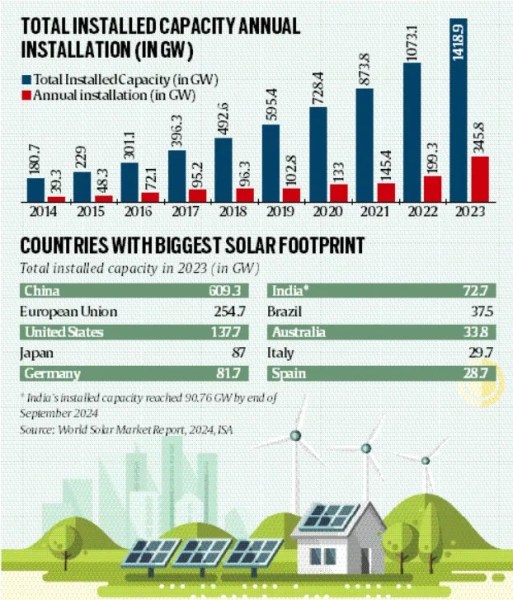
Despite significant advancements in solar energy deployment, ISA has had limited success in facilitating a large number of projects. Over the past five years, global solar power capacity has grown by over 20% annually, with a more than 30% increase reported last year, as indicated by ISA’s World Solar Market Report 2024.
-
Ajay Mathur, director general of ISA, noted that most of these new installations are concentrated in a few countries, with China leading the way. Of the 345 GW of solar capacity added in 2023, China alone contributed over 216 GW, representing more than 62% of the total.
-
More than 80% of global solar energy investments go to developed countries, China, and major emerging markets like India.
-
Many countries lack experience with large-scale energy projects, especially in solar, which is a relatively new technology. Local developers are often absent, meaning international companies are needed for investment. However, these investors typically look for policy stability and well-defined regulatory frameworks.
-
ISA has partnered with governments and local organizations to help establish regulatory frameworks, prepare power purchase agreements, and train local professionals
| India’s dedication to renewable energy and climate action was fundamental to the establishment of the ISA. With a goal of reaching 500 GW of non-fossil fuel energy by 2030, India’s renewable energy targets align with the ISA’s mission to promote solar energy worldwide. This target is part of India’s broader Panchamrit Initiative, which focuses on reducing carbon emissions and advancing sustainable development. Additionally, India is instrumental in shaping ISA’s programs and promoting global cooperation. Its extensive experience in scaling solar energy projects and developing supportive policies serves as a model for other member nations, particularly those aiming to expand energy access. By sharing best practices and technical knowledge, India seeks to support other countries in advancing their solar energy initiatives. |
- Solar energy plays a pivotal role in the global shift to renewable energy, which is essential for addressing climate change. It is the fastest-growing renewable source, though it does face the challenge of intermittency.
-
In many parts of the world, solar is now the most cost-effective energy source when sunlight is available. Projections for solar energy capacity show it could expand by 3 to 15 times by 2050, depending on the pathway chosen to reach global net-zero emissions.
-
China leads in solar PV installations, accounting for about 43% of the world's total. The top ten markets together hold over 95% of installed capacity, while less than 2% of new solar installations are in Africa—a region where nearly 80% of the 745 million people without electricity reside.
-
The ISA was founded with a broader strategic vision for India, aiming to enhance its influence, especially among the Global South, with a particular focus on African nations
- The International Solar Alliance (ISA) seeks to mobilize $1 trillion in solar investments by 2030 through its 'Towards 1000' strategy, which aims to lower both technology and financing costs.
- This ambitious plan targets energy access for 1 billion people and the installation of 1,000 GW of solar capacity. Achieving these objectives would reduce global carbon emissions by approximately 1,000 million tonnes of COâ‚‚ per year.
- ISA’s programs focus on three core areas—Analytics & Advocacy, Capacity Building, and Programmatic Support—to establish a supportive environment for solar investments and share best practices among member nations.
- ISA also drives solar adoption across sectors such as agriculture, healthcare, transportation, and power generation. By promoting policies and facilitating the exchange of successful strategies, ISA enables member countries to encourage solar energy deployment.
- The alliance has introduced innovative business models, supported governments in developing solar-friendly policies via its Ease of Doing Solar analytics, and pooled demand to reduce costs of solar technologies.
- Additionally, ISA enhances financing access by lowering investment risks, making the solar sector more attractive to private investors and paving the way toward a sustainable energy future.
- India's solar sector is growing rapidly, placing the country fifth globally in terms of solar power capacity. As of September 2024, India’s installed solar capacity has reached around 90.76 GW, a 30-fold increase over the last nine years. According to the National Institute of Solar Energy, the country’s solar potential is estimated at 748 GW.
- India’s Panchamrit targets include: (i) achieving 500 GW of non-fossil fuel energy capacity by 2030, (ii) sourcing 50% of its energy from renewables by 2030, (iii) reducing projected carbon emissions by one billion tonnes by 2030, (iv) cutting carbon intensity by 45% by 2030, and (v) reaching Net Zero by 2070.
- India has made significant progress, with its non-fossil fuel capacity increasing by 396% over the past 8.5 years, and 46.3% of its total energy capacity now comes from non-fossil sources, underscoring its dedication to sustainable energy as highlighted in international climate forums.
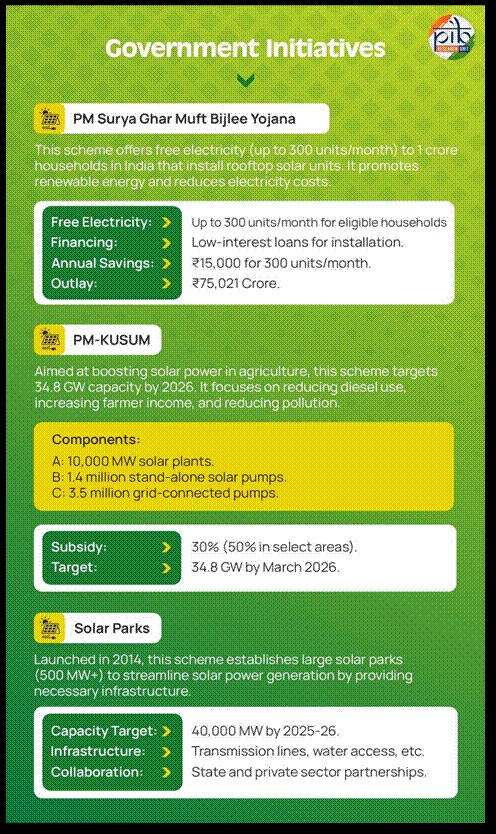
- Government policies, including the 100% FDI allowance in renewable energy projects, have enhanced the sector's appeal to investors. Additionally, technological advancements and a strong regulatory framework are creating an enabling environment for the continued expansion of solar energy projects
The International Solar Alliance (ISA) represents a pivotal shift towards a sustainable energy future, with India at the forefront of this initiative. The ISA’s mission extends beyond improving energy access and security to making substantial global carbon emissions reductions. The upcoming assembly offers an essential platform for nations to collaborate and emphasize the urgent need to accelerate solar energy adoption.
As more countries align with ISA’s mission, solar energy is positioned to play a central role in the global energy landscape. The ISA’s efforts, coupled with India’s strong commitment to solar advancement, pave the way for a cleaner, more sustainable world for future generations. Through international cooperation and innovative approaches, the ISA is well-positioned to contribute meaningfully to global climate objectives and universal energy access
|
For Prelims: General issues on Environmental ecology, Bio-diversity & climate change For Mains: GS-III: Conservation, environmental pollution and degradation, environmental impact assessment. |
|
Previous Year Questions
1.Consider the following statements: (2016)
Which of the statements given above is/are correct? (a) 1 only Answer (a)
|
INDIA-MIDDLE EAST-EUROPE ECONOMIC CORRIDOR (IMEC)
2. The Importance of Red Sea Route
The Red Sea route holds immense significance for global trade due to the strategic location of the Bab el-Mandab Strait. This narrow passage, nestled between Yemen and Djibouti, acts as a critical chokepoint, handling a staggering 12% of the world's international merchandise trade. It serves as a vital conduit for cargo ships and, crucially, almost half of all global oil shipments.
However, the ongoing Red Sea crisis has thrown a wrench into this well-oiled system. With the region in turmoil, major carriers have been forced to take a detour around Africa via the Cape of Good Hope. This significant rerouting has had several ripple effects:
- Soaring ocean freight: The added distance translates to increased fuel consumption and operational costs for shipping companies, which are inevitably passed on to consumers in the form of higher freight charges.
- Inflated insurance costs: The heightened security concerns due to the conflict have also led to increased insurance premiums for traversing the alternate route.
- Longer voyage times: The detour translates to longer journeys for vessels, leading to delayed deliveries and potential product shortages.
- Escalating transportation costs: All these factors culminate in increased transportation costs for goods, ultimately impacting businesses and consumers globally.
The Red Sea crisis acts as a stark reminder of the vulnerability of global supply chains and the critical role the Red Sea route plays in facilitating international trade. The disruption highlights the need for diversification and risk mitigation strategies to ensure the smooth flow of goods and prevent similar future disruptions from creating widespread economic repercussions.
- The Red Sea crisis has significantly impacted India's trade, particularly with European and North African countries. These regions account for a substantial portion of India's trade volume, with nearly 24% of exports and 14% of imports flowing through the disrupted Red Sea route.
- In the past year (2022-23), India's bilateral trade with these regions amounted to a staggering $189 billion and $15 billion respectively. The ongoing crisis has instilled fear and uncertainty among Indian traders, leading to a 25% reduction in cargo shipments transitioning through the Red Sea, according to the Federation of Indian Export Organisations (FIEO).
- As these disruptions continue to cause delays and cost increases in global supply chains, China is seizing the opportunity to promote an alternative route: China-Europe freight trains as part of their Belt and Road Initiative (BRI). This strategic move by China presents a potential challenge for India, potentially impacting its trade competitiveness in the future.
4. About the IMEC
The India-Middle East-Europe Economic Corridor (IMEC) is a proposed trade route aimed at enhancing economic connectivity between India, the Middle East, and Europe. Announced during the G-20 summit in 2023, the IMEC seeks to establish a seamless transportation network to facilitate the flow of goods, services, and investments across the regions involved. The corridor is envisioned as a strategic initiative to bolster trade relations, spur economic growth, and promote regional integration.
Objectives of IMEC
- IMEC aims to boost bilateral and multilateral trade among the participating countries by streamlining trade routes and reducing transportation costs.
- The corridor intends to promote infrastructure development, including the construction of ports, railways, roads, and logistics facilities, to support efficient trade operations.
- IMEC seeks to foster greater economic integration and cooperation among India, the Middle East, and Europe, thereby creating a more interconnected and interdependent economic landscape.
- By providing an alternative trade route, IMEC aims to reduce dependence on existing maritime routes and mitigate the risks associated with geopolitical tensions and disruptions in traditional trade pathways.
- The backbone of IMEC is a comprehensive transportation network comprising sea routes, land routes, railways, and highways connecting key economic centers across India, the Middle East, and Europe.
- IMEC emphasizes the development of efficient logistics and connectivity infrastructure, including ports, airports, customs clearance facilities, and multimodal transport hubs, to facilitate seamless movement of goods and services.
- Effective policy coordination and regulatory harmonization among participating countries are crucial for the smooth functioning of IMEC. This involves aligning trade policies, customs procedures, and regulatory frameworks to minimize trade barriers and bureaucratic hurdles.
- IMEC requires substantial investments in infrastructure development, technology upgrades, and capacity-building initiatives. Leveraging public-private partnerships (PPPs), international financial institutions, and sovereign wealth funds can provide the necessary financing for IMEC projects.
- The geopolitical landscape of the Middle East, including conflicts and tensions in the region, poses significant challenges to the implementation of IMEC. Political stability and security are critical factors for the success of the corridor.
- Developing the requisite infrastructure, particularly in landlocked regions and conflict-affected areas, may encounter logistical and financial challenges. Coordinating large-scale infrastructure projects across multiple jurisdictions requires careful planning and coordination.
- Harmonizing trade regulations, customs procedures, and legal frameworks among diverse countries with varying legal systems and administrative practices can be complex and time-consuming.
- The environmental sustainability of IMEC infrastructure projects, such as port development and transportation networks, must be carefully assessed to minimize adverse ecological impacts and promote sustainable development.
5. The Way Forward
|
For Prelims: India-Middle East-Europe Economic Corridor, Belt and Road Initiative, Red Sea, Cape of Good Hope
For Mains:
1. Discuss the significance of the Red Sea route for global trade, and analyze how the ongoing Red Sea crisis is impacting international supply chains. (250 Words)
2. Discuss the role of public-private partnerships (PPPs), international financial institutions, and sovereign wealth funds in financing the infrastructure development required for the IMEC. (250 Words)
|
|
Previous Year Questions
1. With reference to the “G20 Common Framework”, consider the following statements: (UPSC 2022)
1. It is an initiative endorsed by the G20 together with the Paris Club. 2. It is an initiative to support Low Income Countries with unsustainable debt. Which of the statements given above is/are correct? (a) 1 only (b) 2 only (c) Both 1 and 2 (d) Neither 1 nor 2 Answer: C
2. In which one of the following groups are all the four countries members of G20?
(UPSC 2020)
A. Argentina, Mexico, South Africa and Turkey
B. Australia, Canada, Malaysia and New Zealand
C. Brazil, Iran, Saudi Arabia and Vietnam
D. Indonesia, Japan, Singapore and South Korea
Answer: A
3. Read the statements (A) and (R) and choose the correct option. (CTET 2022)
Assertion (A): The Roman empire carried out trades with South India.
Reason (R): Roman gold coins have been found in South India.
A. Both (A) and (R) are correct and R is the correct explanation of A.
B. Both (A) and (R) are correct and R is not the correct explanation of A.
C. (A) is true, but (R) is false.
D. (A) is false but (R) is true.
Answer: A
4. Who was the first emperor of the Roman Empire? (ACC 122 CGAT 2020)
A. Tiberius B. Mark Antony C. William Shakespeare D. Augustus
Answer: D
5. Comprehension (SSC CGL Tier 2 2020)
Directions:
Read the passage and answer the questions that follow.
The Roman Empire covered a vast stretch of territory that included most of Europe as we know it today and a large part of the Fertile Crescent and North Africa. The Roman Empire embraced a wealth of local cultures and languages; that women had a stronger legal position then than they do in many countries today; but also that much of the economy was run on slave labour, denying freedom to substantial numbers of persons. From the fifth century onwards, the empire fell apart in the west but remained intact and exceptionally prosperous in its eastern half. Roman historians have a rich collection of sources to go on, which we can broadly divide into three groups: (a) texts, (b) documents and (c) material remains. Textual sources include letters, speeches, sermons, laws, and histories of the period written by contemporaries. These were usually called ‘Annals’ because the narrative was constructed on a year-by-year basis. Documentary sources include mainly inscriptions and papyri. Inscriptions were usually cut on stone, so a large number survive, in both Greek and Latin. The ‘papyrus’ was a reed-like plant that grew along the banks of the Nile in Egypt and was processed to produce sheets of writing material that was very widely used in everyday life. Thousands of contracts, accounts, letters and official documents survive ‘on papyrus’ and have been published by scholars who are called ‘papyrologists’. Material remains include a very wide assortment of items that mainly archaeologists discover (for example, through excavation and field survey), for example, buildings, monuments and other kinds of structures, pottery, coins, mosaics, even entire landscapes. Each of these sources can only tell us just so much about the past, and combining them can be a fruitful exercise, but how well this is done depends on the historian’s skill!
Which of these statements is NOT true?
A. Archaeologists make discoveries through excavations.
B. Inscriptions were carved in Greek and Latin
C. The Roman empire flourished longer in the west.
D. Texts, documents and material remains were the main sources for the historians
Answer: C
6. In the first century AD, which among the following was not a major item of Indian exports to Rome? (CDS GK 2018)
A. Pepper B. Spikenard C. Tortoiseshell D. Nutmeg
Answer: D
7. Pepper was as valued in Roman Empire that as it was called (CTET 2013)
A. Black magic B. Black charm C. Black stone D. Black gold
Answer: D
8. In the middle of the first century BC, under ________, a high-born military commander, the ‘Roman Empire’ was extended to present-day Britain and Germany. (SSC JE CE 2017)
A. Alexander B. Julius Caesar C. Xerxes D. Caligula
Answer: B
9. Comprehension
Direction: Read the passage carefully and select the best answer to each question out of the given four alternatives.
The Silk Road was a network of trade routes which connected the East and West, and was central to the economic, cultural, political, and religious interactions between these regions from the 2nd century BCE to the 18th century. The Silk Road primarily refers to the land routes connecting East Asia and Southeast Asia with South Asia, Persia, the Arabian Peninsula, East Africa and Southern Europe. The Silk Road derives its name from the lucrative trade in silk carried out along its length, beginning in the Han dynasty in China. The Silk Road trade played a significant role in the development of the civilizations of China, Korea, Japan, the Indian subcontinent, Iran, Europe, the Horn of Africa and Arabia, opening long-distance political and economic relations between the civilizations. Though silk was the major trade item exported from China, many other goods and ideas were exchanged, including religions (especially Buddhism), syncretic philosophies, sciences, and technologies like paper and gunpowder. So, in addition to economic trade, the Silk Road was a route for cultural trade among the civilizations along its network. Diseases, most notably plague, also spread along the Silk Road. Some remnants of what was probably Chinese silk dating from 1070 BCE have been found in Ancient Egypt. The Great Oasis cities of Central Asia played a crucial role in the effective functioning of the Silk Road trade. The originating source seems sufficiently reliable, but silk degrades very rapidly, so it cannot be verified whether it was cultivated silk (which almost certainly came from China) or a type of wild silk, which might have come from the Mediterranean or Middle East. Archeological sites such as the Berel burial ground in Kazakhstan, confirmed that the nomadic Arimaspians were not only breeding horses for trade but also great craftsmen able to propagate exquisite art pieces along the Silk Road.
According to the passage, The Silk Road primarily refers to the land routes connecting to one another. Which routes were not linked by it? (DSSSB Junior Stenographer 2021)
A. East Asia with Southern Europe
B. East Asia with South Asia
C. South America and South Africa
D. East Asia with Persia
Answer: C
10. The term “Silk Route” in the ancient period refers to (CTET 2022)
A. the travelling route of traders from China to other countries carrying silk.
B. Sea routes connecting countries in which silk traders sold their products.
C. roads connecting all the countries in which mulberry plants were cultivated.
D. road and sea routes in which silk products were traded.
Answer: A
11. Who started the ‘Silk-route’ (Marg) for Indians? (UKPSC RO/ARO 2016)
A. Kanishka B. Harshwardhan C. Ashok D. Fahien
Answer: A
12. With reference to ancient South India, Korkai, Poompuhar, and Muchiri were well-known as (UPSC 2023)
A. capital cities B. ports C. centres of iron-and-steel D. making shrines of Jain Tirthankaras
Answer: B
13. Two thousand years ago, a trader narrates that he has been to Gaza, Petra and Apologos. Which of the following trade routes has he travelled through? (CTET 2022)
A. Route controlled by Roman emperors
B. Route under the rulers of Persia
C. Route controlled by Kushanas
D. Route under the rulers of China
Answer: A
14. Red sea is an example of: (UPPSC Civil Service 2017)
A. Volcanic valley B. Eroded valley C. Axial trough D. U-shaped valley
Answer: C
15. In which Indian state was the ancient sea port 'Muziris' located? (UP Police SI 2017)
A. Kerala B. Gujarat C. Karnataka D. Tamil Nadu
Answer: A
16. Regarding the Indus Valley Civilization, consider the following statements: (UPSC 2011)
1. It was predominantly a secular civilization and the religious element, though present, did not dominate the scene.
2. During this period, cotton was used for manufacturing textiles in India.
Which of the statements given above is/are correct?
A. 1 only B. 2 only C. Both 1 and 2 D. Neither 1 nor 2
Answer: C
|
ANTIMICROBIAL RESISTANCE
1. Context
Prime Minister Narendra Modi, Home Minister Amit Shah and Health Minister JP Nadda have recently raised awareness about Anti-Microbial Resistance (AMR) stemming from antibiotic overuse, highlighting how India is facing a silent public health crisis.
2. What is Anti Microbial Resistance?
Antimicrobial Resistance (AMR) occurs when bacteria, viruses, fungi, and parasites change over time and no longer respond to medicine making infections harder to treat and increasing the risk of disease spread severe illness, and death.

3. Emergence and spread of AMR
- AMR occurs naturally over time, usually through genetic changes.
- Antimicrobial-resistant organisms are found in people, animals, food, plants, and the environment (in water, soil, and air).
- They can spread from person to person or between people and animals, including from food of animal origin.
- The main drivers of antimicrobial resistance include the misuse and overuse of antimicrobials, lack of access to clean water, sanitation, and hygiene (WASH) for both humans and animals, and poor infection and disease prevention and control in healthcare facilities and farms. Poor access to quality, affordable medicines, vaccines, and diagnostics, lack of awareness and knowledge, and lack of enforcement of legislation.
4. Factors causing AMR in India
- The high disease burden
- The rising income
- The easy and cheap availability of these medicines to the public.
- The uncontrolled sales of antibiotics
- Poor Public health infrastructure
- Lack of awareness regarding the misuse of antibiotics.
6. Government Initiatives that help to curb Antimicrobial Resistance In India
- Through the Swacch Bharat Program, the government has taken active steps to improve hygiene and sanitation and reduce the environmental spread of pathogens.
- Vaccination is an equally important public health measure, and through Mission Indradhaniush, India has set itself an ambitious goal of increasing routine immunization coverage to 90% within just a few years.
6.1 Red Line Campaign
7. WHO's Global plan on Anti-Microbial Resistance?
- To improve awareness and understanding of antimicrobial resistance through effective communication, education, and training.
- To Strengthen the knowledge and evidence base through surveillance and research.
- To reduce the incidence of infection through effective sanitation, hygiene, and infection prevention measures.
- To Optimize the use of antimicrobial medicines in human and animal health.
- To develop the economic case for sustainable investment that takes account of the needs of all countries and to increase investment in new medicines, diagnostic tools, vaccines, and other interventions.
8. Global efforts
|
For Prelims: Food and Agriculture Organization (FAO), UN Environment Programme, the World Health Organization (WHO), World Organisation for Animal Health, Mission Indradhaniush, Red Line Campaign.
For Mains: 1.Antimicrobial resistance (AMR) is considered one of the most significant challenges the world faces today. Discuss.
|
|
Previous Year Questions
1.Which of the following are the reasons for the occurrence of multi-drug resistance in microbial pathogens in India? ( UPSC CSE 2019)
Select the correct answer using the code given below. (a) 1 and 2 Answer: (b) |
CENSUS 2027
-
The Indian Census is the world’s largest administrative and statistical exercise. The Office of the Registrar General and Census Commissioner of India (ORG&CCI), under the Ministry of Home Affairs, is tasked with conducting the decennial census.
-
As per the Census India website, prior to 1951, a temporary Census Organisation was set up for each census. In 1948, the Census Act was enacted to establish a structured process for conducting population censuses and to define the responsibilities of census officials.
-
To systematically collect data on population size, growth, and related statistics, the Government of India decided in May 1949 to create an organisation within the Ministry of Home Affairs under the Registrar General and ex-Officio Census Commissioner.
-
This body was tasked with generating population statistics, including vital statistics and census data, and was later given the responsibility to implement the Registration of Births and Deaths Act, 1969 across the country.
-
Mritunjay Kumar Narayan is the current RGI, assuming office on November 1, 2022. His tenure was extended last year until August 4, 2026, or until further orders.
-
According to the Census India website, the RGI’s office oversees the following key functions:
-
Housing & Population Census: The Census Commissioner is the statutory authority responsible for conducting the Housing & Population Census under the Census Act, 1948 and its rules.
-
Civil Registration System (CRS): As Registrar General of India under the Registration of Births & Deaths (RBD) Act, 1969, the RGI ensures the compulsory registration of births and deaths, coordinating civil registration and vital statistics across all States and Union Territories.
-
National Population Register (NPR): Prepared under the Citizenship Rules, 2003, the NPR collects information on all individuals who are usually resident in India, as part of the broader Citizenship Act, 1955 framework.
-
Mother Tongue Survey: This survey records mother tongues consistently reported across multiple Census decades and documents linguistic features of selected languages.
-
Sample Registration System (SRS): The ORG&CCI implements the SRS, a large-scale sample survey conducted semi-annually to estimate vital statistics such as birth rate, death rate, infant mortality rate, and maternal mortality rate at the state level
-
-
India’s first nationwide census, though non-synchronous, was carried out in 1872. It attempted to count people across most regions of the country, but some areas under British rule were not covered.
-
The first synchronous census of India was conducted in 1881 under the supervision of W.C. Plowden.
-
The 1881 Census represented a major step toward a modern, coordinated census system, focusing not only on complete population coverage but also on the classification of demographic, social, and economic features
-
The Census 2027 will mark India’s 16th decennial Census overall and the eighth since Independence. The exercise will gather population data at the village, town, and ward levels, covering parameters such as housing conditions, amenities, assets, demographic characteristics, religion, Scheduled Castes and Scheduled Tribes, language, literacy and education, economic activity, migration, and fertility.
-
On June 16, the Centre officially notified its plan to conduct the Census 2027. This marks the first time a decennial Census has been delayed by six years. Some key features of the upcoming Census include:
-
Digital Census: For the first time, Census 2027 will be fully digital, with data collected via dedicated mobile applications. Citizens will also have the option to self-enumerate, and caste data will be recorded electronically.
-
Caste enumeration: On April 30, the Cabinet Committee on Political Affairs (CCPA) approved the inclusion of caste data in the Census.
-
Real-time monitoring and management: The Registrar General of India (RGI) is developing a Census Monitoring & Management System (CMMS) website to enable real-time oversight of the exercise. Over 35 lakh enumerators and supervisors will be deployed, which is more than 30% higher than the 27 lakh personnel used for the 2011 Census
-
5. NPR
- The NPR, unlike the Census, is a comprehensive identity database of every "usual resident" in the country and the data proposed to be collected at the family level can be shared with States and other government departments.
- Though Census also collects similar information, the Census Act of 1948 bars sharing any individual's data with the State or Centre and only aggregate data at the administrative level can be released.
- According to Citizenship Rules 2003 under the Citizenship Act, 1955, NPR is the first step towards a compilation of the National Register of Indian Citizens (NRIC/NRC).
- Assam is the only State where an NRC has been compiled based on the directions of the Supreme Court, with the final draft of Assam's NRC excluding 19 lakhs of the 3.29 crores applicants.
- Assam Government has rejected the NRC in its current form and demanded re-verification of 30 per cent of names included in the NRC in areas bordering Bangladesh and 10 per cent in the remaining State.
- In 2020, the NPR was opposed by several State governments such as West Bengal, Kerala, Rajasthan, Odisha, Bihar, Andhra Pradesh, Telangana, Punjab and Chhattisgarh and Civil Society Organisations due to its link with the proposed NRC as it might leave many people stateless for want of legacy documents.
- There are apprehensions that the Citizenship Amendment Act 9 (CAA), 2019 allows citizenship based on religion to six undocumented religious communities from Pakistan, Afghanistan and Bangladesh who entered India on or before December 31, 2014, will benefit non-Muslims excluded from the proposed citizens' register, while excluded.
- Muslims will have to prove their citizenship. The government has denied that the CAA and NRC are linked and there are currently any plans to compile a countrywide NRC.
5.1. The current status of NPR
- The NPR was first collected in 2010 when the Congres government was in power at the Centre.
- It was updated in 2015 and already has details of 119 crore residents.
- In March 2020, the Ministry of Home Affairs (MHA) amended the Census Rules framed in 1990 to capture and store the Census data in an electronic form and enabled self-enumeration by respondents.
- The NPR is scheduled to be updated with the first phase of Census 2021.
- For this phase (house listing and household phase), 31 questions have been notified, while for the population enumeration, the second and main phase 28 questions have been finalised but are yet to be notified.
- The NPR is expected to collect details on 21 parameters of all family members, up from 14 questions in 2010 and 2015.
- The Sub-heads include passport number, relationship to head of the family, whether divorced/ widowed or separated, mother tongue if non-worker, cultivator, labourer, government employee, daily wage earner among others.
- The form also has a column on Aadhar, mobile phone, Voter ID and driver's licence.
- Though the government has claimed that the NPR form has not been finalised yet, the sample form is part of the Census of India 2021 Handbook for Principal/District Census Officers and Charge Officers in 2021.
- The NPR has retained contentious questions such as "mother tongue, place of birth of father and mother and last place of residence", possible indicators to determine inclusion in the Citizenship register.
- The questions were opposed by the State governments of West Bengal, Kerala, Rajasthan and Odisha in 2020.
- The final set of questions of both the phases and NPR was asked during a pre-test exercise in 2019 in 76 districts in 36 States and Union Territories covering a population of more than 26 lakhs.
|
For Prelims: NPR, CAA, Census, Covid-19, Expenditure Finance Committee, Registrar General of India, Registration of Births and Deaths Act, of 1969, The Treatise on Indian Censuses Since 1981, Assam,
For Mains:
1. How can citizens file Census details online? Explain the norms being laid down and discuss the reasons for National Population Register being made compulsory for those who want to fill out the form digitally. (250 Words)
|
|
Previous Year Questions
Prelims:
1. Consider the following statements: (UPSC 2009)
1. Between Census 1951 and Census 2001, the density of the population of India has increased more than three times.
2. Between Census 1951 and Census 2001, the annual growth rate (exponential) of the population of India has doubled.
Which of the statements given above is/are correct?
(a) 1 only (b) 2 only (c) Both 1 and 2 (d) Neither 1 nor 2
Answer: D
2. In the context of vaccines manufactured to prevent COVID-19 pandemic, consider the following statements: (UPSC 2022)
1. The Serum Institute of India produced COVID-19 vaccine named Covishield using mRNA platform.
2. Sputnik V vaccine is manufactured using vector based platform.
3. COVAXIN is an inactivated pathogen based vaccine.
Which of the statements given above are correct?
A. 1 and 2 only B. 2 and 3 only C. 1 and 3 only D. 1, 2 and 3
Answer: B
3. Sinovac given for Covid-19 is a (UPPSC Combined State Exam 2022)
A. Protein sub-unit
B. Non-replicating viral vector
C. Whole virus vaccine
D. mRNA vaccine
Answer: C
4. Along with the Budget, the Finance Minister also places other documents before the Parliament which Include "The Macro Economic Framework Statement". The aforesaid document is presented because this is mandated by (UPSC 2020)
A. Long-standing parliamentary convention
B. Article 112 and Article 110 (1) of the Constitution of India
C. Article 113 of the Constitution of India
D. Provisions of the Fiscal Responsibility and Budget Management Act, 2003
Answer: D
5. Who is the Census Commissioner of India in 2021? (ICAR Technician 2022)
A. Dr Vivek Joshi
B. Dr C Chandramouli
C. Shri Sailesh
D. DK Sikri
Answer: A
6. The Registration of Birth and Death Act came into force in the year _____. (UPSSSC Junior Assistant 2020)
A. 1964 B. 1969 C. 1972 D.1981
Answer: B
7. Consider the following States: (UPSC 2022)
1. Andhra Pradesh
2. Kerala
3. Himachal Pradesh
4. Tripura
How many of the above are generally known as tea-producing States?
A. Only one State
B. Only two States
C. Only three States
D. All four States
Answer: C
8. Consider the following rivers (UPSC 2014)
1. Barak
2. Lohit
3. Subansiri
Which of the above flows/flow through Arunachal Pradesh?
A. 1 only B.2 and 3 only C. 1 and 3 only D. 1, 2 and 3
Answer: B
Mains:
1. Two parallel run schemes of the Government, viz the Adhaar Card and NPR, one as voluntary and the other as compulsory, have led to debates at national levels and also litigations. On merits, discuss whether or not both schemes need run concurrently. Analyse the potential of the schemes to achieve developmental benefits and equitable growth. (UPSC 2014)
|


