
JEHOVAH'S WITNESSES
Two people were killed and scores injured after a series of blasts at a Sunday prayer convention of the Jehovah’s Witnesses sect near Kochi.
The incident took place at the Zamra International Convention and Exhibition Centre at Kalamassery, where around 2,500 faithful from across the state had gathered for a prayer session
2. Who are Jehovah's Witnesses?
- Jehovah’s Witnesses are a Christian sect, but do not believe in the Holy Trinity (the doctrine that God exists in three equal persons of the Father, the Son (Jesus Christ) and the Holy Spirit)
- They worship Jehovah as “the one true and Almighty God, the Creator”, who is “the God of Abraham, Moses, and Jesus”. They believe Jesus Christ to be the “King of God’s Kingdom in heaven”, but not as the Almighty God
- They base their beliefs only on the text of the Bible, which they see as the word of God. They don’t celebrate Christmas or Easter, because they believe such festivals to be inspired by Pagan traditions
- Jehovah’s Witnesses are known for their evangelical work, for which they go door to door, to spread “The Truth”
- They believe the end of the world is near, and the “Kingdom of God” will “replace human governments and accomplish God’s purpose for the earth.” The denomination has millions of followers worldwide
- The origins of the sect lie in a Bible Student movement started in the 1870s by American pastor Charles Taze Russell
- The Governing Body of Jehovah’s Witnesses is located in Warwick, New York. The main body to disseminate the doctrines of the sect is called the Watch Tower Bible and Tract Society of Pennsylvania, also headquartered in Warwick
- India has about 56,747 Ministers who teach the Bible. “Jehovah’s Witnesses have been present in India since 1905
- They established an office in 1926 in Bombay and obtained legal registration in 1978. The Witnesses benefit from the guarantees of India’s constitution, which include the right to practice, profess, and propagate one’s faith
- Jehovah's Witnesses are strict monotheists who believe in one God, whom they call "Jehovah." They reject the Christian doctrine of the Trinity, believing that God is a single divine being.
- They consider the Bible to be the inspired word of God and the ultimate authority in matters of faith and doctrine. They primarily use their own translation of the Bible, known as the New World Translation of the Holy Scriptures
- Jehovah's Witnesses believe in the imminent arrival of God's Kingdom on Earth. They emphasize the need to prepare for the end times and actively engage in evangelism and preaching to share their beliefs
- The Supreme Court, in its 1986 verdict, granted protection to three children belonging to the sect, who did not join in the singing of the National Anthem at their school.
- The court held that forcing them to sing the Anthem violated their fundamental right to religion under Article 25 of the Constitution
- The Supreme Court then ruled that “Article 25 (“Freedom of conscience and free profession, practice and propagation of religion”)…[was] incorporated in recognition of the principle that the real test of a true democracy is the ability of even an insignificant minority to find its identity under the country’s Constitution.”
- Their members in India have at times been accused of trying to convert people due to their evangelical work
- The court noted that according to the New Encyclopaedia Britannica’ (Macropaedia) Jehovah’s Witnesses believe that “the Watch Tower Bible and Tract Society, their legal agency and publishing arm, exemplifies the will of God and proclaims the truths of the Bible against the evil triumvirate of organised religion, the business world, and the state.”
- The Supreme Court also cited a ruling of the Australian High Court in Adelaide Company of Jehovah’s Witnesses v The Commonwealth, which was a challenge against 1941 Australian law that booked the sect for subversive activities
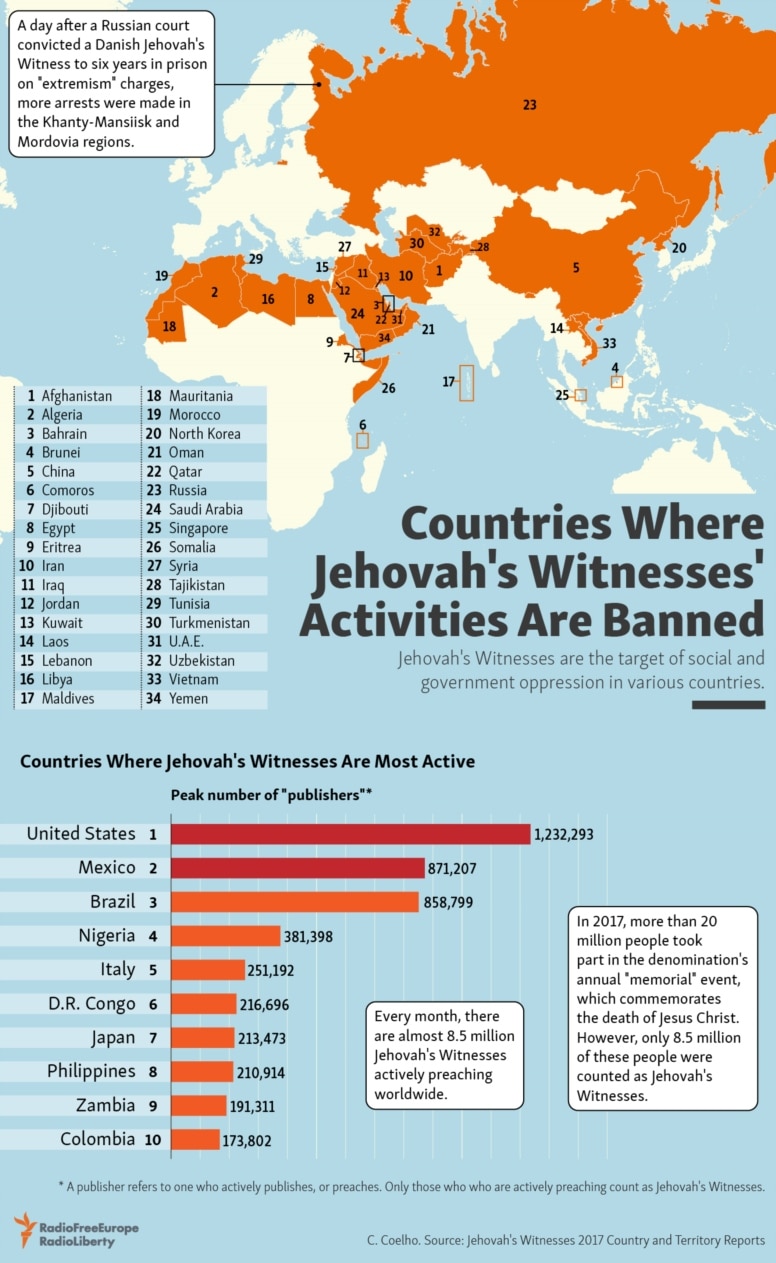
ehovah's Witnesses have faced bans or restrictions in several countries at various points in history due to objections from governments or religious authorities. It's important to note that these bans or restrictions can change over time, so the status of Jehovah's Witnesses in specific countries may have evolved since my knowledge cutoff date in January 2022. As of that time, some countries where Jehovah's Witnesses have faced significant restrictions or bans include:
-
Russia: In 2017, the Russian government banned the activities of Jehovah's Witnesses, declaring their organization an extremist group. This led to the closure of their administrative center and local congregations, as well as the arrest and imprisonment of some members.
-
China: Jehovah's Witnesses have faced government restrictions in China, with reports of arrests, detentions, and harassment of members. The Chinese government views their activities as illegal and considers them a banned religious organization.
-
Singapore: The Singaporean government has banned the Jehovah's Witnesses since 1972, and their activities are considered illegal. This is primarily due to their refusal to salute the flag, which is a requirement in Singapore.
-
Eritrea: In Eritrea, the government has banned all religious groups that are not officially recognized, including Jehovah's Witnesses. Members have faced persecution and imprisonment for their religious activities.
-
Tajikistan: The government of Tajikistan has banned Jehovah's Witnesses, and their activities are considered illegal. Members have faced harassment and detention.
-
Turkmenistan: Jehovah's Witnesses have been banned in Turkmenistan since 1997, and their activities are prohibited. Members have faced persecution, including imprisonment.
-
Saudi Arabia: In Saudi Arabia, the government strictly enforces Islamic law and does not allow the practice of religions other than Islam. As a result, Jehovah's Witnesses, along with other religious groups, are effectively banned, and their activities are not tolerated.
Jehovah's Witnesses have faced criticism and controversy over the years, particularly regarding their strict disciplinary practices, including shunning, as well as their stance on medical treatments like blood transfusions. They have also been involved in legal battles to protect their religious freedoms and practices
Source: Indianexpress


